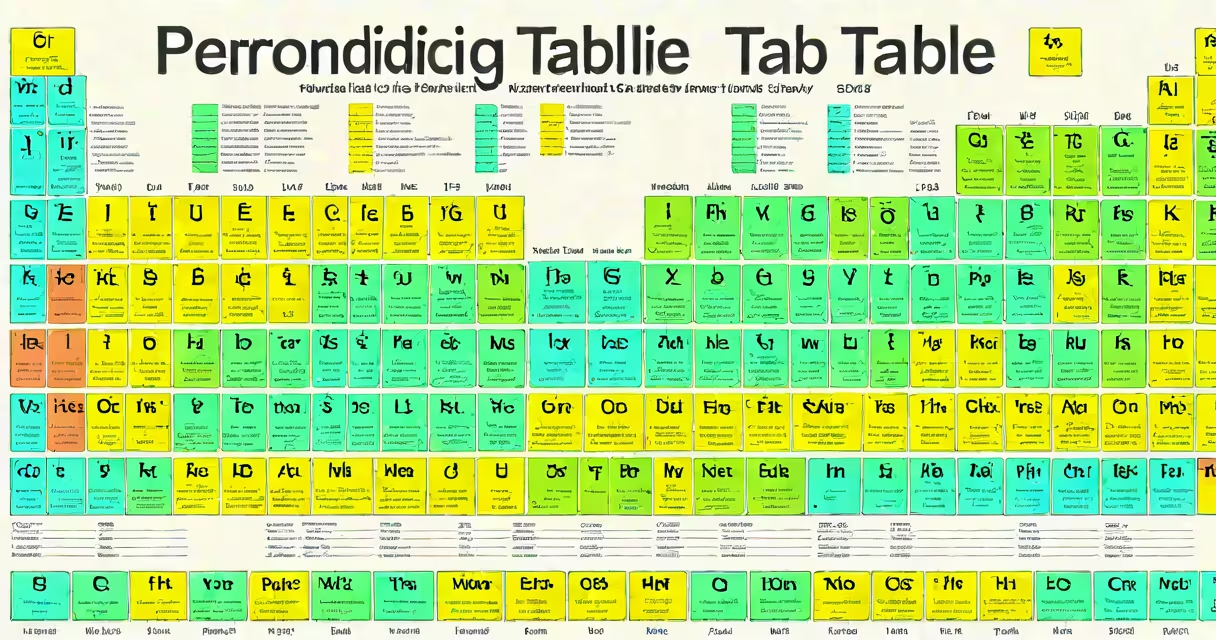
The periodic table showing metals and non metals is a structured layout of chemical elements arranged by atomic number, electron configuration, and recurring chemical properties, with metals occupying the left and center areas and nonmetals confined to the upper right. This visual division reveals patterns in elemental behavior, such as conductivity, malleability, and reactivity.
Elements are grouped based on shared physical and chemical traits. Metals dominate the left side and central block, including alkali metals, alkaline earth metals, transition metals, and post-transition metals. Nonmetals appear in the upper right, including halogens, noble gases, and key biological elements like carbon, nitrogen, and oxygen. The boundary between them runs diagonally from boron to polonium, with metalloids like silicon and arsenic forming a bridge.
Each element's position reflects its electron shell structure. Metals lose electrons easily, forming cations and conducting electricity. Nonmetals gain or share electrons, forming covalent bonds and resisting current flow. For example, sodium (Na) in group 1 readily donates one electron, making it highly reactive and soft enough to cut with a knife. In contrast, chlorine (Cl) in group 17 accepts one electron to achieve stability, forming salts like sodium chloride.
The periodic table shows metals and nonmetals through distinct zones. The majority of elements-95 out of 118-are metals. They include iron (Fe), copper (Cu), gold (Au), and uranium (U). These elements typically have high melting points, luster, and ductility. Most metals are solids at room temperature except mercury (Hg), which is liquid.
Nonmetals-22 elements-include hydrogen (H), carbon (C), nitrogen (N), oxygen (O), fluorine (F), and neon (Ne). They tend to be brittle, poor conductors, and often exist as gases or liquids. Oxygen makes up 21% of Earth's atmosphere. Carbon forms the core of organic molecules. Fluorine is the most electronegative element, pulling electrons strongly in compounds.
Between metals and nonmetals lie metalloids-six elements with mixed properties. Silicon (Si) conducts electricity under certain conditions, making it essential in semiconductors. Arsenic (As) is toxic but used in alloys and glass. These elements blur the line between metallic and nonmetallic behavior, demonstrating that classification isn't always binary.
Grouping elements by their metal/nonmetal status reveals functional differences in chemistry and industry.
| Type | Examples | Key Properties | Common Uses |
|---|---|---|---|
| Metal | Copper (Cu), Iron (Fe), Aluminum (Al) | High electrical conductivity, malleable, shiny | Wiring, construction, aircraft parts |
| Nonmetal | Oxygen (O), Nitrogen (N), Sulfur (S) | Low conductivity, brittle in solid form | Respiratory gas, fertilizers, rubber vulcanization |
| Metalloid | Silicon (Si), Germanium (Ge), Antimony (Sb) | Variable conductivity, semiconductor behavior | Microchips, solar cells, flame retardants |
One non-obvious fact: the term "nonmetal" includes elements that are gaseous at room temperature-hydrogen, nitrogen, oxygen, fluorine, chlorine, and the noble gases. This contrasts with metals, which are mostly solid. Yet hydrogen, despite being a nonmetal, shares some properties with metals under extreme pressure, such as becoming metallic in the cores of gas giants like Jupiter.
A common confusion is equating "metal" with "heavy." Lead (Pb) is dense and toxic, but not all metals are heavy. Lithium (Li), the lightest metal, floats on oil. Conversely, some nonmetals like iodine (I₂) are solid and dark purple, resembling metals visually but lacking conductivity.
Understanding the periodic table showing metals and non metals enables accurate predictions about compound formation. For example, sodium (metal) reacts violently with water to produce hydrogen gas and sodium hydroxide. Chlorine (nonmetal) reacts with sodium to form sodium chloride-a stable ionic compound. This reaction demonstrates how opposite behaviors lead to bonding.
In materials science, engineers select metals for strength and durability-such as titanium in aerospace components-or nonmetals for lightweight and corrosion resistance-like carbon fiber composites. Metalloids like silicon are critical in electronics due to their tunable conductivity.
I once built a simple circuit using copper wire and a graphite pencil lead. Copper conducted electricity flawlessly. Graphite, a form of carbon (a nonmetal), conducted weakly-enough to dim an LED. This hands-on test confirmed the table's predictive power: metals conduct, nonmetals generally do not.
Some assume all metals are shiny and hard. But cesium (Cs), a metal, is so soft it can be cut with a knife and melts at 28°C. Its low melting point defies the stereotype of metallic rigidity.
Another error is treating metalloids as purely intermediate. While they exhibit both metallic and nonmetallic traits, their behavior varies. Silicon conducts electricity better than nonmetals but less than metals. Its semiconductor properties make it indispensable in computing devices.
Also, not all elements in the upper right are nonmetals. Astatine (At), though in the halogen group, is radioactive and extremely rare. Its properties are poorly understood due to short half-life-making it a borderline case in classification.
The International Union of Pure and Applied Chemistry (IUPAC) maintains standardized element names and classifications. According to IUPAC's 2021 report, the periodic table's structure reflects quantum mechanical principles governing electron orbitals and energy levels.
For deeper study, explore how electron configurations determine metallic character. Elements with few valence electrons (like potassium, K) readily lose them-defining metal behavior. Those needing one or two electrons (like oxygen, O) are nonmetals. The periodic table showing metals and non metals thus maps directly to atomic structure.