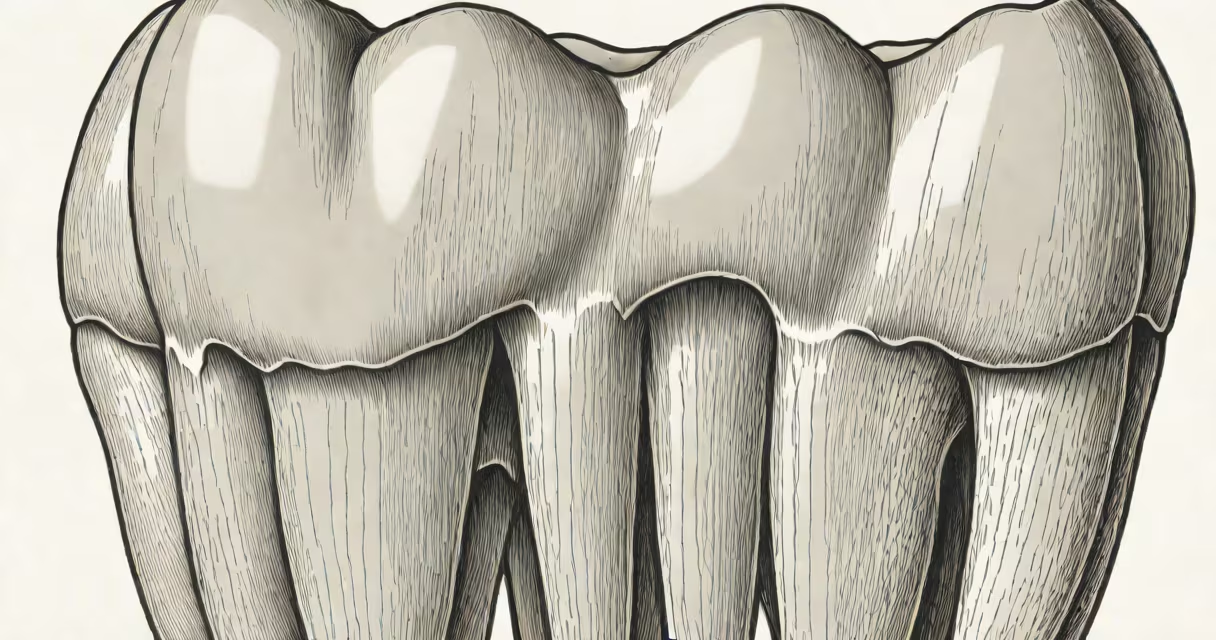
A sharp molar tooth is a posterior tooth with prominent cusps designed for crushing and grinding food. Its sharpness comes from the raised ridges and points on the chewing surface, which break down tough textures during mastication. This structure evolved to handle fibrous plant material and meat in ancestral diets.
Molars are the largest teeth in the human mouth, typically numbering six per jaw. The third molar-commonly called a wisdom tooth-is the last to emerge, often between ages 17 and 25. The term "sharp" refers to the angular geometry of the cusps, not to the tooth's ability to cut. These cusps are formed from layers of dentin and covered in enamel, the hardest substance in the human body.
Enamel protects the tooth from mechanical stress and acid erosion. When enamel wears down through abrasion, acid exposure, or decay, the underlying dentin becomes vulnerable. Dentin contains microscopic tubules that transmit pressure and temperature signals directly to the pulp-the inner core housing nerves and blood vessels. Once the pulp is exposed, even mild stimuli can trigger sharp, localized pain.
During mastication, the upper and lower molars interlock in a pattern known as occlusion. The upper molars have four or five cusps arranged in a W-shaped pattern, while lower molars typically have two or three. This arrangement allows for efficient grinding of food into smaller particles.
When biting down on hard foods like nuts or raw vegetables, the force is distributed across multiple cusps. This reduces stress on any single point. However, if a cusp fractures due to trauma or decay, the remaining edges can become jagged and irritate the tongue or cheek. A fractured cusp may also expose dentin or pulp, leading to acute sensitivity or spontaneous pain.
For example, a person eating a hard pretzel may feel sudden sharp pain when biting down. If the tooth has a cavity near the cusp, the impact can compress fluid within the dentinal tubules, triggering a nerve response. This mechanism explains why cold liquids or sweet foods often worsen the discomfort.
Molars are classified by position and function. The first and second molars are primary chewers, while third molars (wisdom teeth) serve no essential role in modern human diets. Not all molars are equally sharp-some have flatter surfaces adapted for grinding rather than shearing.
| Type | Number per Jaw | Cusps | Function | Common Issues |
|---|---|---|---|---|
| First Molar | 2 | 4-5 | Initial grinding | Cavity, fracture |
| Second Molar | 2 | 4-5 | Secondary processing | Recurrent decay, gum recession |
| Third Molar (Wisdom) | 2 | 3-4 | Minimal use | Impaction, infection |
Some individuals develop supernumerary molars-extra teeth beyond the standard 32. These occur in about 0.1% of the population and can disrupt alignment. A 2021 study published in the Journal of Oral and Maxillofacial Surgery found that 68% of supernumerary molars were located in the mandibular third molar region, often causing impaction and pain.
People often mistake a sharp molar tooth for a canine or incisor. Canines are pointed front teeth used for tearing, while incisors slice. Molars are flat and broad with multiple cusps. The confusion arises because both canines and molars have sharp edges, but their functions differ.
Another misconception is that sharpness equals danger. A sharp molar tooth is not inherently harmful-it's a structural feature for efficient chewing. However, when decay or trauma compromises the integrity of the tooth, the sharp edges can cause injury to soft tissues. For instance, a broken cusp can lacerate the inside of the cheek, especially during sleep or unconscious chewing.
Not all sharp pain in a molar comes from the tooth itself. Referred pain from sinus infections or temporomandibular joint (TMJ) disorders can mimic dental issues. A 2020 review in Oral Surgery, Oral Medicine, Oral Pathology and Oral Radiology reported that 12% of patients presenting with molar pain had no dental pathology-diagnoses included trigeminal neuralgia and maxillary sinusitis.
In 2022, a 34-year-old patient visited a clinic complaining of severe, intermittent pain in the lower left molar. The pain lasted 15-30 seconds and was triggered by cold water. Clinical examination revealed a large cavity extending into the pulp chamber. Radiographs confirmed decay reaching the root canal.
The dentist diagnosed irreversible pulpitis-a condition where the nerve tissue inflames and dies. Without treatment, the infection could spread to surrounding bone. The patient underwent root canal therapy, removing the infected pulp and sealing the canal. After treatment, the sharp pain resolved completely.
This case illustrates how a seemingly minor cavity can progress to a sharp molar tooth issue requiring urgent care. Early intervention prevents complications such as abscess formation or tooth loss.
I once observed a patient who ignored a small chip on a molar for six months. The chip gradually expanded due to constant grinding. Eventually, the tooth became sensitive to air and developed a sharp, stabbing pain. Upon examination, the dentin was exposed, and the nerve responded to thermal changes. After placing a protective filling, the pain subsided within 48 hours.
This experience reinforced that early signs-like increased sensitivity or a rough spot on the tooth-are not normal. They indicate structural compromise. Ignoring them risks advancing to irreversible damage.
Sharp molar tooth pain lasting more than 48 hours, especially with swelling or fever, requires prompt evaluation. Persistent pain suggests infection or nerve involvement. Even mild discomfort should not be dismissed, particularly if it worsens over time.
For immediate relief, avoid hot, cold, or sugary foods. Over-the-counter analgesics like ibuprofen reduce inflammation and dull pain. However, they do not treat the underlying cause. A visit to a dentist is necessary for diagnosis and treatment.
Understanding the structure and function of a sharp molar tooth helps clarify why it can become a source of intense discomfort. Its design supports complex chewing tasks, but damage to enamel or dentin exposes nerves, leading to sharp pain. Recognizing early warning signs enables timely care and prevents long-term dental issues.