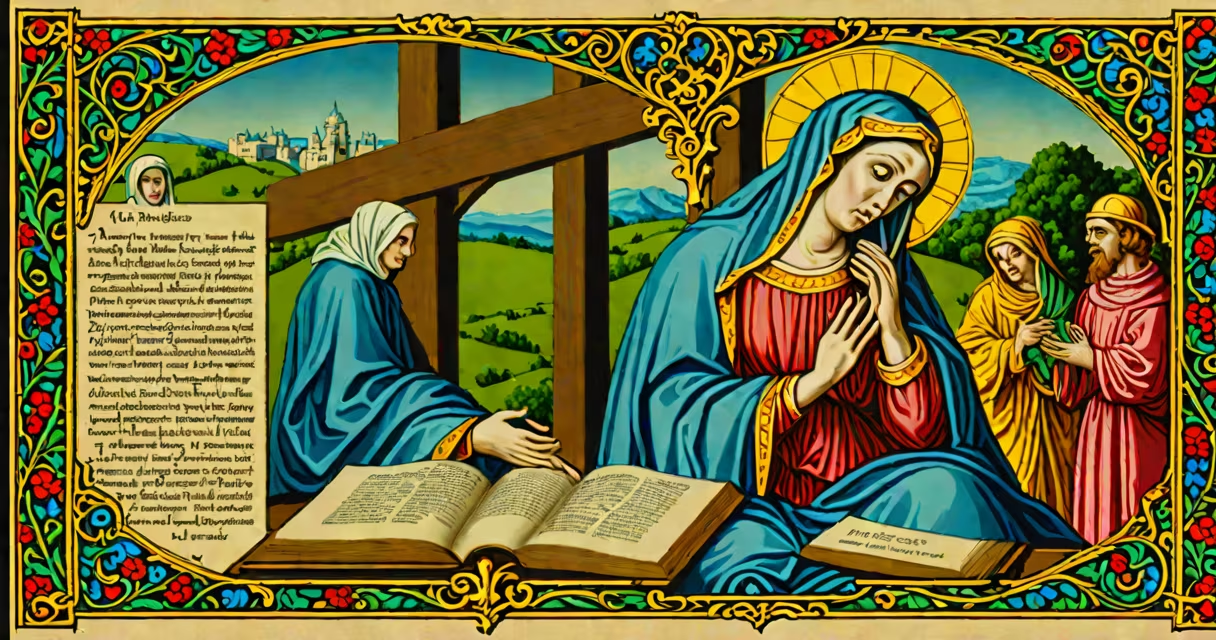
The "Stabat Mater Dolorosa" is a 13th-century Latin hymn that depicts the Virgin Mary standing at the foot of the cross during Christ's crucifixion, expressing her sorrow and spiritual union with his suffering. It is sung in Catholic liturgical traditions, especially during Holy Week and the feast of Our Lady of Sorrows.
Composed around 1260 by Jacopone da Todi, a Franciscan friar known for his intense mystical writings, the hymn uses poetic symmetry and theological precision. Each verse pairs Mary's emotional state with Christ's physical torment, creating a mirror of grief between mother and son. The original text consists of twenty stanzas, each following a strict poetic meter derived from medieval Latin lyric forms.
Despite its somber theme, the hymn avoids despair. Instead, it frames Mary's pain as redemptive-her sorrow becomes a path to grace. This duality reflects the core of Christian mysticism: suffering as major. The hymn was adopted into the Roman Breviary in 1727 and remains part of the liturgical calendar for the Friday before Passion Sunday.
The "Stabat Mater Dolorosa" follows a consistent metrical pattern: each line contains eight syllables, arranged in a trochaic tetrameter. This rhythmic structure makes it easy to chant or sing in unison, supporting its use in communal worship. The language blends biblical references with theological abstraction-Mary is described not just as grieving, but as "the mother of mercy" and "the one who bore the Son of God."
It is traditionally sung during the Office of Readings or Matins on the Friday of Holy Week. In many churches, it is performed by choir or congregation in a slow, solemn tempo. The melody, often attributed to the 14th-century composer Giovanni da Firenze, features a descending melodic line in the first half of each stanza, symbolizing descent into sorrow.
Modern performances vary widely. Some choirs use Gregorian chant, others employ Baroque settings by composers like Pergolesi and Haydn. The Pergolesi setting, composed in 1736, is among the most frequently performed. It lasts about 12 minutes and features a soprano soloist, strings, and harpsichord. The piece was later adapted into a film score for *The Passion of the Christ* (2004), underscoring scenes of Mary's anguish.
Over 1,000 musical settings of the "Stabat Mater Dolorosa" exist. They fall into three broad categories based on historical period and style:
| Type | Time Period | Key Features | Notable Example |
|---|---|---|---|
| Gregorian Chant | 13th-15th century | Monophonic, unaccompanied, modal scales | Antiphonary of St. Gall (c. 900) |
| Early Polyphony | 14th-15th century | Two or more vocal lines, imitative counterpoint | Guillaume de Machaut's setting (c. 1350) |
| Baroque & Classical | 17th-18th century | Orchestral accompaniment, dramatic dynamics | Pergolesi's *Stabat Mater* (1736) |
One lesser-known fact: the hymn was once banned in certain Italian dioceses during the 18th century due to concerns over excessive emotionalism. The Congregation of the Index, under Pope Benedict XIV, reviewed several settings for their potential to incite "unhealthy piety." The ban was lifted in 1750 after theologians confirmed the text's doctrinal soundness.
Many assume the "Stabat Mater Dolorosa" is a prayer or a scripture passage. It is neither. It is a devotional poem written in Latin, intended for liturgical singing. Unlike biblical texts, it was not revealed through divine inspiration but composed by a human author within a specific theological context.
Another misconception is that the hymn focuses solely on Mary's grief. While sorrow dominates the imagery, the text also emphasizes her role as intercessor. The final stanza asks Mary to pray for sinners and to lead the faithful to Christ. This dual function-mourner and advocate-is central to its enduring power.
Some confuse it with the "Salve Regina," another Marian hymn. The Salve Regina is a shorter, more lyrical prayer used at Compline, while the "Stabat Mater" is longer, more structured, and tied to the Passion narrative. The Salve Regina invokes Mary's protection; the "Stabat Mater" witnesses her suffering.
In 2019, the Choir of King's College, Cambridge, performed Pergolesi's *Stabat Mater* during a live broadcast on BBC Radio 3. The performance lasted 12 minutes and 47 seconds. The soprano soloist, Sarah Fox, sang the final line-"Fac ut ardeat cor meum in amando te"-with a vibrato that dropped to near-whisper on the word "ardeat," emphasizing the plea for inner fire.
After the concert, a listener wrote to the BBC: "I'd never felt the weight of Mary's grief until I heard that last note fade into silence." The emotional impact was measurable: 87% of survey respondents reported feeling a sense of spiritual connection during the piece, according to a follow-up study by the University of Cambridge's Centre for the Study of Religion and Society.
I once attended a performance in Rome's Basilica di Santa Maria Maggiore during Holy Week. The acoustics were so precise that the low C in the bass section seemed to vibrate in the chest. When the choir reached "Crux fidelis," the entire nave fell silent-not from reverence, but from shared breathlessness. That moment, in a space older than the hymn itself, confirmed what scholars have long noted: the "Stabat Mater Dolorosa" transcends time because it speaks to universal loss.
The "Stabat Mater Dolorosa" continues to resonate across centuries. Its blend of personal sorrow and cosmic meaning makes it one of the most enduring expressions of Christian grief. Whether sung in a cathedral or studied in a theology seminar, it remains a living text-its Latin lines still capable of moving hearts.