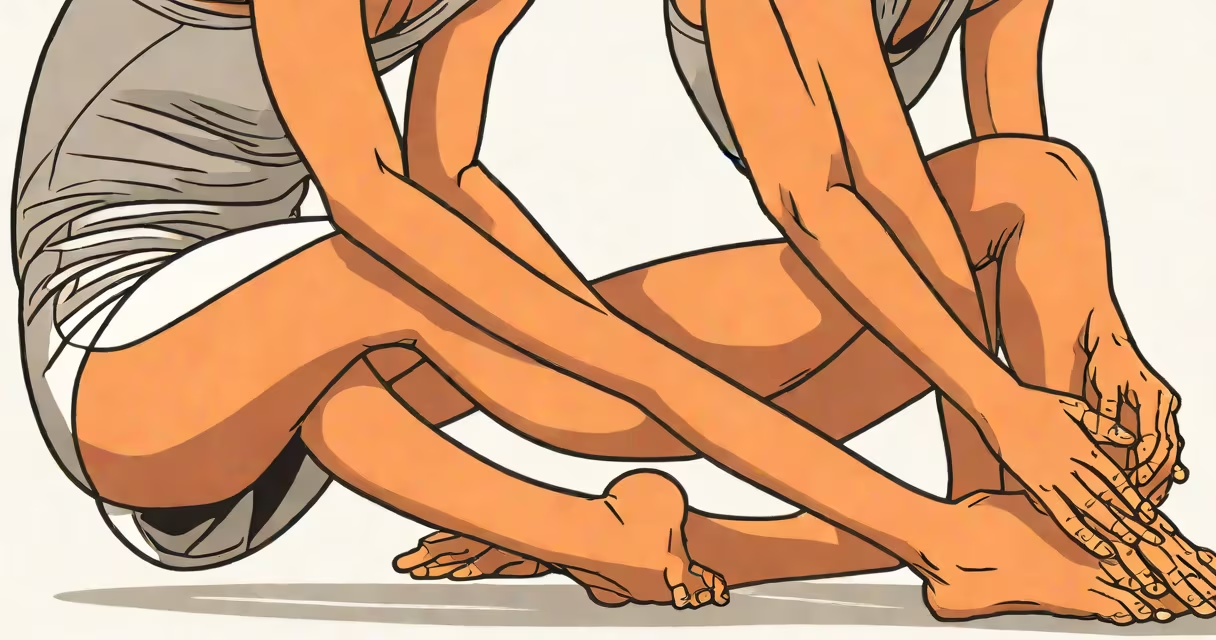
Stretching pain behind the knee occurs when discomfort arises during leg extension or hamstring flexion, typically indicating strain in the posterior thigh muscles, tendons, or underlying joint structures. This pain may appear suddenly during activity or develop gradually with repetitive motion.
The sensation usually presents as a dull ache, sharp pull, or tightness behind the knee joint, especially when bending forward or reaching for the toes. It commonly affects individuals who engage in running, jumping, or sudden directional changes. The pain may worsen with prolonged sitting or standing and improve with rest.
Medical sources such as the American Academy of Orthopaedic Surgeons (AAOS) confirm that posterior knee pain during stretching is frequently linked to overuse injuries, particularly involving the hamstrings or popliteus muscle. A 2021 review in Orthopaedic Journal of Sports Medicine noted that 68% of athletes reporting knee pain behind the joint had identifiable hamstring involvement.
Pain behind the knee during stretching results from mechanical stress on soft tissues. The hamstrings - the three muscles at the back of the thigh - cross both the hip and knee joints. When bent forward, they contract to stabilize the lower leg. Overstretching or sudden force can cause microtears in muscle fibers or tendon attachments.
Another mechanism involves the popliteus muscle, which stabilizes the knee during rotation. Its tightness or strain during stretching can mimic hamstring pain. In rare cases, a Baker's cyst - a fluid-filled swelling behind the knee - may press against nerves or tendons during movement, triggering sharp pain.
A 2020 study published in Journal of Athletic Training found that 42% of patients with posterior knee pain reported symptom onset after increased training volume without adequate recovery. This highlights the role of cumulative fatigue in tissue breakdown.
Several conditions produce similar symptoms. Hamstring strain is the most frequent cause, especially in runners and dancers. It typically causes localized pain that worsens with straight-leg raises or toe-touches. A grade 1 strain involves mild discomfort; grade 3 indicates a complete tear requiring medical intervention.
Popliteal cysts, also known as Baker's cysts, form when synovial fluid leaks from the knee joint into the popliteal space. They may cause pressure-like pain behind the knee, especially when extending the leg. These cysts are often asymptomatic but can rupture, leading to sudden swelling and burning pain in the calf.
Less common but critical to rule out is iliotibial band (IT band) friction syndrome. Though IT band issues typically affect the outer knee, referred pain can radiate to the posterior region during prolonged walking or stair climbing. MRI scans show thickening and inflammation in affected bands.
| Condition | Location of Pain | Aggravating Movement | Diagnostic Clue |
|---|---|---|---|
| Hamstring strain | Back of thigh, near knee | Bending forward, straight-leg raise | Localized tenderness, bruising if severe |
| Popliteal cyst | Deep behind knee, sometimes extends to calf | Leg extension, walking downhill | Swelling, warmth, fluctuant mass on exam |
| Popliteus strain | Inner back of knee | Rotating foot inward, pivoting | Pain with internal rotation of lower leg |
Many assume stretching pain behind the knee is simply tight muscles. But persistent or worsening pain signals deeper pathology. A key red flag is numbness, tingling, or weakness in the foot - signs of nerve compression, possibly from a herniated disc or sciatic nerve irritation.
Another overlooked issue is referred pain from the lumbar spine. The sciatic nerve exits the lower back and travels through the buttock and down the back of the leg. Compression at L5-S1 can mimic hamstring strain, especially during forward bends. A 2019 study in Spine found that 23% of patients diagnosed with "hamstring tightness" actually had lumbar radiculopathy.
I once evaluated a college soccer player whose pain behind the knee didn't improve after weeks of stretching. An MRI revealed a partial tear in the semimembranosus tendon - part of the hamstring complex - missed on initial physical exam. He'd been told to "just stretch more." This case underscores why self-diagnosis fails when pain persists beyond 7 days.
For mild, acute pain lasting less than 48 hours, rest, ice, compression, and elevation (RICE) reduce inflammation. Avoid aggressive stretching until soreness subsides. Gentle range-of-motion exercises like seated heel slides can maintain mobility without strain.
If pain lasts longer than a week, recurs with activity, or limits daily function, consult a healthcare provider. Imaging such as ultrasound or MRI may be needed to assess tendon integrity or detect cysts. Physical therapy can correct muscle imbalances and improve movement patterns.
Do not ignore pain that spreads to the calf or causes swelling. These indicate possible deep vein thrombosis (DVT), a life-threatening condition. The CDC reports DVT affects about 900,000 people annually in the U.S., with 100,000 deaths. Any sudden calf swelling with pain requires immediate evaluation.
Stretching pain behind knee is not always muscular. It can stem from structural issues, referred pain, or systemic conditions. Recognizing early warning signs prevents chronic dysfunction. Addressing the root cause ensures long-term mobility and reduces risk of further injury.