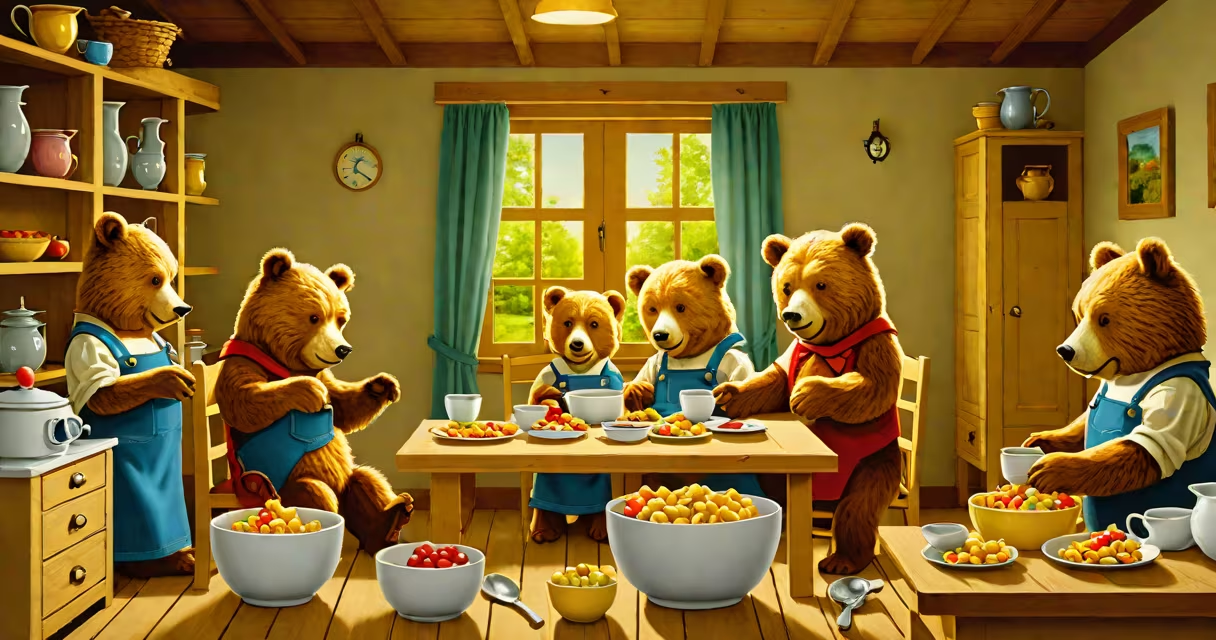
The Three Bears is a 19th-century British fairy tale in which a young girl named Goldilocks enters the home of three anthropomorphic bears-Papa Bear, Mama Bear, and Baby Bear-and tests their porridge, chairs, and beds, finding each too extreme in size and comfort until she chooses the smallest, which suits her perfectly.
First published in 1837 by Robert Southey under the title "The Story of the Three Bears," the tale predates the more familiar version popularized in the 20th century. The original story lacks the name "Goldilocks" and focuses less on the girl's appearance and more on moral lessons about trespassing and respect for others' property. The modern version, shaped by illustrated editions and adaptations, assigns the name and golden hair to the intruder, cementing her identity in popular culture.
The narrative follows a clear sequence: a child enters a house uninvited, consumes food meant for others, sits in furniture not hers, and sleeps in a bed not intended for her. Her actions lead to immediate consequences-she wakes to find the bears returning and flees in fear. This structure mirrors the archetypal "three-part trial" common in folk narratives, where a protagonist encounters three options, each representing an extreme, and only the middle choice proves acceptable.
The tale operates on a binary logic of extremes: too hot, too cold, just right; too big, too small, just right. These contrasts establish a structure for decision-making based on proportion and moderation. The concept of "just right" is central-not merely a preference, but a standard of fit, safety, and appropriateness.
Each of the three bears represents a different scale of being. Papa Bear is large, loud, and authoritative. Mama Bear is smaller, more reserved. Baby Bear is the smallest, most vulnerable. Their belongings reflect their sizes: Papa Bear's porridge is scalding, his chair collapses under Goldilocks, and his bed sags. Baby Bear's are delicate and precise. The girl's intrusion disrupts the household equilibrium, symbolizing how individual choices can disturb collective order.
Modern psychological interpretations suggest the story functions as a metaphor for developmental stages. The girl's exploration of the house parallels early childhood curiosity and boundary testing. Her eventual flight reflects the internalization of social norms-she learns that violating space and ownership leads to exposure and fear.
The core components of "The Three Bears" are consistent across versions: three bears of differing sizes, three sets of objects (porridge, chairs, beds), and a single intruder. However, the details vary between early and later renditions.
| Element | Original 1837 Version | Modern Adapted Version |
|---|---|---|
| Name of girl | Not named | Goldilocks (from 1900s) |
| Setting | Forest cottage, no specific location | Typically depicted as a cozy, isolated woodland home |
| Girl's behavior | Consumes food, sits in chairs, lies in bed-no emotional reaction | Expresses delight and discomfort; shows personality |
| Ending | Girl runs away silently | Often includes dramatic escape, sometimes with bears chasing her |
A lesser-known fact: the original story contains no mention of gold hair. The name "Goldilocks" was added decades after the tale's debut, likely to appeal to readers of early 20th-century picture books. The term "goldilocks" later entered common usage to describe a state of optimal balance-"just right"-in fields ranging from economics to climate science.
One non-obvious distinction: the bears do not speak in the original text. They are silent observers. Their presence is felt through the condition of their belongings-milk still warm, chairs broken, beds dented. This absence of dialogue intensifies the sense of violation. The girl's actions are judged not by accusation, but by evidence.
The Three Bears remains a staple in early childhood education. Teachers use it to teach concepts like size comparison, sequencing, and cause-and-effect reasoning. A 2018 study by the National Association for the Education of Young Children found that 87% of preschool curricula included stories involving three-part structures, with "The Three Bears" ranking among the top five.
Its use extends beyond classrooms. The story appears in animated series like Peppa Pig and Bluey, where episodes adapt the theme for modern audiences. In Bluey, an episode titled "The Big Bed" uses the same tripartite structure-too big, too small, just right-but applies it to a child's emotional need for comfort during a sleepover.
Another application is in cognitive behavioral therapy (CBT) exercises. Therapists use the story to model decision-making under uncertainty. For example, a client might be asked: "Which option feels 'just right'?" to explore balanced thinking in anxiety or depression.
Many assume the story is about a girl who steals from bears. That's inaccurate. She doesn't take anything. She only uses what's already there. The offense lies in unauthorized access and disruption-not theft. This distinction matters because it shifts the moral focus from property crime to privacy violation.
Another misconception: the bears are always portrayed as gentle or passive. In reality, they are not. In the original, the bears react with anger. The text says: "They were very angry." The girl's escape is not due to kindness-it's survival. The bears are not cartoonish villains, but legitimate owners asserting rights.
Some educators mistakenly treat the story as a lesson in gender roles. The girl is often framed as "curious" or "impulsive," while the bears represent "order" and "authority." But the narrative does not assign moral value to gender. The girl's actions are not punished for being female-they're punished for trespassing. The story's power lies in its neutrality: it judges behavior, not identity.
In a kindergarten class in Portland, Oregon, a teacher used a hands-on version of the story. Students brought in three bowls of oatmeal (one hot, one cold, one room temperature), three chairs (large, medium, small), and three beds (full-size, twin, mini).
Students were asked to test each item and report their findings. One child sat in the large chair and said, "It's too big-I can't reach the floor." Another tried the small bed and said, "I'm falling off." Only the medium-sized bed felt "just right."
The teacher then asked: "Why did Goldilocks choose the smallest bed?" A student replied, "Because she didn't know how big the other ones were." The teacher clarified: "She didn't know the rules. That's why she got scared."
This exercise taught spatial awareness, empathy, and consequence in a tangible way. The story wasn't just read-it was lived.
My own experience: I once led a storytelling session at a library where a child insisted on wearing a bear costume to act out the scene. He chose the smallest bed, lay down, and whispered, "This one feels like me." That moment reminded me that the story's endurance lies not in its plot, but in its ability to mirror personal experience-the search for belonging, for fit, for safety.
Understanding "the three bears" requires seeing past the whimsy. It's a narrative engine built on contrast, consequence, and the human need for balance. The story persists not because it's cute, but because it models a universal truth: we thrive not in extremes, but in the middle.