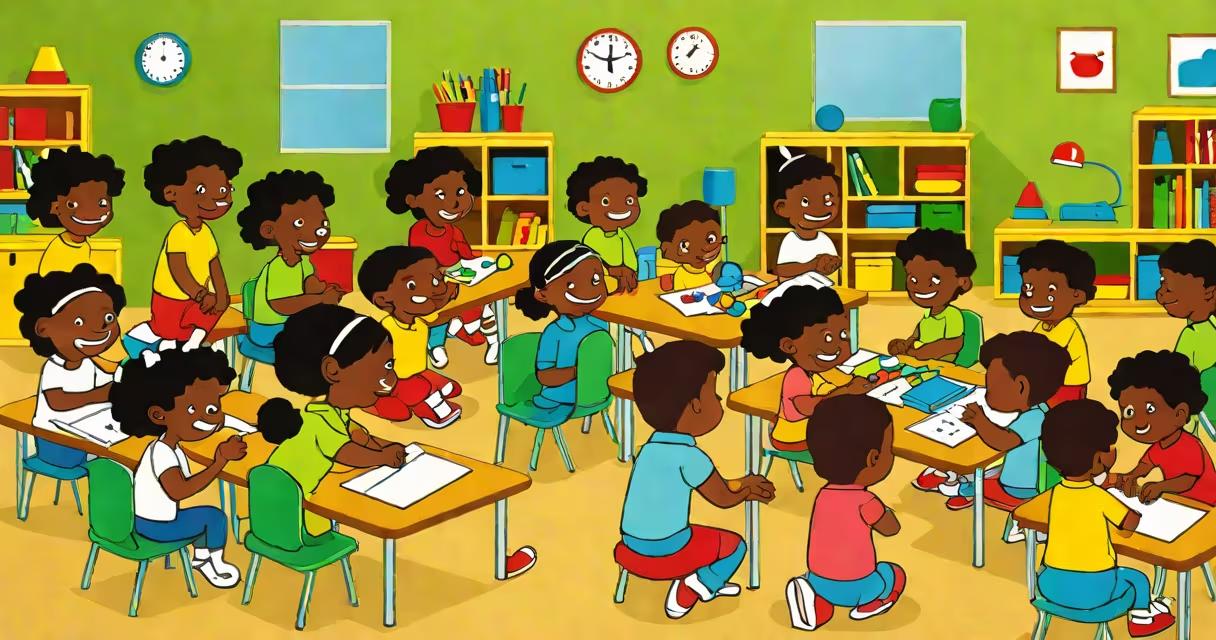
Early childhood spans ages 3 through 8, a period marked by rapid cognitive, emotional, and social development. The National Association for the Education of Young Children (NAEYC) defines this stage as foundational for lifelong learning and behavior patterns.
This phase begins when children transition from toddlerhood and continues through the early years of formal schooling. By age 3, most children can follow multi-step instructions, engage in pretend play, and express complex emotions. By age 8, they typically demonstrate advanced problem-solving, empathy, and independence.
The U.S. Department of Health and Human Services' Administration for Children and Families notes that early childhood experiences influence brain architecture. Neural pathways formed during this time affect language acquisition, emotional regulation, and academic readiness.
Neuroscience shows that the brain forms about 1 million neural connections per second during early childhood. These connections are shaped by interaction, nutrition, sleep, and consistent caregiving. A child who hears 30 million more words by age 3 than a peer from a lower-income household may score 30% higher on vocabulary tests, according to the Hart & Risley study.
Development occurs across domains: physical (fine and gross motor skills), cognitive (memory, attention, reasoning), emotional (self-regulation, resilience), and social (peer interaction, cooperation). For example, a 4-year-old learning to share toys develops executive function skills important for later math and reading success.
Children in this stage learn best through play-based activities. A preschooler building a tower with blocks isn't just having fun-they're exploring gravity, spatial relationships, and cause-and-effect. Research from the American Psychological Association confirms that structured play improves language and mathematical thinking more effectively than rote drills.
Early childhood is often divided into three sub-stages based on developmental milestones:
| Age Range | Key Developmental Focus | Typical Milestones |
|---|---|---|
| 3-5 years | Preschool stage | Uses full sentences, plays cooperatively, recognizes letters and numbers, follows 3-step directions |
| 6-7 years | Early elementary transition | Reads simple texts, writes short stories, understands basic math concepts, participates in group projects |
| 8 years | End of early childhood | Manages personal belongings, completes homework independently, demonstrates perspective-taking, engages in abstract thinking |
These ranges align with the National Association for the Education of Young Children's guidelines for curriculum design. Programs serving children aged 3-5 emphasize exploration and sensory learning. Those for 6-8 focus on literacy foundations and social-emotional regulation.
A common misconception is that early childhood ends at age 5. However, research from the Center on the Developing Child at Harvard University shows that brain plasticity remains high through age 8. Delaying formal instruction beyond age 6 can reduce long-term academic performance, especially in low-income communities.
Early childhood programs are implemented in homes, childcare centers, preschools, and public school classrooms. The federal Head Start program serves over 1 million children annually, providing health screenings, nutrition, and parent engagement services.
Children who attend quality early childhood programs show better outcomes in reading and math by third grade. A longitudinal study by the National Institute of Child Health and Human Development found that 80% of children in high-quality preschools were on track academically by age 9, compared to 55% in low-quality settings.
Quality is measured by teacher qualifications, student-to-teacher ratios, and curriculum alignment with developmental science. Centers with a ratio of 10:1 or better and teachers holding at least an associate degree in early childhood education consistently outperform those without.
One non-obvious fact: children who begin early childhood education before age 4 are less likely to require special education services later. A 2020 study published in Child Development found that early enrollment reduced the risk of learning disabilities by 37% among children from high-risk backgrounds.
Early childhood is often mistaken for infancy or adolescence. Infancy ends at age 2; adolescence begins around age 12. Early childhood sits between them, bridging the gap where foundational skills solidify.
Another confusion arises around "pre-K." Pre-kindergarten is a program type, not a developmental stage. While many pre-K programs serve 4-year-olds, they are not limited to that age. Some states offer universal pre-K for 3-year-olds, particularly in underserved areas.
Parents sometimes assume that early childhood education is purely about academics. In reality, the focus is on complete development. A child who learns to take turns during circle time builds social skills that predict future job success more accurately than early test scores, according to a 2018 longitudinal analysis by the Brookings Institution.
During my time volunteering at a community early childhood center, I observed a 5-year-old struggling to stay seated during storytime. After a few days of consistent routines and movement breaks, she began raising her hand to speak. Her teacher noted that the shift wasn't due to improved attention span-it was because she felt safe and understood. That moment underscored how emotional security underpins all learning.
For families seeking structured support, programs aligned with early childhood education grades provide a structure for choosing appropriate settings. These range from home-based care to licensed centers offering full-day programming.
When evaluating a facility, look for accreditation from the National Association for the Education of Young Children. Accredited centers meet rigorous standards in staff training, safety, and curriculum design. They also prioritize inclusive practices, ensuring children with disabilities participate fully.
Early childhood is not a single moment-it's a changing window of growth. Recognizing that ages 3 to 8 represent this critical phase allows educators, caregivers, and policymakers to invest wisely in programs that yield lasting benefits.
Understanding what age is considered early childhood ensures better decisions about care, education, and policy. This period shapes how children think, feel, and interact with the world. Investing in it now reduces long-term costs in remediation, incarceration, and healthcare.