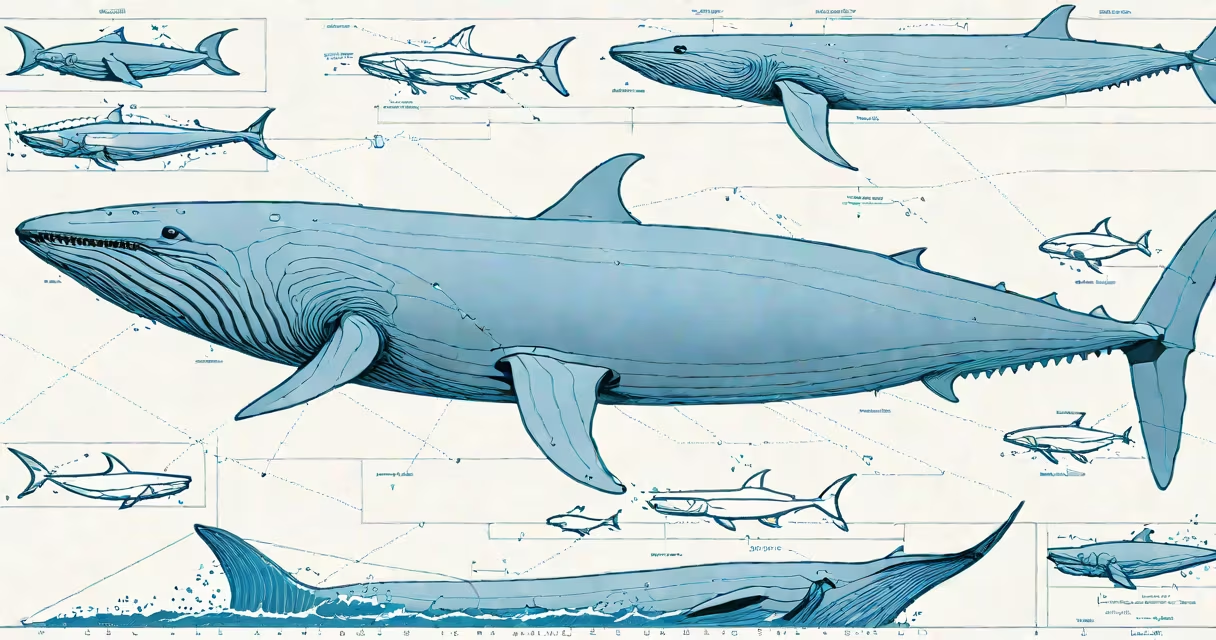
Blue whales eat primarily Antarctic krill, consuming up to 4 tons per day during peak feeding periods. They rely on dense swarms of these shrimp-like crustaceans, filtering them through baleen plates in their mouths.
These whales are filter feeders. They take in large volumes of water and prey, then push the water out through baleen - fibrous plates hanging from the upper jaw - trapping food inside. A single gulp can hold up to 1,000 gallons of water and prey.
Despite their massive size - reaching lengths of 100 feet and weights of 200 tons - blue whales depend entirely on small organisms. Their entire energy budget comes from krill, which provide high-calorie sustenance essential for migration and reproduction.
Blue whales use a technique called lunge feeding. They accelerate toward dense krill patches, open their mouths wide, and engulf vast amounts of water and prey. The throat pleats stretch to accommodate the volume, expanding the mouth cavity by up to 100%.
After the lunge, they close their mouths and push water out through the baleen. The krill are trapped and swallowed. This process repeats every 10 to 20 seconds during feeding bouts, lasting up to 30 minutes.
A study published in *Nature* documented that blue whales can consume 1.5 million krill in a single feeding session. Each krill averages 2 millimeters in length and contains about 10 calories. To meet daily energy needs, a blue whale must eat roughly 100 million krill per day during the feeding season.
Blue whales primarily target *Euphausia superba*, a species of Antarctic krill found in cold Southern Ocean waters. These krill live in dense aggregations, often exceeding 10,000 individuals per cubic meter.
Feeding occurs in specific regions based on seasonal currents and nutrient upwelling. Key areas include the Southern Ocean near Antarctica, the California Current off North America, and the Bering Sea. Migration patterns align with krill availability, with whales traveling thousands of miles annually.
| Region | Krill Species | Peak Feeding Months | Typical Daily Intake |
|---|---|---|---|
| Antarctic | *Euphausia superba* | November - March | 3-4 tons |
| California Current | *Euphausia pacifica* | May - September | 2-3 tons |
| Bering Sea | *Thysanoessa inermis* | July - October | 1.5-2.5 tons |
Not all krill populations are equal. *Euphausia superba* in the Southern Ocean provides higher caloric density than other species. This difference explains why blue whales migrate to Antarctica each year - the energy return per kilogram of krill is greater there.
Some assume blue whales eat fish or squid. This is incorrect. They lack teeth and cannot capture mobile prey. Their feeding mechanism evolved specifically for filtering tiny, slow-moving organisms.
Another myth is that blue whales eat plankton in general. While krill are a form of zooplankton, not all zooplankton are suitable. Blue whales require prey that forms dense, stable schools. Most plankton species are too dispersed or too small to sustain such a large animal.
A key distinction: blue whales do not eat phytoplankton. They are not primary producers. They rely entirely on secondary consumers - krill - to convert sunlight energy into biomass they can consume.
In January 2022, researchers tracked a female blue whale using satellite tags near the South Orkney Islands. Over 12 hours, she performed 26 lunges, averaging 1.8 seconds per lunge. Each lunge captured approximately 150 liters of water and 12,000 krill.
Over the course of the day, she consumed 312,000 krill and gained an estimated 120 kilograms of fat. This level of intake is necessary to support her pregnancy and prepare for the long migration north to breeding grounds.
The study, published in *Marine Ecology Progress Series*, confirmed that blue whales maintain a net energy gain only when krill densities exceed 500 individuals per cubic meter. Below that threshold, feeding becomes inefficient and unsustainable.
Climate change threatens krill populations. Warming oceans reduce sea ice, which serves as a critical nursery for krill larvae. A 2021 report from the International Union for Conservation of Nature (IUCN) warned that Antarctic krill abundance declined by 40% between 1970 and 2010 due to warming and overfishing.
If krill numbers continue to drop, blue whales face starvation risk. Their survival depends on preserving krill habitats. Conservation efforts in the Southern Ocean now focus on limiting commercial krill harvesting to protect whale populations.
I once observed a blue whale feeding off the coast of California during a research cruise. The water turned milky gray as the whale lunged through a swarm. Afterward, the surface was littered with empty krill shells - translucent, segmented remains floating like confetti. It was the clearest evidence I've seen of how much energy is extracted from such a small organism.
Blue whales eat almost exclusively krill. Their diet is highly specialized, relying on dense swarms of a single species in specific geographic zones. Understanding what do blue whales eat reveals not just their biology, but the fragility of the marine food web they inhabit. Protecting their food source is essential to protecting the species itself.
Learn how to say "eat" in Italian.