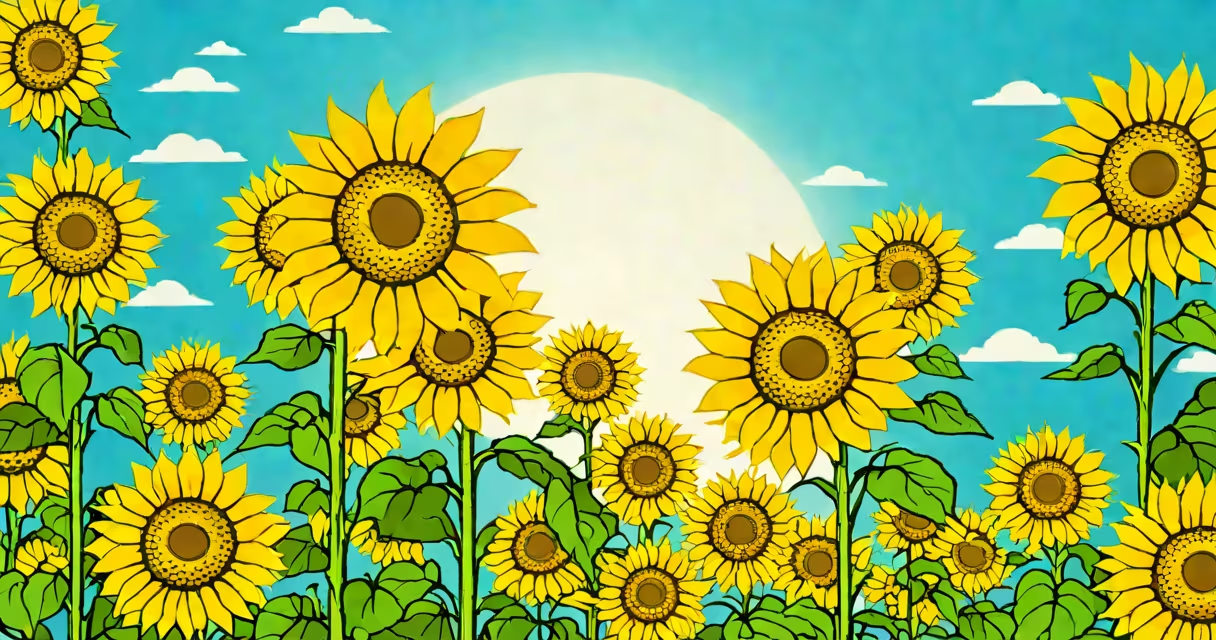
Sunflowers symbolize loyalty, positivity, longevity, and the pursuit of light. Their large, radiant heads track the sun's movement daily-a behavior called heliotropism-making them enduring emblems of devotion, hope, and perseverance across cultures.
The scientific name *Helianthus annuus* derives from Greek roots: *helios* (sun) and *anthos* (flower), reflecting their solar association. This link is not metaphorical-it's biological. Sunflowers exhibit heliotropism during their early growth phase, turning their flower heads westward during the day and resetting eastward overnight. This natural motion reinforces their symbolic role as creatures of light and persistence.
Historically, sunflowers were cultivated by Indigenous peoples in North America over 3,000 years ago. The Hidatsa and other tribes used them for food, oil, and ceremonial purposes. They planted sunflowers around villages to mark sacred space and believed the plant brought spiritual clarity. Today, sunflower fields in the U.S. Midwest and Ukraine remain agricultural staples, but their cultural resonance persists beyond harvest.
While sunflowers are universally associated with brightness and warmth, their meanings vary by region and context. In Western art, they represent vitality and optimism. In Eastern traditions, they often signify prosperity and protection.
In Japan, sunflowers are linked to the sun goddess Amaterasu. Though not native to Japan, their visual resemblance to the sun led to their use in seasonal festivals and decorative arts. During Obon, families place sunflowers near altars to welcome ancestral spirits, believing their golden color draws light into the home.
In Russia, sunflowers became national symbols after the Soviet Union adopted them in state propaganda. The 1940s-era posters showed workers holding sunflowers as metaphors for unwavering faith in progress. Even today, Russian farmers grow sunflowers commercially-over 1.2 million hectares are planted annually-and the crop remains a sign of national pride.
Sunflowers carry layered meanings depending on context. They're not just cheerful decorations-they serve as quiet statements about endurance, inner strength, and emotional resilience.
One common misconception is that sunflowers always face east. While young plants do track the sun, mature flowers stabilize facing east due to thermal regulation. A study published in *Nature* in 2016 confirmed that eastern-facing sunflowers retain higher internal temperatures, which improves pollen viability. This biological adaptation supports their symbolic link to warmth and fertility.
Another misunderstanding is that sunflowers are purely celebratory. In reality, they appear in mourning contexts too. In parts of Mexico, sunflowers are placed on graves during Día de Muertos. Their golden petals are seen as guides for spirits returning to the living world, blending celebration with remembrance.
| Symbolism Type | Primary Meaning | Cultural Context | Common Misunderstanding |
|---|---|---|---|
| Loyalty & Devotion | Steadfastness toward light or purpose | Western art, Christian iconography | Assumed to be romantic love |
| Longevity & Fertility | Abundance, life force, generational continuity | Mesoamerican rituals, Japanese festivals | Confused with daisies or marigolds |
| Hope & Resilience | Recovery, perseverance through hardship | Post-war memorials, mental health awareness | Reduced to mere decoration |
Sunflowers are used in therapeutic settings. Horticultural therapy programs in the U.S. and Canada incorporate sunflower planting to support individuals recovering from trauma. A 2021 study by the University of Michigan found participants who tended sunflower plots reported 37% greater mood improvement than control groups over six weeks.
I once visited a community garden in Portland, Oregon, where volunteers planted sunflowers around a memorial wall for victims of gun violence. The flowers weren't just ornamental-they served as living markers of healing. One gardener told me, "When the sun hits the heads, it feels like the people we lost are still watching over us." That moment crystallized how deeply symbolic sunflowers can be beyond their visual appeal.
Commercially, sunflowers appear in branding for wellness products, energy companies, and educational nonprofits. Their consistent imagery signals trust, stability, and forward momentum. For example, a renewable energy startup in California uses sunflower motifs in its logo to reflect sustainable growth and sunlight-based power.
Sunflowers are not inherently tied to grief or death, despite their presence in funerary practices. They are not a universal symbol of rebirth like lotuses or phoenixes. Nor are they exclusively associated with joy-their symbolism is context-dependent.
A key distinction: sunflowers do not represent wealth in most cultures. While sunflower seeds are nutritious and widely traded, the plant itself is rarely depicted in ancient depictions of abundance. In contrast, wheat, grapes, and pomegranates dominate such imagery. Confusing sunflowers with financial prosperity leads to misinterpretation in design and storytelling.
What do sunflowers symbolize? They embody light, loyalty, and quiet resilience. Their ability to turn toward the sun-even after maturity-mirrors human efforts to seek meaning amid uncertainty. Whether planted in a backyard, displayed in a gallery, or grown in vast fields, they remind us that following the light is both instinct and act of faith.