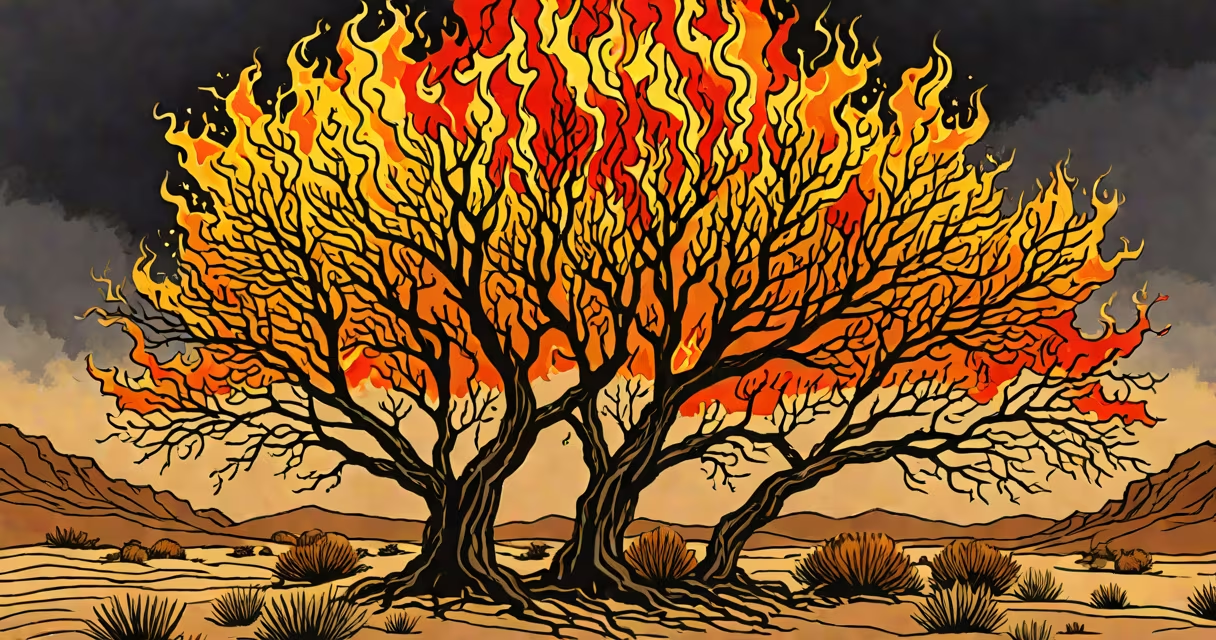
The burning bush symbolizes God's direct, holy presence and the beginning of a divine mission. In Exodus 3, Moses encounters a bush that burns without being consumed, marking the moment God calls him to lead the Israelites out of Egypt. This event establishes the bush as a sign of God's enduring, major power.
God speaks from the flame, declaring, "I am who I am," affirming His eternal nature. The bush is not destroyed by fire, a detail critical to its meaning. Fire in ancient Near Eastern thought often represented destruction or judgment, but here it signifies life, protection, and revelation. The unburnt bush becomes a physical manifestation of God's holiness-present, useful, and safe.
According to the New Revised Standard Version of Exodus 3:2-4, Moses sees the bush "on fire, but it was not consumed." This contradiction-fire that does not destroy-mirrors the paradox of divine presence: awe-inspiring yet non-destructive, overwhelming yet nurturing. The bush stands as a threshold between the ordinary and the sacred.
The burning bush appears only once in the Hebrew Bible, but its imagery echoes through centuries of religious thought. It functions as a theophany-a visible manifestation of God-similar to other divine appearances such as the pillar of cloud and fire in the wilderness. Unlike those, however, the bush is not a moving phenomenon; it is stationary, rooted, and persistent.
This stillness contrasts with the changing movement of God's actions later in Exodus. The bush remains fixed while God speaks. That stillness emphasizes focus: God's message is not delivered through chaos, but through calm, deliberate encounter. Moses removes his sandals-not because the ground is hot, but because it is holy. The act marks a shift from everyday life to sacred space.
Modern biblical scholars note that the Hebrew word for "bush" is *seneh*, which may derive from a root meaning "to dry up" or "to shrivel." This linguistic nuance adds depth: a plant that should wither under fire instead thrives. The bush defies natural law, just as God's plan defies human expectation. As scholar John Goldingay writes in Old Proof Theology, "The bush is not a miracle of preservation-it is a miracle of transformation."
Different religious traditions interpret the burning bush differently, though all agree on its role as a divine sign.
| Tradition | Interpretation | Key Source |
|---|---|---|
| Judaism | Symbol of God's covenant with Israel; the fire represents divine revelation and the permanence of the Torah. | Chabad.org |
| Christianity | Prefiguration of Christ's resurrection-fire that consumes but does not destroy, mirroring Christ's death and resurrection. | Romans 6:4-5 |
| Eastern Orthodoxy | Seen as a type of the Virgin Mary-holy, untouched by sin, yet containing divine presence. | Orthodox Christian Network |
Some early Church Fathers, like Origen, interpreted the bush as a symbol of the Church itself-enduring through trials, never consumed by persecution. Others, including Augustine, saw it as a metaphor for the soul: capable of holding divine fire without being destroyed by it.
A lesser-known interpretation comes from medieval Jewish mysticism. In the Zohar, the burning bush is linked to the sefirah of *Tiferet*-beauty and balance-representing harmony between divine power and mercy. The fire is not wrathful, but radiant.
Many assume the burning bush was a literal tree on fire. But the Hebrew text says nothing about a tree. The word *seneh* refers to a shrub or low-growing plant, possibly a wild rose or bramble. Its small size underscores the idea that God's presence does not require grandeur-divinity can appear in humble forms.
Another mistake is thinking the bush burned continuously. The text says Moses saw it "on fire," not that it remained ablaze throughout the encounter. The fire appeared only when God spoke. This timing suggests the fire is not a natural phenomenon but a sign of divine attention.
Some modern depictions show the bush as a glowing, supernatural flame with wings or halos. These artistic choices misrepresent the original narrative. The bush is described plainly: green, on fire, not consumed. The power lies in its simplicity, not spectacle.
In 2018, a 12-foot-tall sculpture of the burning bush was installed at the National Museum of American Jewish History in Philadelphia. Made of steel and embedded with LED lights, it pulses slowly, mimicking flame. Visitors reported feeling a sense of awe-not from the light, but from the quiet stillness around it.
I stood before it during a rainy afternoon. The lights flickered faintly. No sound. No fanfare. Yet people paused, some even knelt. One woman whispered, "It's not supposed to burn." That moment captured the core of the symbol: presence without destruction, holiness without fear.
The sculpture is not a recreation of the biblical event. It's a meditation on it. Still, it reveals how deeply the image resonates-even in secular spaces. The burning bush persists not as a relic, but as a living metaphor.
Understanding what the burning bush symbolizes requires letting go of literalism. It is not a fire alarm, a warning sign, or a miracle of survival. It is a call-an invitation to step into the unknown, to hear God speak from the midst of the ordinary. The bush burns, but it does not vanish. Neither does the message.
When we ask what the burning bush symbolizes, we're not seeking a theological term. We're asking: Where do I meet God? What form does holiness take in my life? The answer, drawn from Exodus 3, is clear: in fire that does not consume, in silence that speaks, in a moment when the world pauses-and something sacred happens.