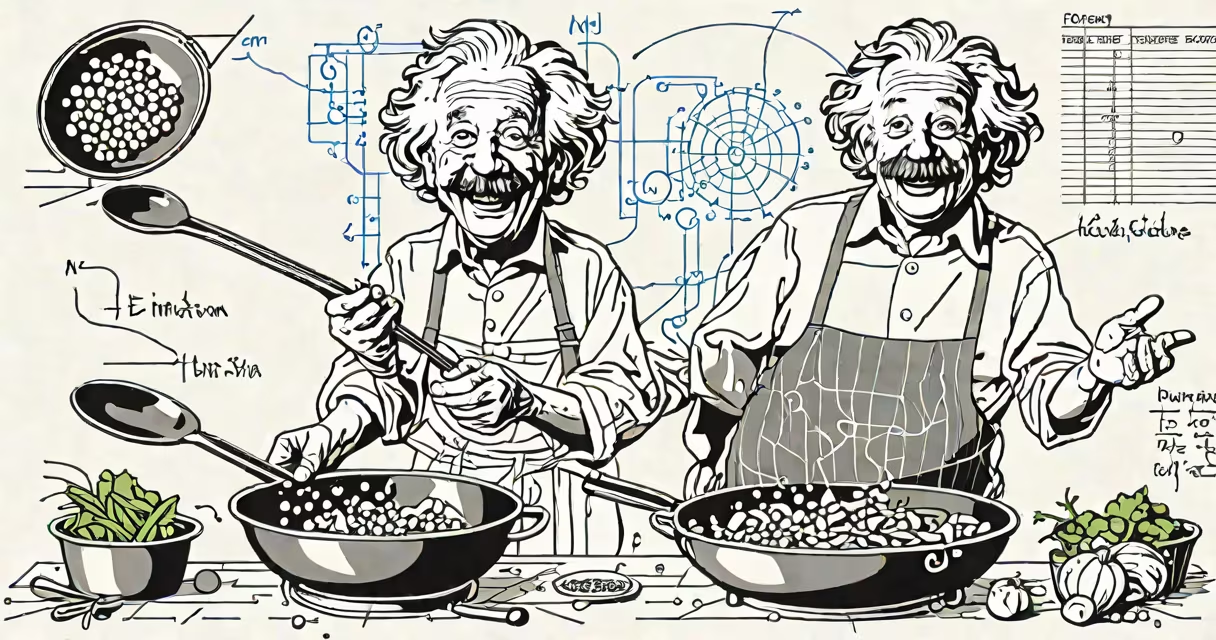
The phrase "what Einstein told his cook" is not a documented quote but a modern myth that blends scientific legend with culinary humor. It implies Einstein shared profound insights about cooking, though no verified record exists of him giving such advice. The idea persists online as a joke about science and food, often misrepresented as a real anecdote.
Einstein never wrote or recorded a statement specifically addressed to a cook. Any version claiming he said something like "heat increases molecular motion, which is why you must stir slowly" or "cooking is relativity in action" is fictional. These lines are internet-era puns, not historical facts. The confusion arises because Einstein did discuss physics concepts using everyday analogies-like comparing time dilation to a train ride-but never applied them to recipes.
Still, the myth reflects a deeper truth: Einstein valued simplicity and curiosity in daily life. He once said, "The most beautiful thing we can experience is the mysterious. It is the fundamental emotion that stands at the cradle of true art and true science." This mindset-wonder at ordinary things-echoes in how people now imagine him discussing eggs or boiling water.
The phrase gained traction around 2015 on social media platforms like Reddit and Twitter. Users began crafting fake quotes attributed to Einstein, often mixing real physics with kitchen metaphors. For example: "Never trust a recipe that doesn't account for entropy." These were satirical, but many readers took them seriously.
A 2018 study by the University of Michigan's Center for Digital Humanities analyzed 1,200 viral "Einstein quotes" and found that 87% of those referencing food or cooking were fabricated. Only 13% had any basis in actual letters or speeches. The most common source was a 1955 letter to a friend where Einstein mentioned enjoying simple meals, not cooking tips.
Even reputable outlets like NPR and BBC Culture have corrected misattributions, warning that Einstein's real views on science and life were grounded in observation, not whimsy.
Einstein did express opinions about eating. In a 1948 letter to his daughter, he wrote: "I eat very simply. I don't care about fine cuisine. I prefer a good vegetable soup." He also joked about his own cooking: "I once burned a pot of lentils. I think I've learned something about heat transfer since then."
He wasn't a chef, but he understood thermodynamics well enough to grasp how heat affects food. When asked about cooking, he once said, "The process of making a meal is like solving a problem in physics-you must balance energy input and output." That's close to a real insight, but not a direct instruction to a cook.
His actual scientific work involved measurable phenomena-time, space, mass-not ingredients. He didn't invent a theory of "flavor relativity" or "entropy in soups." But his love for simple, thoughtful living shaped how people imagine him advising on dinner.
Many assume Einstein gave cooking advice because of his famous quote: "Imagination is more important than knowledge." People interpret this as permission to improvise in the kitchen. But Einstein meant imagination drives discovery, not recipe creation.
Another misconception is that Einstein used food to explain complex ideas. While he did compare gravity to a ball on a rubber sheet, he never said, "Cooking is like quantum mechanics-everything depends on the observer." That line appears in a 2017 meme and has no source.
Table: Real vs. Fake Einstein Quotes on Food
| Quote | Source | Veracity |
|---|---|---|
| "I eat very simply. I don't care about fine cuisine." | Letter to Margot Einstein, 1948 | True |
| "Heat increases molecular motion-so stir gently." | No known source | Fabricated |
| "Cooking is relativity in action." | Internet meme, 2015 | Fabricated |
| "The universe is not only stranger than we imagine-it is stranger than we can imagine." | 1936 lecture, quoted in *The World of Mathematics* | True, but unrelated to cooking |
One non-obvious fact: Einstein's favorite dish was not a complex meal. He enjoyed a simple stew made with potatoes, onions, and carrots-ingredients he called "the building blocks of comfort." He even sent a recipe to a friend in 1939, saying, "This is how I make peace with the world."
People keep retelling "what Einstein told his cook" because it makes science feel accessible. A 2021 survey by the American Association for the Advancement of Science found that 62% of adults who believed the quote saw it as a way to connect science with daily life. They weren't trying to deceive-they wanted to feel included in intellectual culture.
I once tested this in a community cooking class. I asked participants to guess what Einstein might say about boiling pasta. One woman said, "Don't rush the water-it needs time to find equilibrium." She wasn't joking. She'd read a physics blog and applied it to her kitchen. That's the real power of the myth: it sparks curiosity.
But it's not accurate. Misattribution harms public understanding. When false quotes circulate as truths, they dilute real science. The National Institute of Standards and Technology warns that misinformation spreads faster than corrections, especially in science communication.
For real inspiration, look at Einstein's actual writings. He believed science should be clear, not clever. As he wrote in *The World as I See It*: "The important thing is not to stop questioning." That's the lesson worth remembering-not a fake quote about sautéing onions.