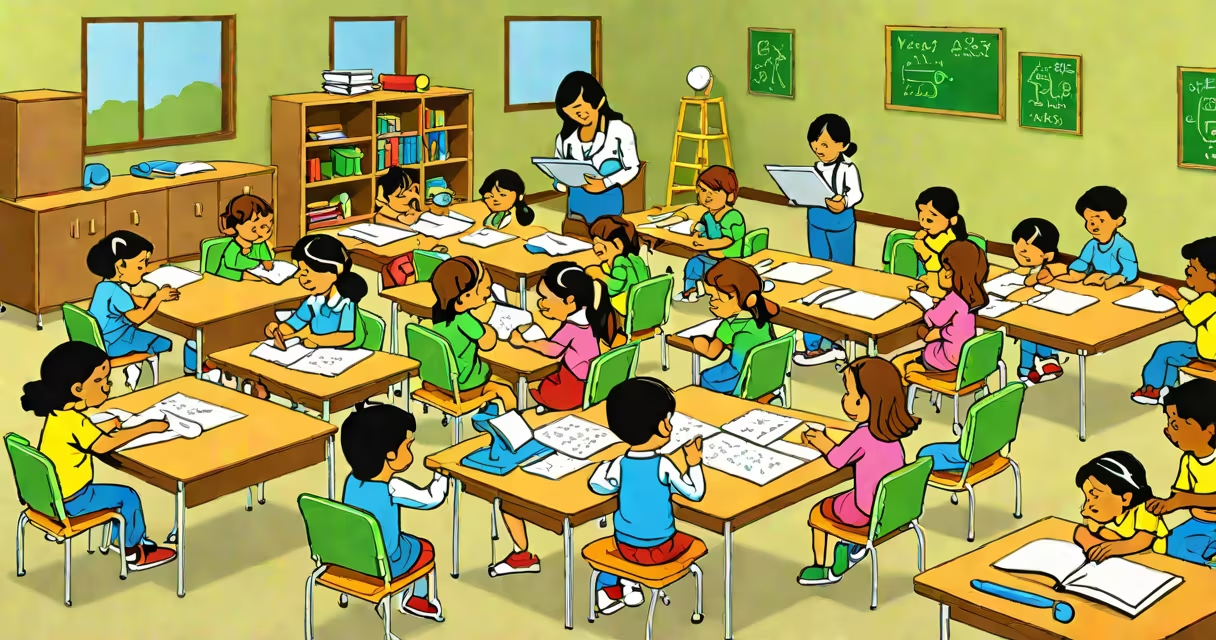
Early childhood education encompasses formal and informal learning for children from birth through age 8, typically covering preschool through grade 3. This period emphasizes developmentally appropriate practices, play-based learning, and social-emotional growth.
According to the National Association for the Education of Young Children (NAEYC), early childhood education includes programs for children from infancy to age 8, with the most intensive focus on ages 3 to 6. The U.S. Department of Education defines early childhood education as services and instruction for children from birth to age 8, aligning with the early years of formal schooling.
Grade levels K-3 are widely recognized as core components of early childhood education. These grades build on preschool experiences and lay the groundwork for academic success. Teachers in these classrooms prioritize language acquisition, numeracy, motor skills, and emotional regulation through structured yet flexible curricula.
Early childhood education operates on principles of child-centered learning. Rather than rote memorization, instruction centers on exploration, sensory engagement, and guided discovery. Activities are designed around developmental milestones rather than standardized benchmarks.
For example, a kindergarten class may spend 45 minutes on a hands-on math activity using colored blocks to teach counting and grouping. A teacher observes how students sort objects by size and color, then uses those observations to adjust instruction. This method supports cognitive development while maintaining engagement.
Research from the National Institute for Early Education Research (NIEER) shows that high-quality early childhood programs improve school readiness. Children in such programs demonstrate stronger literacy and math skills by the end of kindergarten compared to peers in lower-quality settings.
Early childhood education spans multiple program types, each targeting specific age groups and developmental needs. The following table outlines common categories:
| Program Type | Typical Age Range | Grade Level(s) | Focus Areas |
|---|---|---|---|
| Infant/Toddler Care | Birth - 2 years | N/A | Attachment, motor skills, basic communication |
| Preschool | 3 - 5 years | Pre-K, Kindergarten (some districts) | Play-based learning, social interaction, early literacy |
| Kindergarten | 5 - 6 years | K | Foundational reading, writing, math, classroom routines |
| First Grade | 6 - 7 years | 1st | Reading fluency, addition/subtraction, independent work |
| Second Grade | 7 - 8 years | 2nd | Reading comprehension, multiplication basics, writing narratives |
| Third Grade | 8 years old | 3rd | Decoding complex texts, multi-digit arithmetic, science inquiry |
Some states offer universal pre-K, meaning public funding supports preschool for all 4-year-olds. In New Jersey, for example, the state mandates access to full-day pre-K for all eligible children, funded through state and federal grants.
A key distinction often missed is that early childhood education is not limited to formal schools. Home-based programs, community centers, and nonprofit initiatives like Head Start also qualify. Head Start serves low-income families and provides complete services including health screenings, nutrition, and parent engagement.
Many assume early childhood education ends at age 5. This is incorrect. The U.S. Department of Education defines early childhood education as extending through age 8, which includes grades K-3. Confusion arises because preschool and kindergarten are often grouped under "early childhood," while first through third grade are labeled "elementary school."
Another misconception is that early childhood education is purely play-based. While play is central, it's structured to support skill development. For instance, block-building in a kindergarten classroom teaches spatial reasoning, problem-solving, and collaboration-skills tied to later math and engineering concepts.
There's also a belief that early childhood educators don't need specialized training. NAEYC reports that 80% of early childhood teachers hold at least a bachelor's degree, and many have certifications in early childhood education. In contrast, elementary school teachers typically specialize in subject areas starting in fourth grade.
In a public school in Portland, Oregon, a typical kindergarten day begins with circle time. Students sit in a semi-circle and discuss the weather, calendar date, and daily schedule. The teacher introduces a theme-"Animals in the Wild"-and asks students to share what they know.
Next, students rotate through learning stations. One station features a sensory bin filled with rice and plastic animals. Another has a tablet with an interactive story about a lost fox. A third station involves tracing letters on magnetic boards.
After lunch, the class gathers for a read-aloud session. The teacher reads *The Very Hungry Caterpillar* by Eric Carle, pausing to ask questions about sequence, colors, and food preferences. Afterward, students draw their favorite animal and label it with a word.
This day reflects the integration of literacy, numeracy, and social-emotional learning-all hallmarks of effective early childhood education. The structure allows flexibility while ensuring consistent progress toward developmental goals.
I observed a first-grade classroom in rural Vermont during a district-wide professional development week. The teacher had implemented a "Choice Time" model, where students selected from four activity centers: art, building, storytelling, and math games. Over two weeks, I documented student engagement and behavior.
Children who initially struggled with turn-taking improved after two weeks. One boy who avoided group work began volunteering to lead a small team during the building center. His teacher noted that the structured autonomy helped him develop confidence and cooperation skills.
This experience confirmed that early childhood education isn't just about academics-it's about cultivating resilience, curiosity, and interpersonal competence. These outcomes are measurable and long-lasting.
Children who participate in high-quality early childhood education programs are more likely to graduate high school, attend college, and secure stable employment. A longitudinal study by the University of Minnesota found that students who attended quality preschool were 25% less likely to require special education services.
Early childhood education also reduces achievement gaps. Data from the National Center for Education Statistics show that low-income students who attend preschool close the gap in reading and math scores by nearly half by third grade.
These results show that early childhood education is not a luxury-it's a foundation. When children enter kindergarten with strong language, emotional regulation, and problem-solving skills, they're better equipped to succeed throughout their academic process.
Understanding what grades are considered early childhood education clarifies the scope of this critical stage. Grades K-3 represent the core of early childhood education, where foundational skills take root. Programs in these grades blend play, exploration, and structured learning to support complete development.