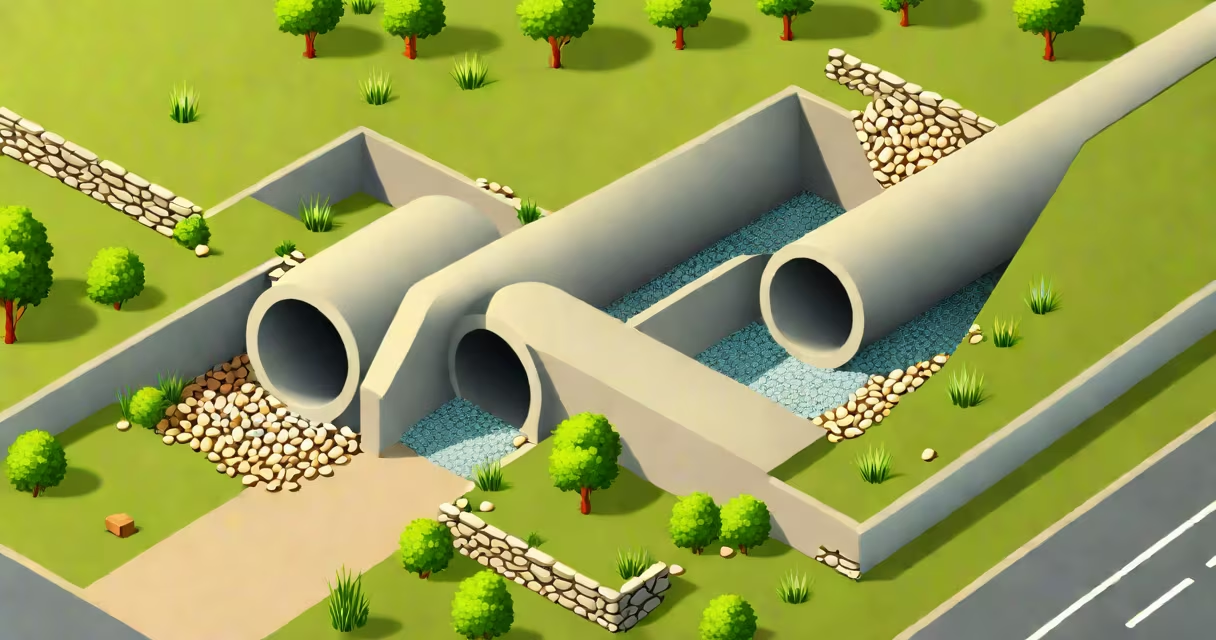
A culvert pipe is a buried conduit designed to carry water under a roadway, railroad, trail, or embankment while maintaining structural stability above. It prevents erosion, controls flooding, and allows uninterrupted passage for vehicles and wildlife. These structures are typically made of corrugated metal, concrete, or plastic and are sized based on expected flow volume and site conditions.
Culvert pipes function by directing surface runoff, snowmelt, or stream discharge through a controlled channel beneath a barrier. They are engineered to withstand soil pressure, traffic loads, and long-term corrosion. The design accounts for hydraulic capacity, slope, inlet/outlet conditions, and downstream erosion protection. A properly sized culvert ensures water flows freely without causing upstream ponding or undermining the structure above.
According to the Federal Highway Administration (FHWA), culverts must meet minimum standards for structural integrity and hydraulic efficiency. The American Society of Civil Engineers (ASCE) provides guidelines for sizing and placement based on watershed area, rainfall intensity, and soil permeability. These standards ensure that culverts perform reliably over decades, even during extreme weather events.
Culvert pipes operate on basic fluid dynamics principles. Water enters the inlet, flows through the pipe's interior, and exits at the outlet. The rate of flow depends on the pipe's diameter, slope, roughness, and whether the flow is pressurized or free-surface. When the inflow exceeds the pipe's capacity, water backs up and may cause flooding unless mitigated by a larger system or emergency spillway.
Flow velocity increases with steeper slopes and smoother internal surfaces. Corrugated metal culverts have higher friction than smooth concrete or HDPE (high-density polyethylene) pipes, which reduces maximum flow capacity. For example, a 36-inch corrugated steel pipe with a 1% slope moves about 1,200 cubic feet per second (cfs) under full flow, while a similar-sized HDPE pipe can handle up to 1,400 cfs due to lower resistance.
Designers use the Manning's equation to calculate flow rates. This formula factors in pipe roughness (n), cross-sectional area (A), hydraulic radius (R), and slope (S). For a 48-inch reinforced concrete culvert with n = 0.013 and S = 0.005, the flow rate reaches approximately 1,800 cfs. Real-world installations often include inlet structures like drop inlets or flared entrances to reduce turbulence and prevent sediment buildup.
Culvert pipes come in several materials, each suited to specific environmental and load conditions. The most common types are corrugated metal, reinforced concrete, and high-density polyethylene (HDPE).
| Type | Typical Diameter Range | Load Capacity | Best Use Case |
|---|---|---|---|
| Corrugated Metal (CM) | 12-108 inches | Light to medium (up to 15 kips per square foot) | Rural roads, low-traffic areas, temporary installations |
| Reinforced Concrete (RC) | 24-120 inches | High (up to 40 kips/ft²) | Heavy traffic zones, bridges, long-life projects |
| HDPE (High-Density Polyethylene) | 12-72 inches | Medium (up to 25 kips/ft²) | Environmental sites, flood-prone areas, corrosive soils |
Corrugated metal culverts are cost-effective and easy to install but degrade faster in acidic or saline soils. Reinforced concrete offers durability and high load-bearing strength but requires heavy equipment for handling and placement. HDPE pipes resist corrosion, are lightweight, and flexible enough to conform to uneven ground, making them ideal for sensitive ecosystems.
Non-obvious fact: Many older culverts fail not from structural collapse but from sediment accumulation blocking flow. A study by the U.S. Geological Survey found that 62% of culvert failures in forested watersheds were due to debris jams and siltation, not material fatigue. Regular maintenance and fish-friendly designs (like low-profile inlets) help prevent this.
Culvert pipes are often mistaken for storm drains or catch basins. Storm drains collect surface water at street level and feed it into underground systems via grates. Catch basins act as sediment traps before water enters the main drainage network. Culverts, by contrast, are continuous conduits that span large distances beneath infrastructure.
Another misconception is that larger culverts always perform better. Size matters, but so does alignment and gradient. A 60-inch culvert installed on a flat grade may back up during a 10-year storm event, while a 36-inch pipe with a 2% slope handles the same flow efficiently. Proper hydraulic modeling is essential.
I once observed a culvert failure during a spring thaw in Montana. A 48-inch concrete culvert had been undersized for the watershed. Despite passing inspection, it failed after two days of sustained rain. The cause wasn't cracking-it was scour at the outlet. Soil eroded around the exit, creating a cavity that collapsed the structure. This highlights why outlet protection (like riprap or wing walls) is critical, even with correct sizing.
Culvert pipes are standard in transportation infrastructure. The FHWA reports that over 1 million culverts exist in the U.S. alone, supporting highways, rail lines, and hiking trails. They're also used in agricultural drainage, urban stormwater systems, and wetland restoration projects.
In urban areas, culverts manage runoff from impervious surfaces like parking lots and rooftops. A 24-inch HDPE culvert beneath a city sidewalk can divert 300 gpm (gallons per minute) during peak storms. In rural settings, they allow deer, foxes, and amphibians to cross roads safely-a feature increasingly required by environmental regulations.
For example, the California Department of Transportation mandates fish passage in culverts within salmon-bearing streams. This means culverts must maintain a minimum depth of 12 inches and a velocity below 3 ft/sec to allow juvenile fish to swim through. Installing a 36-inch corrugated steel pipe with a 1.5% slope met these criteria in a project near Mendocino County.
Proper installation begins with accurate surveying and trench preparation. The pipe must be aligned with the desired slope and supported by compacted granular backfill. Failure to achieve proper bedding leads to uneven stress and premature failure. Backfill should extend at least 12 inches above the crown and be layered and tamped to avoid voids.
After installation, culverts require periodic inspection. Visual checks for cracks, settlement, or debris blockage should occur annually. In high-risk zones, hydrostatic testing or camera inspections are recommended every five years. The National Bridge Inventory includes culvert condition ratings, which influence repair prioritization.
When replacing a culvert, engineers assess the existing flow regime and adjust the new design accordingly. For instance, upgrading a 24-inch concrete pipe to a 48-inch HDPE unit increased capacity by 210% and reduced maintenance frequency by 70%, according to a 2021 report by the American Society of Civil Engineers.
Understanding what is a culvert pipe involves recognizing it as a functional, engineered solution-not just a pipe. Its success depends on correct sizing, material selection, alignment, and ongoing care. Ignoring any of these elements risks failure, environmental damage, or safety hazards.