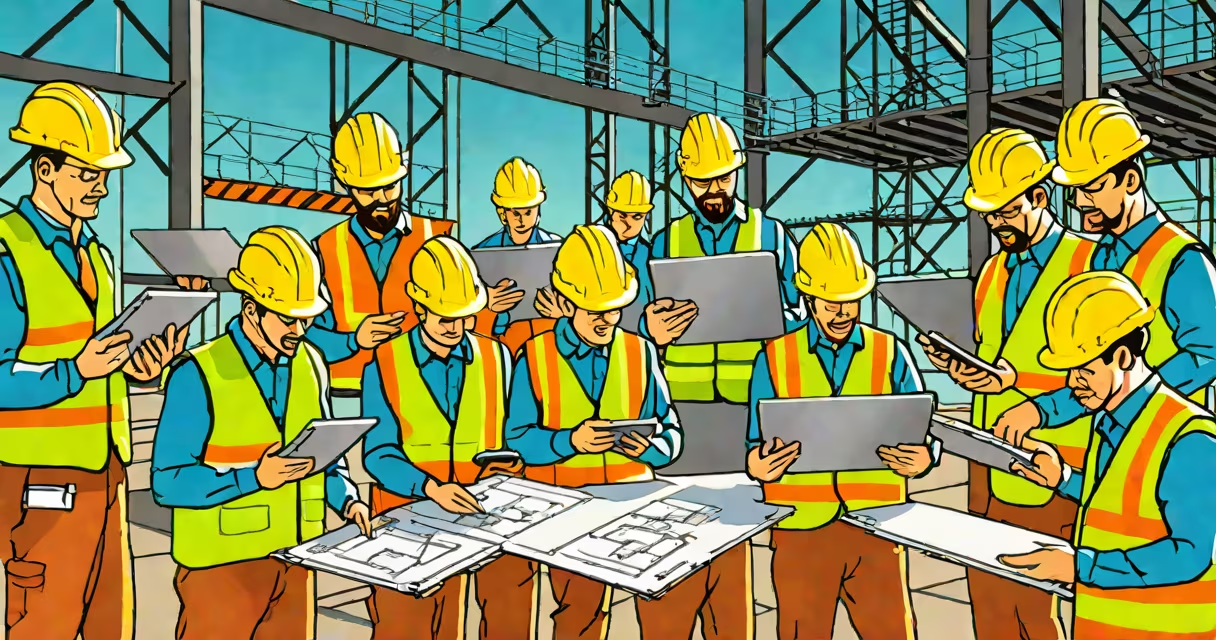
The term AEC refers to the combined industries of architecture, engineering, and construction-collectively responsible for designing, planning, and building physical structures such as buildings, bridges, roads, and infrastructure systems.
AEC projects begin with conceptual design by architects who define form, function, and aesthetics. Engineers then analyze structural integrity, mechanical systems, electrical layouts, and environmental performance. Construction teams execute the work based on detailed plans, often using advanced software and field coordination tools.
These sectors operate under tight timelines, complex regulations, and high safety standards. Projects range from residential homes to skyscrapers, hospitals, airports, and large-scale urban developments. The AEC process integrates technical precision, regulatory compliance, and collaborative execution across multiple disciplines.
Every AEC project follows a sequence of stages: concept, schematic design, design development, construction documentation, bidding, construction, and handover. Each phase involves input from architects, engineers, contractors, clients, and regulators.
For example, a new hospital requires architects to draft floor plans aligned with patient flow and medical equipment needs. Structural engineers assess load-bearing capacity for MRI rooms and operating theaters. Mechanical engineers design HVAC systems that maintain sterile environments. All outputs feed into a shared digital model used during bidding and site execution.
Construction managers oversee daily operations, track progress against schedules, manage subcontractors, and ensure safety protocols are met. After completion, facilities managers take over for maintenance, energy monitoring, and system optimization.
Today's AEC environment relies heavily on digital modeling and data integration. Building Information Modeling (BIM) is the central technology-creating intelligent 3D models that embed data about materials, costs, timelines, and lifecycle performance.
BIM enables clash detection before construction begins. For instance, during the design of a subway station in London, BIM revealed a conflict between a ventilation duct and a structural beam. Resolving it digitally saved £120,000 in rework and reduced delays by six weeks.
Other key tools include:
Projects are delivered through different contractual and operational models. The most common are:
| Method | Description | Best For |
|---|---|---|
| Design-Bid-Build | Sequential process: design completed before bidding begins. Contractor selected via lowest bid. | Simple projects with clear scopes, public-sector work |
| Design-Build | Single entity handles both design and construction. One point of responsibility. | Time-sensitive projects, private developments |
| Integrated Project Delivery (IPD) | All stakeholders collaborate early. Shared risk and reward. Contracts are joint ventures. | High-complexity projects, large infrastructure |
Design-Bid-Build remains dominant in government projects due to competitive bidding requirements. However, IPD has shown measurable improvements: a 2021 study by the National Institute of Standards and Technology (NIST) found IPD projects had 30% fewer change orders and 18% lower cost variance compared to traditional methods.
Many assume AEC is purely manual labor or limited to on-site work. In reality, over 60% of AEC professionals now use digital tools daily, according to a 2023 report by McKinsey & Company. Roles span software developers, data analysts, sustainability consultants, and automation specialists.
Another misunderstanding is that AEC is slow-moving. While legacy processes persist, adoption of cloud-based collaboration platforms has accelerated decision cycles. For example, a renovation of a historic library in Boston used real-time 3D scanning and cloud sharing to align restoration teams across three states. Work was completed 22 days ahead of schedule.
Some confuse AEC with real estate development. While related, they differ: real estate focuses on ownership, financing, and leasing. AEC centers on physical creation and technical execution. A developer may own a property; an AEC firm constructs it.
I observed a mid-sized AEC firm in Seattle implement a BIM-driven workflow for a mixed-use apartment complex. The team used Revit for modeling, Navisworks for coordination, and Power BI for tracking budget deviations. Daily stand-up meetings included remote participants from the client's office and the structural engineering subcontractor.
During the prefabrication stage, wall panels were fabricated offsite with embedded sensors. Data from the factory fed into the project's digital twin. When a panel arrived with a misaligned window cutout, the issue was flagged automatically in the BIM model. The error was corrected before installation, avoiding $8,000 in rework.
This case illustrates how AEC is no longer just about bricks and steel-it's about data, precision, and integrated systems.
By 2030, global infrastructure spending is projected to reach $10 trillion annually, according to the World Bank. AEC firms are essential to delivering housing, transportation networks, renewable energy plants, and climate-resilient buildings.
Sustainability is now a core requirement. The U.S. Green Building Council reports that LEED-certified buildings reduce energy consumption by 25% on average. AEC teams integrate passive solar design, rainwater harvesting, and low-carbon materials into their plans.
AEC supports economic growth. The U.S. Bureau of Labor Statistics estimates that construction employment will grow 4% from 2022 to 2032-faster than average for all occupations-driven by demand for new housing and infrastructure upgrades.
What is an AEC? It is the collective domain of architecture, engineering, and construction-responsible for creating the built environment. This sector combines creative design, technical analysis, and hands-on execution across diverse project types.
Modern AEC leverages digital tools like BIM, cloud collaboration, and data analytics to improve accuracy, reduce waste, and accelerate delivery. It is not a single job or company, but a network of professionals, technologies, and processes working together to build safe, efficient, and sustainable structures.
Understanding what is an AEC helps clarify how cities grow, how homes are built, and how infrastructure shapes everyday life.