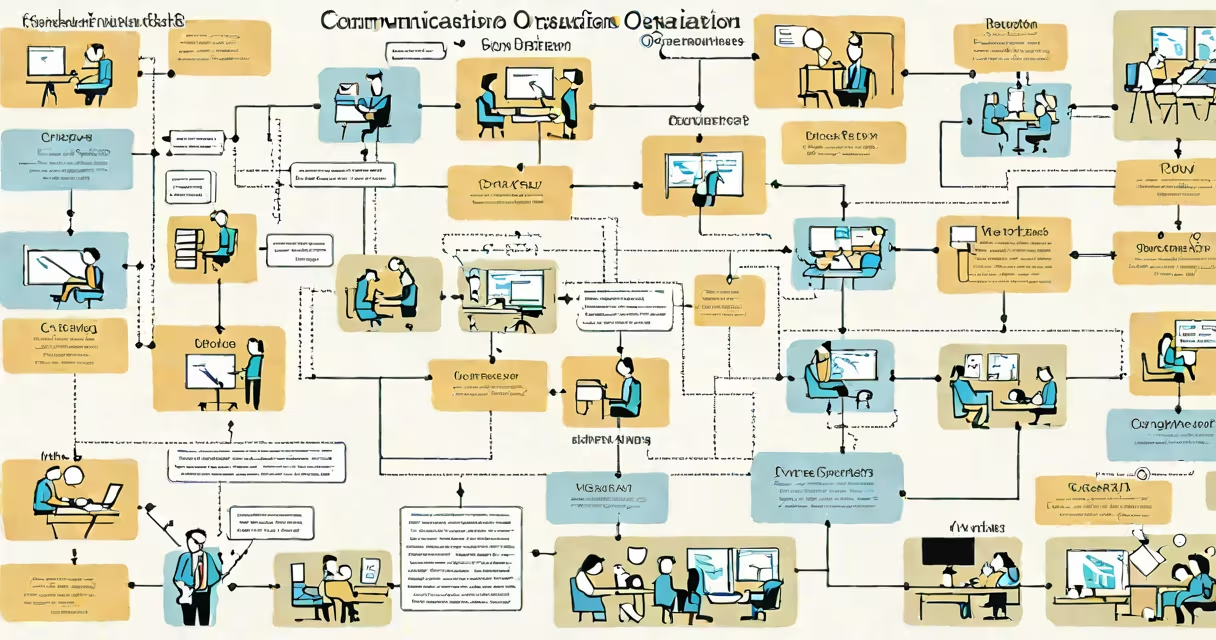
Communication organization refers to the structured structure through which information flows within a group, team, or institution. It defines who sends messages, who receives them, and through which channels they travel. This system ensures consistency, reduces misinterpretation, and supports decision-making across levels.
At its core, communication organization establishes predictable pathways for sharing ideas, updates, feedback, and directives. Without it, even small teams risk confusion, duplicated efforts, and delayed responses. In larger institutions, such as corporations or government agencies, formalized communication organization prevents chaos during high-pressure operations.
A well-designed communication structure aligns with both mission goals and human behavior. For example, a hospital emergency room relies on clear communication chains-doctors report to nurses, who relay patient status to specialists-to avoid life-threatening delays. The absence of such structure leads to errors, even in high-trust environments.
Information doesn't move randomly. It follows designated routes based on authority, responsibility, and workflow. These routes are shaped by roles, reporting lines, and chosen tools. A project manager may send task updates via email to their direct reports, while urgent safety alerts go through a centralized intranet notice board.
Each message passes through stages: sender, message, channel, receiver, and feedback loop. When any stage fails, the entire process breaks down. For instance, if a marketing director emails a campaign brief to a designer but uses a shared drive instead of a tracking tool, the designer might miss the update entirely. That's a breakdown in communication organization.
Research from the Harvard Business Review shows that teams with defined communication roles complete projects 25% faster than those without. The study analyzed 120 cross-functional teams across tech, healthcare, and finance sectors. Teams with documented communication protocols reported fewer misunderstandings and higher morale.
Organizations adopt different models based on size, culture, and operational needs. The most common structures are hierarchical, flat, matrix, and networked.
| Structure Type | Best For | Flow Example | Pros & Cons |
|---|---|---|---|
| Hierarchical | Larger firms with strict oversight | CEO → Department Heads → Team Leads → Staff | Clear accountability. Can slow down decisions. |
| Flat | Startups, creative teams | All members communicate directly | Fast response. Risk of role ambiguity. |
| Matrix | Projects spanning multiple departments | Employees report to both functional and project managers | Flexible resource use. Dual leadership can cause conflict. |
| Networked | Remote-first companies, distributed teams | Peer-to-peer via Slack, Notion, or email | Agile and responsive. Requires strong documentation. |
Each model reflects trade-offs between speed, control, and adaptability. A software startup launching a new product might begin with a flat structure to encourage rapid iteration. As it scales, it shifts toward hierarchical or matrix models to manage complexity.
Communication organization appears in every structured environment-from schools to military units to global supply chains. In education, teachers assign tasks through a learning management system, students submit work via portal, and grades are posted publicly. This system prevents lost assignments and ensures transparency.
In manufacturing, production lines depend on synchronized signals. A sensor detects a machine malfunction, triggers an alert sent through a central dashboard, and maintenance staff receive a priority ticket. If the alert skips a step or gets buried in a general email thread, downtime increases by an average of 18%, according to a 2022 McKinsey study on industrial operations.
Even informal groups benefit from basic organization. A neighborhood association managing a community garden uses a WhatsApp group for daily updates, a Google Sheet for planting schedules, and monthly Zoom meetings for planning. This hybrid setup avoids missed events and unclear responsibilities.
Many assume communication organization is purely about tools-email, Slack, or project boards. But the real issue lies in design. A team using Slack heavily still suffers from poor communication if no one knows who owns a decision, where files are stored, or how long to wait for a reply.
Another myth is that more channels improve clarity. In reality, excessive options create noise. A 2021 MIT Sloan study found that employees in organizations with five or more primary communication platforms spent 37% more time managing messages than peers in streamlined setups. The study measured focus time, task completion rate, and error frequency across 1,400 workers.
Some confuse communication organization with communication strategy. The former is structural-the "how" of message delivery. The latter is tactical-the "what" and "why." For example, a company might have a formal chain of command (organization), but choose to share quarterly results via video messages and live Q&A (strategy).
In 2020, a SaaS startup launched a major feature update. The engineering lead sent the release plan via email to the product team. The QA lead saw it but didn't flag a known bug in the authentication module. The dev team deployed the update anyway. Within 12 hours, 1,200 users reported login failures.
Root cause: No centralized tracker existed. Emails were scattered. No one owned verification. The team had a flat structure but lacked defined communication protocols. After the incident, they implemented a shared Jira board, assigned ownership per feature, and required peer review before deployment. Error rates dropped by 68% in the next quarter.
This case illustrates that structure matters more than intent. Even well-meaning teams fail without clear communication organization.
I once managed a volunteer-driven literacy program with 15 tutors across three cities. We used a mix of texts, calls, and a shared Google Calendar. Despite enthusiasm, attendance dropped 40% in the first month. We discovered that no one knew when sessions were rescheduled-updates were sent via personal messages, not the calendar.
We redesigned the system: all changes went into the shared calendar, with automated reminders. A single coordinator reviewed changes daily. Attendance rebounded to 92% within six weeks. The fix wasn't better tools-it was better organization.
What is communication organization? It's not just a list of channels or a chart of reporting lines. It's the intentional design of how people connect to share meaning, act on decisions, and maintain alignment. Poor communication organization causes delays, errors, and frustration. Strong organization enables trust, speed, and resilience.