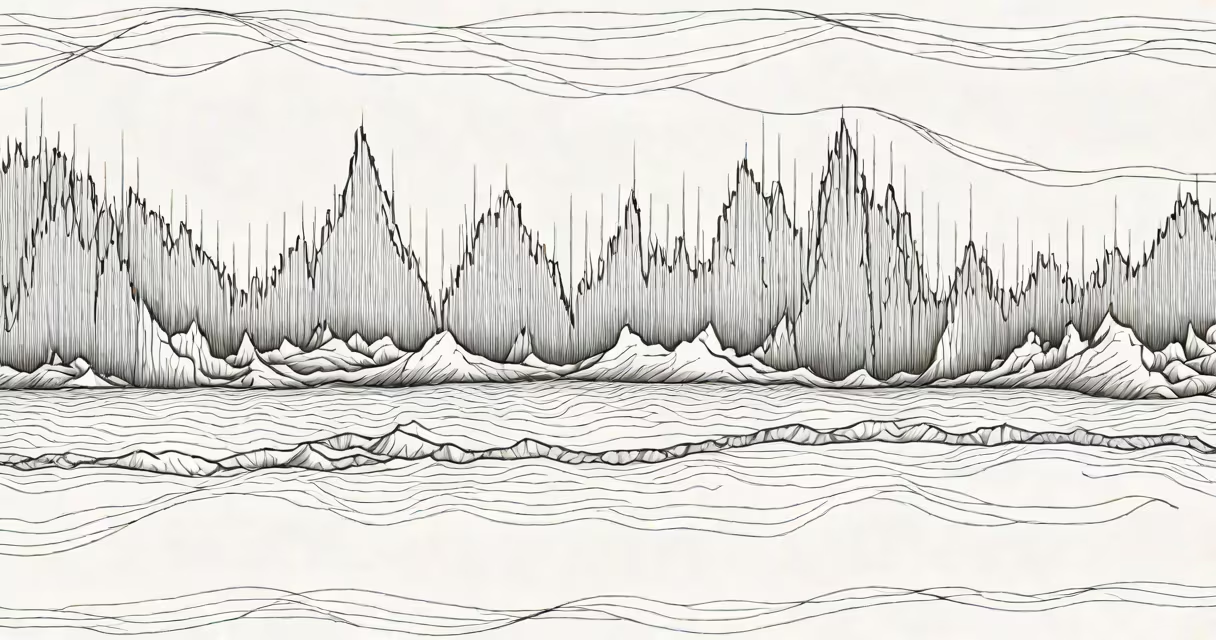
Seismic refers to phenomena related to vibrations or movements within the Earth's crust, most commonly caused by sudden energy release along fault lines. These movements generate seismic waves that travel through rock layers and cause ground shaking. Seismic activity includes earthquakes, volcanic tremors, and human-induced vibrations.
Seismic events originate deep beneath the surface, typically at tectonic plate boundaries where stress builds until rock fractures. The rupture releases stored elastic energy as seismic waves-primary (P-waves), secondary (S-waves), and surface waves-that propagate outward. P-waves compress and expand material in their path; S-waves shear sideways; surface waves move along the Earth's surface and cause the most damage.
Seismologists use instruments called seismographs to detect and record these waves. Data from multiple stations allow scientists to pinpoint an earthquake's epicenter-the point on the surface directly above the focus-and estimate its magnitude. The Richter scale, though widely referenced, measures logarithmic amplitude; each whole number increase represents a tenfold rise in measured amplitude and roughly 31.6 times more energy released.
Earth's outer layer consists of rigid tectonic plates floating on the semi-fluid asthenosphere below. As these plates drift-averaging 2-10 cm per year-they collide, slide past one another, or pull apart. Friction at their edges traps strain until it exceeds rock strength, causing sudden slippage. This slip generates seismic waves.
For example, the 2011 Tōhoku earthquake in Japan occurred when the Pacific Plate subducted under the North American Plate. The resulting rupture spanned over 200 km and released energy equivalent to 600 million tons of TNT. A tsunami followed, triggered by vertical displacement of the seafloor.
Not all seismic events stem from tectonics. Volcanic eruptions produce harmonic tremors and long-period seismic signals due to magma movement. Mining operations and reservoir impoundment can induce quakes by altering subsurface pressure. In 2016, Oklahoma experienced a spike in seismicity linked to wastewater injection wells, with over 900 magnitude 3+ quakes recorded between 2015 and 2017.
Seismic waves fall into three categories based on propagation and particle motion:
| Wave Type | Speed | Motion | Damage Potential |
|---|---|---|---|
| P-waves (Primary) | 5-8 km/s | Compressional (push-pull) | Low - arrive first, often felt as a jolt |
| S-waves (Secondary) | 3-5 km/s | Shear (side-to-side) | Medium - can destroy buildings if they reach surface |
| Surface waves | 2-3 km/s | Rolling or side-to-side motion | High - responsible for most structural damage |
Surface waves, particularly Rayleigh and Love waves, dominate destruction because they move along the surface and amplify on soft soils. During the 1989 Loma Prieta quake, areas built on landfill in San Francisco experienced up to 10 times greater ground acceleration than bedrock sites.
Seismic networks monitor ground motion globally. The United States Geological Survey (USGS) operates over 1,000 seismometers across the country. Real-time data feeds into early warning systems like ShakeAlert, which sends alerts seconds before strong shaking arrives.
ShakeAlert uses P-wave detection to estimate intensity and issue warnings. In 2023, a magnitude 6.4 quake near Napa County triggered alerts 12 seconds before peak shaking. Trains slowed, doors opened automatically, and emergency responders prepared-saving lives and reducing injury risk.
Urban planning relies heavily on seismic hazard maps. California's 2023 update identifies zones prone to liquefaction, landslides, and amplified shaking. Buildings in high-risk areas must meet stricter design codes. For instance, new hospitals in Los Angeles must withstand 2.5g peak ground acceleration-over twice the force of gravity.
Many assume seismic events follow predictable patterns. In reality, earthquakes are statistically random in timing. While aftershocks cluster around the mainshock, they don't indicate future large quakes. The 2011 Virginia earthquake (magnitude 5.8) had no foreshocks, surprising experts who expected precursory activity.
Another myth: "Earthquakes only happen in California." The U.S. experiences over 20,000 detectable quakes annually. The New Madrid Seismic Zone in Missouri produced three major quakes in 1811-1812, estimated at magnitudes 7.5-8.0. These shook the Mississippi Valley and were felt across 10 states.
A lesser-known fact: seismic waves can travel through the Earth's core. P-waves refract and reflect at boundaries, allowing scientists to infer internal structure. The discovery of the Earth's liquid outer core came from analyzing P-wave shadow zones-regions where direct P-waves don't arrive due to refraction.
In 2022, I installed a low-cost seismometer (Quake-Catcher Network node) in my home office. When a magnitude 4.2 quake hit southern Oregon, the device logged 1.8 mm/sec peak ground velocity. The waveform showed clear P-wave arrival 1.2 seconds before S-waves-a pattern visible in professional records. This confirmed that consumer-grade tools can capture meaningful seismic data.
Such networks contribute to research by expanding spatial coverage. The Quake-Catcher Network now includes over 10,000 volunteer sensors worldwide, enhancing detection speed and accuracy in remote regions.
Understanding what is seismic involves recognizing it as both a natural process and a measurable physical phenomenon. From tectonic shifts to engineered responses, seismic science informs safety, infrastructure, and public policy. With accurate data and improved modeling, society can better prepare for inevitable ground motion.
Seismic events remain unpredictable in timing but increasingly understood in mechanism. Continued investment in monitoring and education reduces risk. What is seismic? It is the Earth's changing response to internal forces-measurable, studied, and mitigated through science.