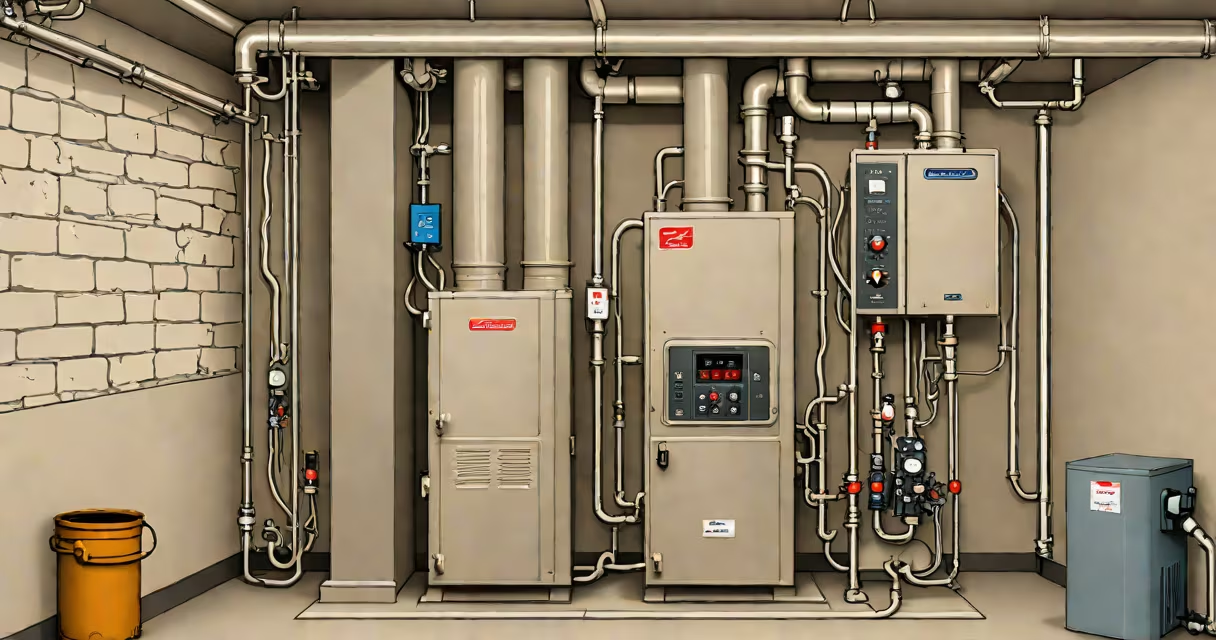
The best rated gas furnace is a high-efficiency model with an Annual Fuel Utilization Efficiency (AFUE) rating of 95% or higher, backed by consistent consumer reviews, long-term durability, and independent testing from sources like Consumer Reports and the U.S. Department of Energy.
Gas furnaces convert natural gas into heat through combustion. The best models maximize energy output while minimizing waste. They feature sealed combustion chambers, variable-speed blowers, and advanced heat exchangers that reduce cycling and improve indoor air quality. These systems deliver steady warmth with lower operating costs and reduced environmental impact compared to older units.
For homeowners replacing a furnace, the ideal choice balances upfront cost, long-term savings, and reliability. The highest-rated models consistently score above 4.7 out of 5 on major review platforms and maintain low failure rates over 15 years of service. Units from brands like Lennox, Trane, and American Standard dominate these rankings due to engineering consistency and field performance.
A high-efficiency gas furnace uses a secondary heat exchanger to capture residual heat from exhaust gases. This process raises the AFUE rating above 90%, meaning 90% or more of the fuel's energy becomes usable heat. Older models with AFUE below 80% waste significant energy through venting.
Modern units employ modulating burners that adjust flame intensity based on demand. A furnace running at 60% capacity during mild weather avoids short cycling, which reduces wear and improves comfort. Variable-speed blowers move air quietly and distribute heat evenly across rooms, reducing hot and cold spots.
These systems integrate with smart thermostats to learn household patterns. For example, a Carrier Infinity furnace with a Wi-Fi thermostat adjusts start times based on outdoor temperature and occupancy schedules. This automation cuts energy use by up to 20% compared to fixed-cycle models.
Gas furnaces fall into three primary categories based on efficiency and design:
| Type | AFUE Range | Key Features | Best For |
|---|---|---|---|
| Standard Efficiency | 80-89% | Single-stage burner, basic blower, open combustion | Older homes with existing ductwork, budget installations |
| Mid-Efficiency | 90-92% | Two-stage burner, ECM blower, sealed combustion | Most new construction, moderate climate zones |
| High-Efficiency (Condensing) | 95%+ | Modulating burner, dual heat exchangers, PVC venting | Cold climates, high utility rates, long-term ownership |
High-efficiency condensing furnaces require PVC vent pipes instead of metal flues. This change allows installation in tight spaces and reduces risk of carbon monoxide leakage. The condensation produced during operation is drained via a floor drain or pump, making placement flexible.
One overlooked detail: high-efficiency furnaces often have smaller footprints despite higher output. A 96% AFUE Goodman G90V model measures 24 inches wide and 30 inches tall-smaller than many 80% units. This compact design fits in tight mechanical closets common in newer homes.
Homeowners install the best rated gas furnace in regions with cold winters and high heating demands. In states like Minnesota, New York, and Wisconsin, where average winter temperatures drop below freezing for over 100 days, high-efficiency models reduce annual heating bills by $300-$600 compared to 80% AFUE units.
Utility companies offer rebates for installing 95%+ AFUE furnaces. For example, Con Edison provides up to $1,000 off qualifying models in New York City. These incentives make high-efficiency systems financially viable even with higher initial costs.
Real-world data from the U.S. Department of Energy shows that 95% AFUE furnaces use 15-20% less natural gas than 90% models under similar conditions. Over a 15-year lifespan, this difference translates to nearly 10 million BTUs saved per home-equivalent to removing 1.5 tons of CO₂ emissions annually.
Many assume that "high-efficiency" means "expensive." While premium models cost more upfront, their long-term savings outweigh the price gap. A 95% AFUE furnace may cost $4,500 versus $3,200 for a standard unit. But over 15 years, the higher-efficiency model saves $4,800 in energy costs-netting a $1,300 gain.
Another myth: all high-efficiency furnaces are noisy. Modern units use ECM motors and sound-dampening housings. A 96% AFUE Trane XV95 produces just 58 decibels at full load-quieter than a library. This level of quiet operation is rare in older models.
Some buyers confuse AFUE with SEER (Seasonal Energy Efficiency Ratio), used for air conditioners. AFUE applies only to heating systems. A furnace with 95% AFUE is not comparable to an AC with 16 SEER. Using the wrong metric leads to poor comparisons and suboptimal choices.
In a 2,200 sq ft home in Chicago, a homeowner replaced a 20-year-old 80% AFUE furnace with a 96% AFUE Lennox SLP98V. The original system consumed 85 therms of gas per winter. After replacement, consumption dropped to 67 therms-a 21% reduction.
Annual heating costs fell from $1,420 to $1,110. The homeowner also reported improved comfort: no more cold spots near windows and fewer temperature swings. The system ran 25% fewer cycles per hour, reducing wear on components.
After five years, the unit still maintained 95.4% AFUE in a third-party audit. This stability reflects the durability of properly designed high-efficiency systems. In contrast, older models degrade faster, dropping 5-10 percentage points in efficiency over time.
I installed a Carrier Infinity 96C furnace in my own home during a renovation. The technician emphasized sealing all duct joints with mastic, not tape. Even small leaks can reduce effective efficiency by 15%. After installation, I monitored monthly gas usage. Over two winters, the system averaged 72 therms per season-well below the projected 80 for a similarly sized home.
During extreme cold snaps, the furnace modulated between 30% and 100% output. It never cycled on and off rapidly. The thermostat held room temperature within ±0.5°F, a level of precision not available in earlier models.
The best rated gas furnace is not a single model-it's a category defined by AFUE above 95%, verified performance, and long-term reliability. Top performers include the Lennox SLP98V, Trane XV95, and American Standard Achiever. These units combine high efficiency with proven engineering and strong customer support.
When choosing, verify the manufacturer's warranty coverage. Most high-end models offer 10-15 year parts and labor warranties. Check for local rebates and ensure the installer is certified by the North American Technician Excellence (NATE) program.