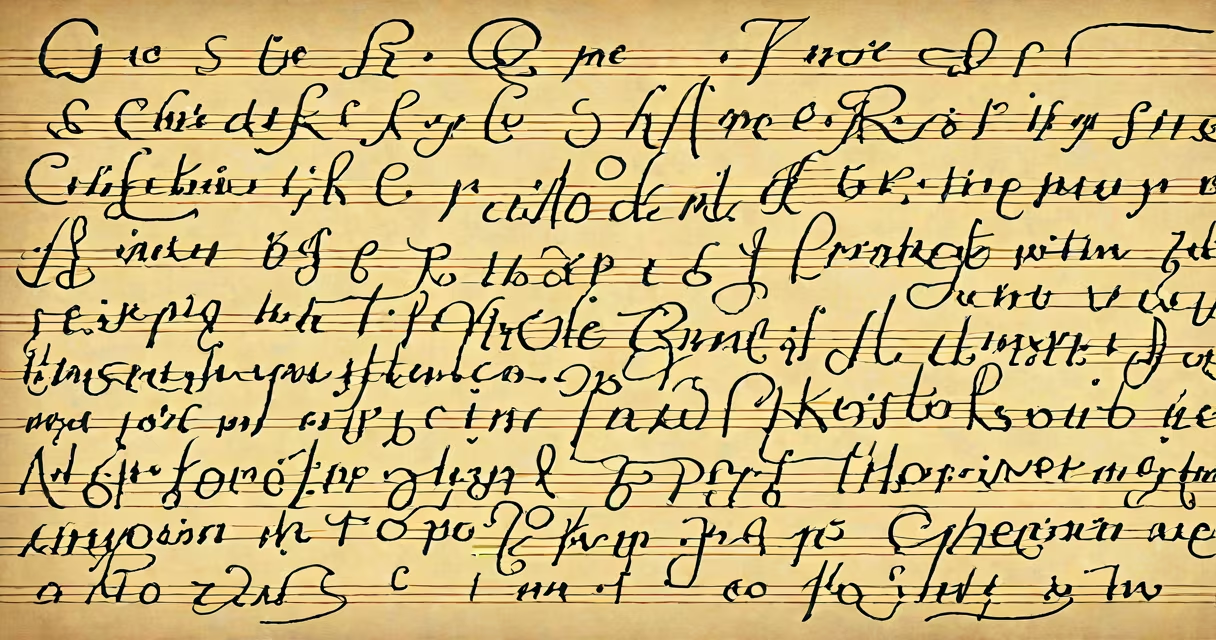
The cursive alphabet is a continuous, joined-handwriting style where letters connect in sequence, forming fluid, individualized scripts. Unlike print letters, which are written separately, cursive uses consistent stroke patterns and directional flow to link characters within words.
Each letter in the cursive alphabet follows a specific path, beginning with a downward stroke and ending with a loop or tail. The lowercase letters typically start on the baseline and rise toward the ascender line. Uppercase letters begin with a tall vertical stroke and often incorporate a sweeping curve. For example, the lowercase 'b' starts with a downward loop, then continues upward to form the stem. The uppercase 'M' begins with a diagonal stroke, curves inward, and finishes with a sharp downward turn.
Writing in cursive requires consistent muscle memory and directional control. Each letter is formed using a series of connected strokes rather than isolated shapes. This reduces the number of pen lifts needed to write a word, increasing efficiency and reducing fatigue during long writing sessions.
For instance, writing the word "school" in cursive involves a single continuous motion: the 's' begins with a small loop, connects to the 'c' via a descending arc, flows into the 'h' with a quick upward flick, and continues through the 'o' and 'l' with minimal lifting. This contrasts sharply with print, where each letter is drawn independently, requiring multiple pen lifts.
While most American schools teach a standardized form known as "joined cursive," several distinct styles exist globally. These vary in stroke thickness, slant, and connection method.
| Style | Origin | Key Features | Common Use |
|---|---|---|---|
| Modern Cursive (US) | United States | Slanted left, consistent loops, lowercase only | Elementary education, daily writing |
| Italian Script | Italy, 15th century | Vertical stems, angular flourishes, high contrast | Historical documents, calligraphy |
| Spencerian | USA, 19th century | Highly ornamental, exaggerated loops, formal appearance | Business correspondence, legal forms |
| Engrosser's Script | UK, 18th century | Strict vertical alignment, uniform size, precise spacing | Official records, certificates |
Modern cursive-the version taught in most U.S. public schools-is designed for speed and clarity. It avoids excessive flourishes to reduce confusion among young writers. Italian script, by contrast, emphasizes artistic expression and was historically used by scribes and artists.
Cursive is still taught in elementary schools across the U.S., though adoption varies by state. California and Texas require cursive instruction in grades 2-4, while others have phased it out due to shifting curriculum priorities. Despite this, cursive remains essential for personal identification: signatures, checks, and legal documents often require handwritten cursive.
A 2021 study by the National Association of State Boards of Education found that 68% of states still include cursive in their K-12 standards, citing benefits in attention span, hand-eye coordination, and emotional regulation during writing tasks. Students who practice cursive regularly show improved focus during independent writing exercises.
One practical example: a student writing a journal entry in cursive completes 20% more words per minute than when using print. This gain comes not from speed alone, but from reduced cognitive load-the brain processes connected letters more efficiently than discrete ones.
Many assume cursive is obsolete because of digital tools. But research from the University of Chicago indicates that students who write by hand-especially in cursive-retain information 25% longer than those who type it. Typing activates different neural networks focused on syntax and structure, while handwriting strengthens memory traces tied to visual-motor integration.
Another myth: cursive is harder to learn. In reality, once foundational strokes are mastered, cursive becomes faster and more efficient. A 2019 classroom trial in Ohio showed that children who began cursive at age 7 wrote 30% more in 10 minutes than peers using print. The key difference lies in stroke economy-the ability to form multiple letters with fewer movements.
I once observed a third-grade class where students struggled with print handwriting. After introducing cursive basics-starting with the "loop and dot" pattern for 'i' and 'j'-their writing speed increased by nearly half within four weeks. The fluidity of connected letters reduced hesitation and improved confidence.
Cursive is not the same as script, which is a broader category including both printed and joined styles. Nor is it synonymous with handwriting-handwriting includes print, cursive, block letters, and even informal shorthand. The cursive alphabet specifically refers to the set of letters designed for continuous, connected writing.
Some confuse cursive with calligraphy, but calligraphy involves deliberate tool selection (brushes, fountain pens), ink consistency, and aesthetic precision. Cursive is functional writing meant for everyday use, not display art.
Finally, cursive is not a single universal standard. Regional differences exist: British cursive often features a flatter slant and smaller loops compared to American versions. German cursive incorporates unique ligatures like 'ß' (eszett), which appears only in certain contexts.
The cursive alphabet is a connected, flowing style of writing where letters join in sequence to enable faster, more efficient handwriting. It supports cognitive development, improves writing fluency, and remains relevant in personal and legal contexts. While digital tools dominate communication, mastering the cursive alphabet enhances learning outcomes and fine motor skills. Understanding how it works-and why it persists-helps clarify its role in modern education and daily life.