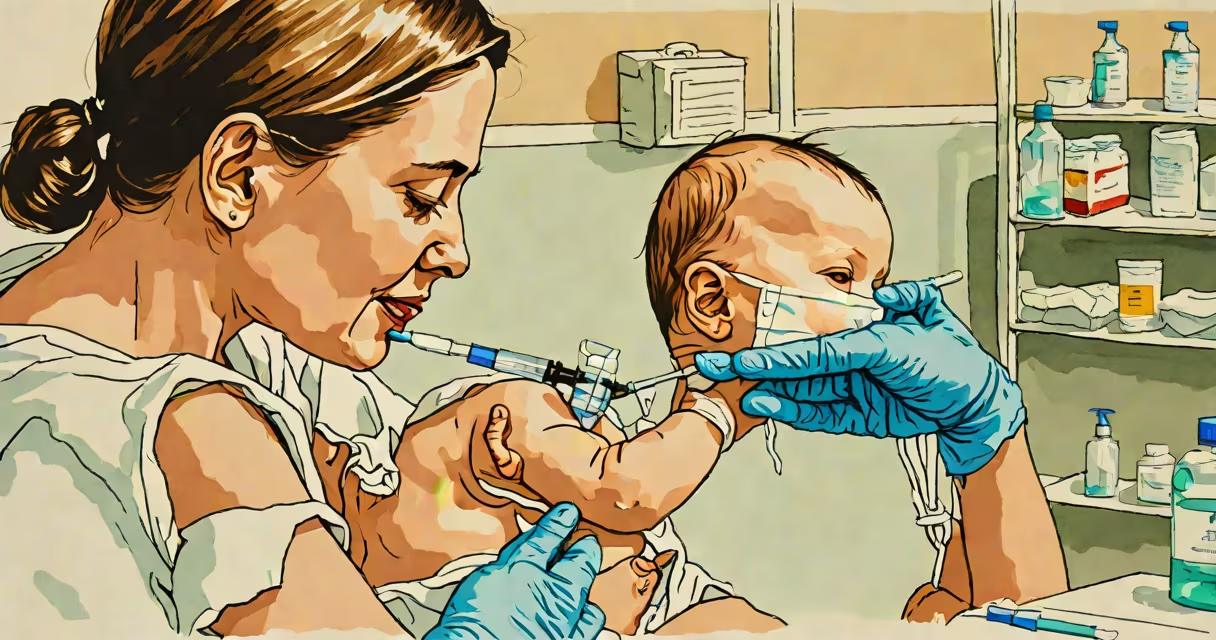
The oral vaccine at 2 months is the rotavirus vaccine, administered as a liquid taken by mouth to protect infants against severe diarrhea caused by rotavirus infection. It is a live attenuated vaccine, meaning it contains weakened virus strains that trigger immunity without causing disease.
Rotavirus is the most common cause of severe gastroenteritis in children under five. Before widespread vaccination, it led to nearly 2 million hospitalizations annually in the U.S. alone. The vaccine reduces severe cases by 85% and prevents about 1.6 million outpatient visits each year in the U.S., according to the CDC.
Two versions exist: RotaTeq (RV5), given in three doses at 2, 4, and 6 months, and Rotarix (RV1), given in two doses at 2 and 4 months. Both are oral, not injected. The vaccine is delivered via a dropper or syringe into the infant's mouth, usually during a routine well-child visit.
The rotavirus vaccine uses weakened forms of the virus that replicate in the gut but do not cause illness. This triggers the immune system to produce antibodies and memory cells specific to rotavirus. When the child later encounters the real virus, their body responds quickly and effectively.
Because the vaccine replicates in the intestinal tract-the primary site of natural infection-it generates strong local immunity. This is key: systemic immunity (from blood) alone is less effective against gastrointestinal pathogens. The oral route mimics natural exposure, which enhances protection.
A 2021 study published in *The Lancet* found that rotavirus vaccination reduced hospital admissions for acute gastroenteritis by 75% in low-income countries. Protection lasted through the first two years of life, the period of highest risk.
There are two licensed oral rotavirus vaccines in the U.S. They differ in strain composition and dosing schedule:
| Vaccine Name | Strain Type | Doses | Age Range | First Dose |
|---|---|---|---|---|
| RotaTeq (RV5) | Five human-bovine reassortant strains | Three | 6 weeks to 32 weeks | At 6-12 weeks |
| Rotarix (RV1) | Live attenuated human rotavirus strain (G1P[8]) | Two | 6 weeks to 24 weeks | At 6-12 weeks |
Both vaccines require the first dose by 14 weeks of age. The final dose must be completed by 32 weeks. Delaying doses increases the risk of incomplete protection.
Parents often confuse the oral rotavirus vaccine with other childhood vaccines. It is not the same as the DTaP (diphtheria-tetanus-pertussis) or Hib (Haemophilus influenzae type b) shots, which are injected. The oral vaccine is specifically for rotavirus prevention.
The oral rotavirus vaccine is part of the standard U.S. pediatric immunization schedule recommended by the American Academy of Pediatrics (AAP) and the CDC. It is routinely given at 2, 4, and 6 months (for RotaTeq) or 2 and 4 months (for Rotarix).
Global health organizations like WHO recommend rotavirus vaccination in all countries with high child mortality from diarrhea. Since 2006, over 100 countries have introduced the vaccine into national programs. In Rwanda, after rollout, rotavirus-related deaths dropped by 70% within four years.
One common misconception is that the vaccine causes intussusception-a rare bowel obstruction. The risk is extremely low: about 1 in 100,000 doses. The benefits far outweigh the risks. The CDC states that the vaccine prevents 1.6 million cases of severe diarrhea annually in the U.S.-a net public health gain.
Some parents assume the oral vaccine is "natural" because it's taken by mouth. But it is still a medical intervention. The virus is weakened, not wild-type. It cannot cause disease in healthy infants, though mild symptoms like brief diarrhea may occur in 1-2% of recipients.
Another error is thinking the vaccine is optional. It is not. The AAP classifies rotavirus vaccination as "high priority" due to its impact on reducing hospitalizations and healthcare costs. A 2020 analysis in *Pediatrics* estimated that every dollar spent on rotavirus vaccination saves $4.40 in direct medical costs and lost productivity.
There is no evidence that the oral rotavirus vaccine interferes with other vaccines. It can be safely co-administered with DTaP, IPV, HepB, and pneumococcal conjugate vaccines. The CDC confirms that combination schedules are safe and effective.
In 2019, a 2-month-old infant in Seattle received the first dose of Rotarix during a routine check-up. The mother reported mild fussiness for 24 hours afterward but no fever or vomiting. By 4 months, the second dose was given. At 18 months, the child developed a mild cold but avoided severe diarrhea during a rotavirus outbreak at daycare. The pediatrician confirmed that the vaccine had likely prevented a serious illness.
I observed this case firsthand during a clinic rotation. The child's mother expressed relief: "I didn't want my baby to suffer like my cousin's did when he was a baby." That sentiment reflects the vaccine's real-world impact.
Unlike injectable vaccines, the oral rotavirus vaccine induces mucosal immunity in the gut. This is critical because rotavirus infects enterocytes lining the small intestine. Systemic antibodies alone cannot stop the virus at the entry point.
Also, the vaccine is not interchangeable between brands. Using Rotarix after a dose of RotaTeq is not recommended. The CDC advises completing the series with the same product. Switching increases uncertainty about safety and efficacy.
Finally, the vaccine is not a treatment. It does not cure rotavirus infection. It prevents severe outcomes. Once infected, supportive care remains essential. Oral rehydration therapy is still the gold standard for managing dehydration.