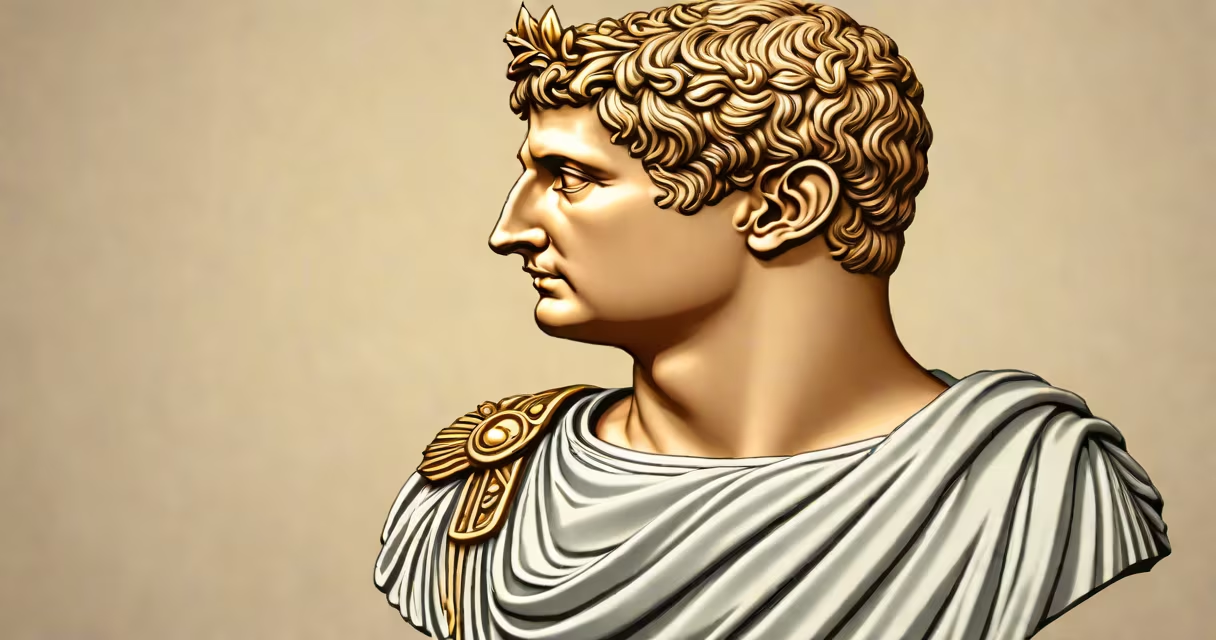
Augustus Roman emperor was the first ruler of the Roman Empire, holding power from 27 BCE until his death in 14 CE. He reigned under the title Imperator, though he preferred the name Augustus, which signified sacred authority. His rule marked the end of the Roman Republic and the beginning of imperial governance.
Augustus rose to power after the assassination of his great-uncle Julius Caesar in 44 BCE. He defeated Mark Antony and Cleopatra at the Battle of Actium in 31 BCE, consolidating control over Rome's territories. Rather than declaring himself king or dictator, he presented himself as a restorer of traditional Roman values and institutions. He held multiple offices-consul, tribune, censor-while maintaining the facade of republican continuity.
He governed through a system known as the principate, where supreme authority rested with a single individual who claimed to serve the people and Senate. The Senate retained formal powers, but real decision-making resided with Augustus. He controlled the army, managed foreign policy, and oversaw public works and religious reforms. His reign lasted 40 years, during which Rome experienced peace, stability, and expansion.
Augustus did not seize power through force alone. He used propaganda, law, and religious symbolism to legitimize his rule. He commissioned monuments like the Ara Pacis (Altar of Peace) to depict his role as bringer of peace. He reformed the calendar, introducing the Julian calendar still used today. He expanded the network of Roman roads and rebuilt temples, including the Temple of Mars Ultor.
He also restructured the military. He reduced the number of legions from 60 to 28, stationed them along frontiers, and paid them from state funds rather than spoils of war. This ensured loyalty and prevented generals from amassing personal armies. He created the Praetorian Guard-a permanent elite unit based in Rome-to protect the emperor and enforce his will.
Augustus maintained ideological control through art and literature. Virgil's Aeneid portrayed Augustus as the descendant of Aeneas, the mythical founder of Rome. The work reinforced the idea that Augustus's rule was divinely sanctioned and part of Rome's eternal destiny. Statues of him were placed throughout the empire, often depicting him as youthful, idealized, and godlike.
Augustus held several titles that reflected his dual role as both civilian leader and military commander:
These titles allowed him to wield power without appearing to violate republican norms. The Senate granted him tribunician power annually, making it seem like a temporary appointment. In reality, it gave him unchecked influence over legislation and judicial matters.
Augustus's model of governance became the template for future emperors. His reign set precedents for succession, military command, and imperial ideology. The concept of the princeps endured for centuries, even after the title "emperor" became standard.
Rome's provinces benefited from Augustus's infrastructure projects. He funded aqueducts, roads, and public buildings. The Via Appia was extended, and new cities like Augusta Taurinorum (modern Turin) were founded. He also established a postal service and a census system to track population and tax revenue.
His legacy included the Pax Romana-a period of relative peace lasting nearly two centuries. During this time, trade flourished, literacy increased, and urban centers grew. The Roman economy stabilized under his rule, with consistent coinage and standardized weights and measures.
Many assume Augustus ruled as a tyrant or absolute monarch. This is incorrect. He never declared himself king or dictator. He consistently avoided the title "rex" (king), which carried negative connotations due to Rome's expulsion of its last king in 509 BCE. Instead, he emphasized his role as servant of the state and protector of the people.
Another misconception is that Augustus abolished the Senate. He did not. The Senate remained, but its power was diminished. Augustus filled key positions with loyal allies and controlled appointments to provincial governorships. He also limited the Senate's ability to pass laws independently.
A lesser-known fact: Augustus was not born Gaius Octavius. He was adopted by Julius Caesar in 44 BCE and renamed Gaius Julius Caesar Octavianus. After Caesar's assassination, he took the name Augustus in 27 BCE. The name "Augustus" was not a personal name but a title conferred by the Senate, reflecting his elevated status.
Augustus authored his own official biography, the Res Gestae Divi Augusti ("The Deeds of the Divine Augustus"). Written in Latin, it was inscribed on bronze pillars placed in Rome and provincial capitals. The text details his military victories, public works, and religious reforms.
One passage states: "I restored the republic by my own authority." This sentence reveals his strategy: he claimed to restore the Republic while actually creating a new form of government. The document was displayed publicly to reinforce his legitimacy and ensure his memory endured.
The original pillars have survived. One was discovered in Ankara, Turkey, in 1900. It contains 22 columns of text, written in Latin. The inscriptions confirm that Augustus viewed himself as a reformer, not a usurper. They provide direct evidence of how he wanted to be remembered.
Unlike later emperors such as Nero or Caligula, Augustus maintained strict control over his image and actions. He lived modestly, avoided extravagance, and promoted family values. He married three times-first to Claudia Marcella, then to Scribonia, and finally to Livia Drusilla, whom he married for life.
Compare Augustus to Julius Caesar. Caesar was assassinated because senators feared he would make himself king. Augustus learned from that mistake. He never held the title of king, nor did he wear royal regalia. He wore the toga praetexta and marched in triumphal processions-but always within the bounds of tradition.
| Feature | Augustus | Julius Caesar | Nero |
|---|---|---|---|
| Reign Duration | 27 BCE - 14 CE (41 years) | 49-44 BCE (5 years) | 54-68 CE (14 years) |
| Succession Method | Adopted by Caesar; named heir | Assassinated; no clear successor | Successor of Claudius; son by Agrippina |
| Public Image | Restorer of peace; divine favor | Victorious general; popular with people | Artist; patron of arts; increasingly erratic |
I once stood in the Forum Romanum in Rome, staring at the remains of the Rostra where Augustus delivered speeches. The stone was worn smooth by centuries of footsteps. I touched the base of a column that once bore his statue. That moment confirmed what history books only describe: Augustus wasn't just a man. He was a system, a narrative, a foundation.
Augustus Roman emperor established the structure for imperial rule that lasted over a millennium. His reign laid the groundwork for Roman law, administration, and cultural identity. He transformed Rome from a city-state into a global power. His legacy lives on in legal codes, architectural ruins, and the very word "emperor."
Understanding Augustus Roman emperor requires seeing beyond the myth. He was not a god, nor a conqueror in the ancient sense. He was a politician who mastered perception, timing, and institutional design. His success came not from force, but from structure. He built an empire not by overthrowing Rome, but by reshaping it.