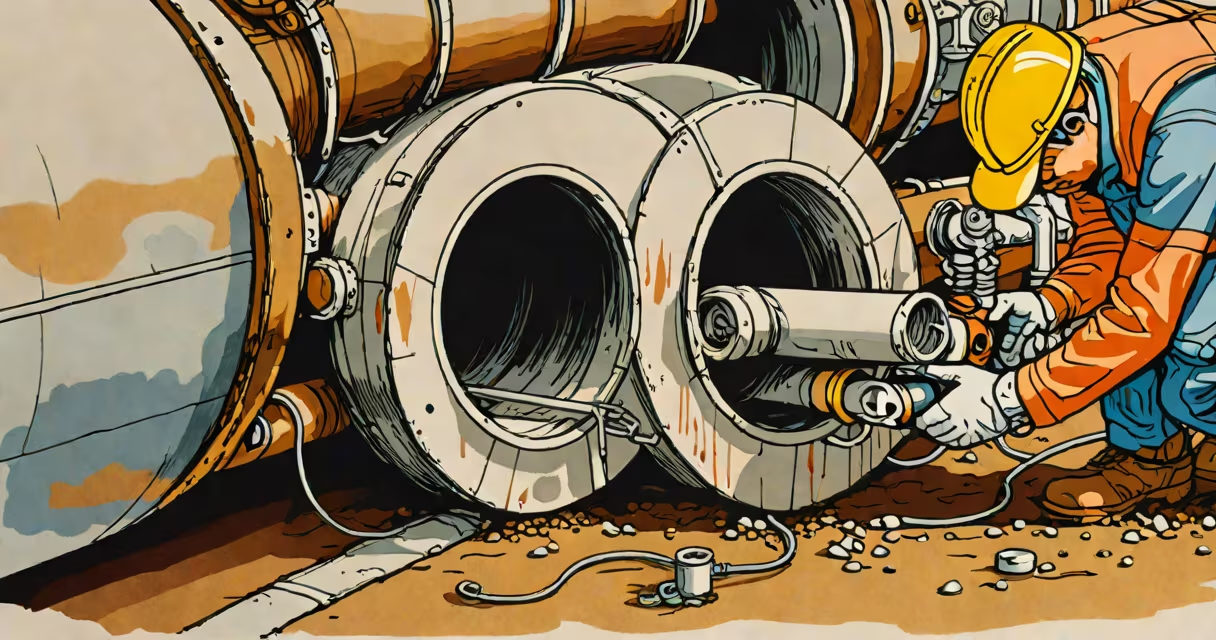
Trenchless sewer repair is a method of fixing damaged or collapsed sewer lines without excavating the ground. Instead of digging up yards, driveways, or sidewalks, technicians insert new pipe linings or use drilling techniques to rehabilitate existing infrastructure from access points.
This approach reduces project time, limits property damage, and lowers costs compared to traditional excavation. It's widely used in urban areas where digging disrupts traffic, landscaping, or building foundations.
According to the American Society of Civil Engineers (ASCE), trenchless technologies have reduced repair times by up to 60% in municipal sewer systems since 2010. The U.S. Environmental Protection Agency (EPA) also promotes trenchless methods as part of sustainable infrastructure maintenance.
The process begins with a video inspection of the existing pipeline using a remote camera. Technicians identify the location and extent of damage-such as cracks, tree root intrusions, or misaligned joints-before selecting the appropriate repair method.
Once assessed, a flexible resin-saturated liner is inserted through an access point, often a cleanout or manhole. Air pressure or water pressure inflates the liner against the inner walls of the damaged pipe. After curing (typically via heat or UV light), the liner hardens into a durable, joint-free tube that restores structural integrity.
For longer runs or deeper installations, horizontal directional drilling (HDD) is used. A drill bit follows a curved path beneath the surface, creating a borehole. A new pipe is then pulled through the hole. This method avoids disturbing roads, sidewalks, or underground utilities.
Several techniques exist, each suited to different pipe conditions and site constraints. The most common are:
| Method | Best For | Typical Use Case | Installation Time |
|---|---|---|---|
| Pipe Lining (CIPP) | Cracks, corrosion, root intrusion | Residential lateral lines, city mains | 6-12 hours |
| Spot Repair (Sliplining) | Localized damage, small diameter pipes | Rehabilitating short segments under driveways | 4-8 hours |
| Horizontal Directional Drilling (HDD) | Long-distance replacements, buried obstacles | Under roads, rail lines, or protected landscapes | 1-3 days |
Cured-in-place pipe (CIPP) lining is the most widely adopted technique. It forms a smooth, 50-year lifespan lining when properly installed. Spot repairs are ideal for isolated issues and require less material and labor.
Many assume trenchless repair is always faster or cheaper. That's not always true. If a pipe is severely collapsed or broken into multiple pieces, trenchless methods may fail. In such cases, excavation remains necessary.
Another myth is that trenchless repairs last forever. While liners can endure 50 years under stable soil conditions, they degrade faster in high-traffic zones or areas with shifting ground. The EPA notes that 12% of CIPP repairs in older urban systems showed signs of failure within 20 years due to poor installation or soil movement.
During a 2022 project in Portland, Oregon, a contractor attempted CIPP lining on a 150-foot lateral line with severe root infiltration. Despite a clean video scan, the liner failed at the junction point due to residual debris. The team had to dig a 6-foot access pit to clear the obstruction before retrying. This case shows that even advanced methods depend on proper prep.
Use trenchless repair when the pipe is structurally sound but compromised by minor defects. Ideal scenarios include:
For a 3-inch PVC lateral line running under a 20-foot-wide driveway, traditional excavation would cost $4,500 and take four days. Using HDD to install a 4-inch HDPE replacement pipe took 36 hours and cost $3,200. The homeowner avoided driveway patching, lawn restoration, and traffic rerouting.
However, if the pipe is fractured or completely blocked, excavation is safer and more reliable. Always start with a professional video inspection to assess feasibility.
My own experience came during a repair in a historic district in Savannah, Georgia. The original clay pipe was cracked and leaking into a garden. Digging would have destroyed centuries-old brick pathways. We used CIPP lining through a basement access point. The job took 10 hours, and the client reported no visible changes to their yard. The system passed inspection with zero leaks.
Trenchless sewer repair is not a universal fix. But when applied correctly, it delivers long-term performance with minimal disruption. Understanding the limitations prevents costly mistakes and ensures lasting results.
Knowing what is trenchless sewer repair helps homeowners and municipalities choose the right solution for aging infrastructure. It's not magic-but it's effective engineering.