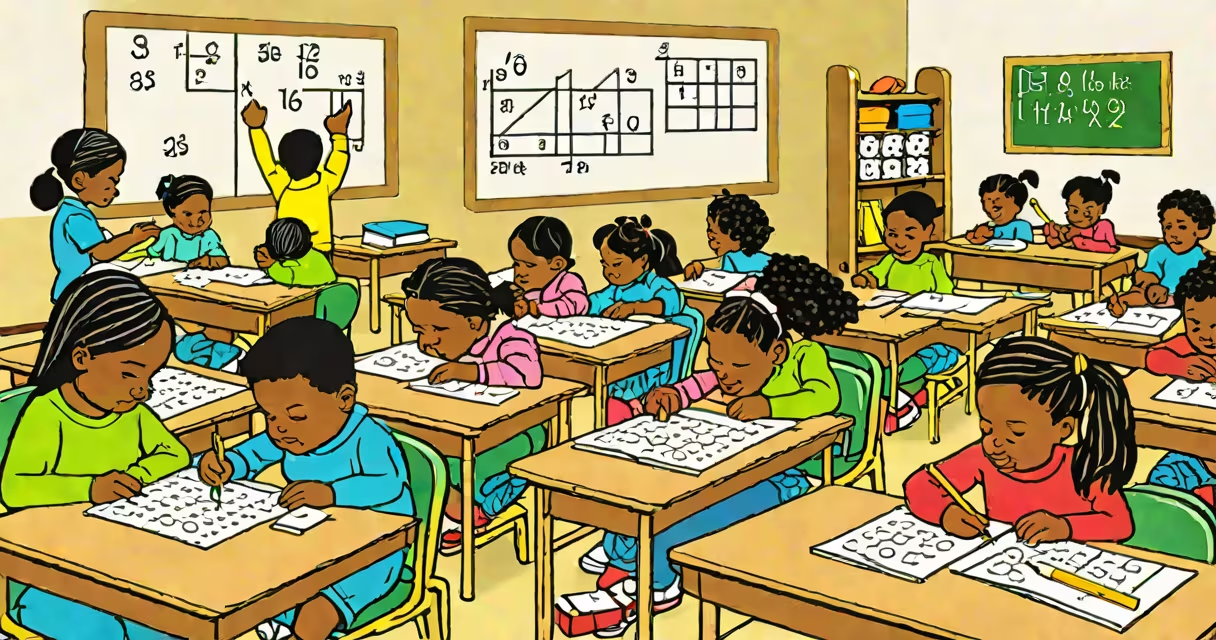
First graders develop core math skills through hands-on activities and structured lessons focused on number sense, addition, subtraction, place value, measurement, and basic geometry. They learn to count to 120, solve word problems within 20, and understand the relationship between numbers and quantities.
Math in first grade builds on kindergarten foundations. Students move beyond rote counting to understanding how numbers represent amounts. They compare groups of objects, identify odd and even numbers, and begin recognizing patterns in sequences. The Common Core State Standards define this stage as critical for developing mental math fluency and problem-solving confidence.
Classroom instruction uses manipulatives like counters, number lines, and base-ten blocks. Teachers emphasize conceptual understanding over memorization. For example, students might use ten frames to visualize how 8 + 5 equals 13 by filling one frame completely and adding three more dots.
First graders focus on four key areas: number operations, place value, measurement, and geometry. These form the foundation for later math success.
These topics align with the National Council of Teachers of Mathematics (NCTM) standards, which stress reasoning, communication, and application. By the end of the year, most students can explain their thinking when solving problems, not just give answers.
Instruction follows a progression from concrete to abstract. Lessons start with physical objects, then move to drawings, and finally symbolic equations. This method supports cognitive development and reduces confusion.
A typical daily math block includes five components:
For example, when learning subtraction, a teacher might show 12 counters, remove 5, and ask how many remain. Students then draw the scenario, write the equation (12 - 5 = 7), and explain their process aloud.
Research from the University of Chicago's Center for Elementary Mathematics and Science Education confirms that this sequence improves retention. Students who engage with multiple representations of a concept score 25% higher on assessments than those taught through drills alone.
Many parents assume first grade is just "counting and adding." But the focus is deeper: understanding relationships between numbers and applying logic. A child may correctly add 6 + 7 = 13 but fail to explain why they regrouped.
Another misconception is that all first graders should master addition facts by memory. While fluency is expected, the goal is flexible thinking. A student might solve 9 + 6 by thinking "9 + 1 = 10, then 10 + 5 = 15," showing number sense rather than recall.
Some schools introduce early algebraic thinking through missing addend problems. For instance, "___ + 8 = 12" teaches inverse operations. This is not advanced-it's part of the standard curriculum. According to the National Mathematics Advisory Panel, early exposure to algebraic reasoning correlates strongly with long-term achievement.
Math in first grade appears in everyday situations. A student might sort buttons by color and count how many are red versus blue. Or they might measure classroom objects using rulers marked in inches.
Consider a word problem from a common first-grade workbook: "Liam has 14 marbles. He gives 6 to his friend. How many does he have left?" A correct response involves drawing 14 circles, crossing out 6, and counting the remainder. The student writes "14 - 6 = 8" and explains, "I took away six and counted the rest."
Teachers assess progress through observations, exit tickets, and informal quizzes. A student who consistently uses efficient strategies-like turning 8 + 7 into 8 + 2 + 5-is demonstrating growth beyond basic computation.
| Topic | Key Skill | Example Activity |
|---|---|---|
| Addition & Subtraction | Solve within 20 using strategies | Use number bonds to show 9 + 6 = 15 |
| Place Value | Understand tens and ones | Build 34 with 3 rods and 4 cubes |
| Measurement | Compare lengths using non-standard units | Measure desk width using paper clips |
| Geometry | Identify shapes by attributes | Sort shapes into groups: triangles vs. quadrilaterals |
I once observed a first-grade class where students used plastic bears to model story problems. One child solved "There were 12 bears. 5 went to sleep. How many stayed awake?" by placing 12 bears on a mat, removing 5, and counting the remaining 7. The teacher asked, "Why did you take away?" The student replied, "Because they went to sleep." That moment revealed deep conceptual understanding-not just a correct answer.
Students who struggle often benefit from small-group interventions using visual aids. Research from the Institute of Education Sciences shows that targeted instruction improves outcomes by 30% compared to whole-class review.
Parents can support learning by asking open-ended questions during daily routines: "How many spoons do we need for dinner?" or "Which box is heavier?" These conversations build number sense and vocabulary.
By mastering number sense, operations, and spatial reasoning, first graders gain tools they'll use throughout life. What math do 1st graders learn? Not just arithmetic-but the mindset behind it: curiosity, logic, and persistence.