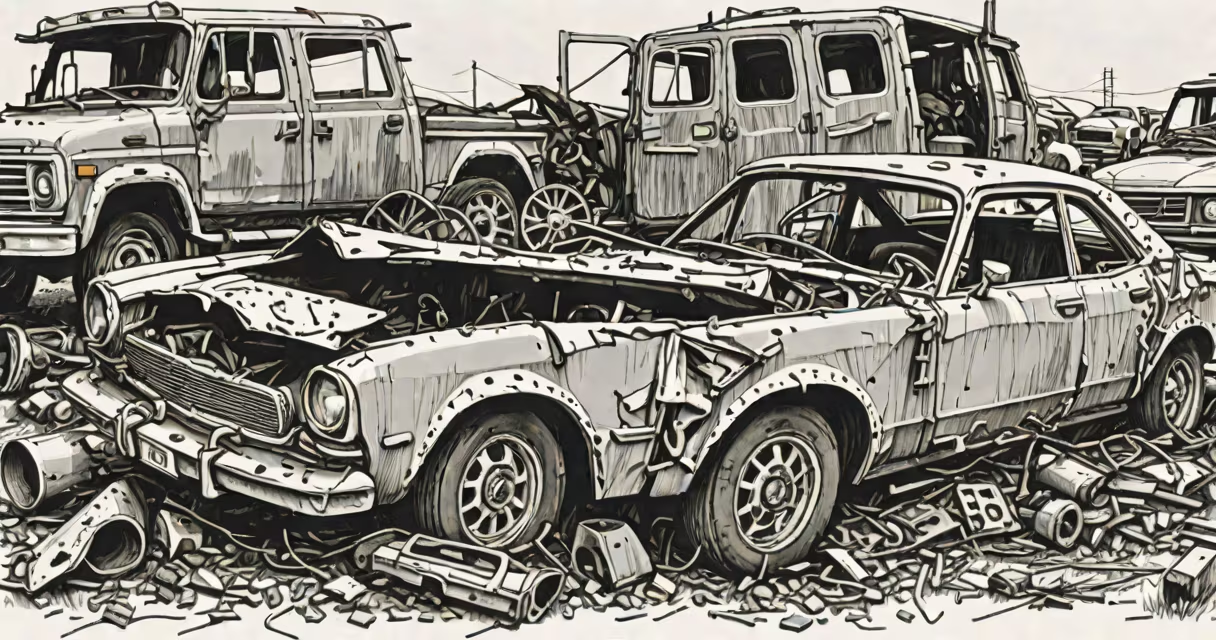
The scrap value of a car is the cash paid for its recycled metal and reusable components after it's deemed totaled, unrepairable, or no longer roadworthy. It's based on the vehicle's weight, current scrap metal prices, and the presence of valuable materials like aluminum, copper, and catalytic converters.
Most scrap yards pay between $100 and $500 for a typical passenger car, though prices fluctuate with market demand. A 2015 Honda Civic weighing 3,000 pounds might fetch $220 at a rate of $0.07 per pound. Larger vehicles, such as SUVs or trucks, often exceed $400 due to higher mass and more recyclable material.
Scrap value differs from trade-in or resale value. While a working car may sell for thousands, its scrap value reflects only the worth of its raw materials. This value is determined by weight, local scrap rates, and the condition of the vehicle's core components.
Scrap yards assess a car's value using three main factors: weight, scrap metal pricing, and component salvageability. The process begins with weighing the vehicle on a scale. Most yards charge per pound, so heavier cars yield higher returns.
Current scrap metal prices vary daily. As of April 2024, steel averaged $0.33 per pound, aluminum $1.10, and copper $4.20. A car with significant aluminum content-such as a 2020 Tesla Model 3-can command more than a traditional steel-bodied sedan. Catalytic converters, which contain platinum, palladium, and rhodium, are especially valuable. One converter can be worth $150-$300 depending on the make and model.
Yards also inspect for usable parts. Engines, transmissions, wheels, and batteries may be sold separately. A working engine from a 2010 Toyota Camry could net $200-$400 in parts resale. However, if the car is crushed or dismantled before pickup, these components lose value.
| Vehicle Type | Avg. Weight (lbs) | Scrap Metal Rate (avg. $/lb) | Estimated Scrap Value |
|---|---|---|---|
| Compact car (e.g., Honda Civic) | 3,000 | $0.07 | $210 |
| SUV (e.g., Ford Explorer) | 4,500 | $0.07 | $315 |
| Truck (e.g., Ford F-150) | 5,200 | $0.07 | $364 |
| Hybrid (e.g., Toyota Prius) | 3,200 | $0.07 | $224 |
Prices are not fixed. During the 2022-2023 surge in metal demand, scrap steel prices rose 40%. A car that fetched $200 in early 2022 could return $300 later that year. Real-time pricing tools from local scrap yards or online platforms like AutoRecycle.com provide updated estimates.
Many assume all scrap cars are worth the same. That's false. A 2005 Ford F-150 with high steel content may earn more than a 2018 BMW 3 Series with lightweight alloys. Aluminum-heavy models, while efficient, reduce scrap value because aluminum trades at a lower rate than steel in most regions.
Another myth: "I'll get more if I remove parts myself." Removing parts can actually lower your payout. Scrap yards pay more for intact vehicles because they can extract multiple components efficiently. Disassembling a car risks losing access to high-value parts like catalytic converters or alternators. One yard in Ohio reported a 15% average loss in payout when customers removed engines prior to pickup.
Some believe scrap value includes insurance or trade-in credit. It does not. Insurance payouts for totaled vehicles are based on market value, not scrap. A car declared a total loss might receive $5,000 from a lender, but its scrap value remains under $500. These are separate financial outcomes.
A 2012 Toyota Camry, 150,000 miles, totaled in a collision, was towed to a scrap yard in Detroit. The yard weighed it at 3,300 pounds. At $0.065 per pound, the base metal payment was $214.50. The yard also extracted the catalytic converter, valued at $180 due to its palladium content. The battery and alternator were sold separately for $45. Total payout: $439.50.
This example shows how non-metal components contribute. Without the converter, the payout would have dropped to $214.50. The vehicle had no working engine or transmission, so those weren't salvaged. The final amount reflects both weight and recoverable parts.
I once visited a scrap yard in Milwaukee where a worker pulled a catalytic converter from a 2010 Subaru Outback. He held it up and said, "This one's worth more than the car's frame." The converter sold for $240 that week. It wasn't the car's weight that drove the value-it was a single part.
Scrap yards operate in nearly every U.S. state. Look for licensed facilities with a Department of Transportation (DOT) permit. Reputable yards provide instant cash, weigh the vehicle on-site, and issue receipts. Avoid unlicensed scrapyards that offer "cash on the spot" without documentation-they may underpay or steal parts.
For maximum return, remove personal items and ensure the car is empty. Some yards deduct fees for fluids like oil, coolant, or gas. Drain them before towing. Also, confirm the yard accepts your vehicle's make and model. Some older models with lead-acid batteries or asbestos-lined brakes require special handling.
When selling, ask for a written quote. Reputable yards provide a breakdown: base metal rate × weight, plus part values. If the quote doesn't list individual components, request clarification. A transparent process prevents disputes.
The scrap value of a car is not a guess-it's a calculation based on weight, current metal prices, and salvageable parts. It's rarely more than $500 for standard vehicles, but can exceed $1,000 for high-aluminum or hybrid models with valuable components. Understanding this value helps owners decide whether to scrap, repair, or donate a totaled vehicle.