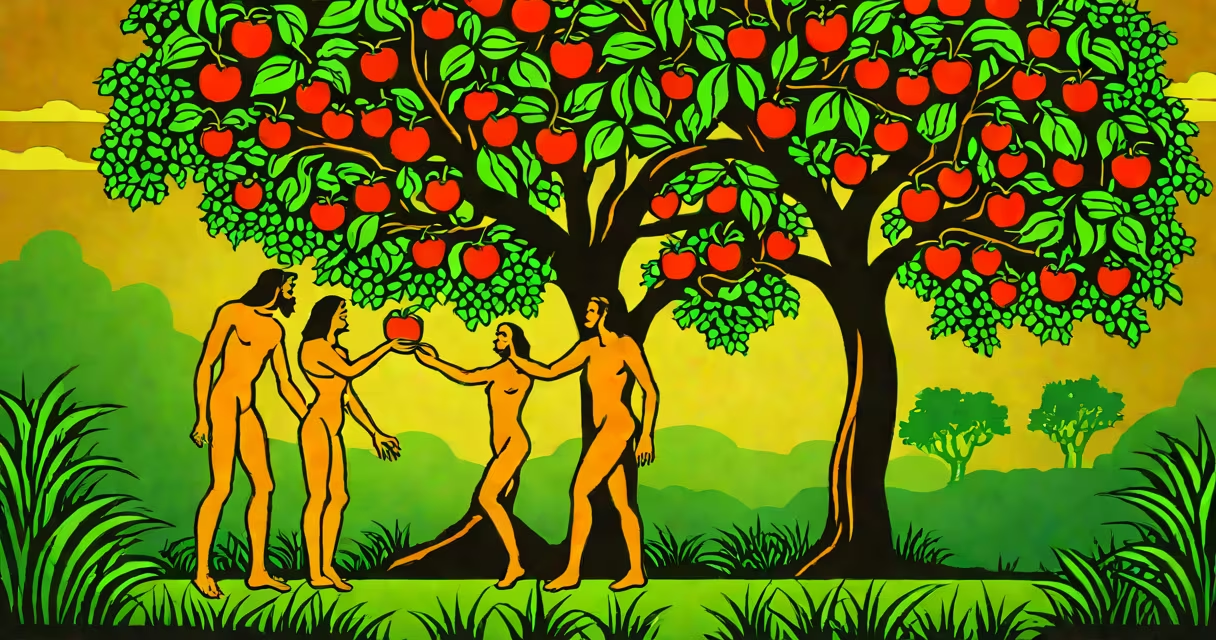
Adam's sin was disobeying God's explicit command not to eat from the Tree of Knowledge of Good and Evil. He consumed the fruit despite knowing it was forbidden, resulting in spiritual death and expulsion from Eden.
The narrative appears in Genesis 2:16-17 and 3:1-7. God told Adam, "You are free to eat from any tree in the garden; but you must not eat from the tree of the knowledge of good and evil, for when you eat from it you will certainly die." Adam ate the fruit after being tempted by the serpent and influenced by Eve's actions.
This act was not merely a dietary violation-it represented a fundamental rejection of divine authority. The fruit symbolized moral autonomy, the desire to define right and wrong independently of God. The consequence was immediate: spiritual separation from God, followed by physical mortality and exile from Eden.
God placed Adam in the Garden of Eden and gave him clear boundaries. The prohibition was absolute: "On the day you eat from it, you will certainly die." The word "certainly" underscores inevitability-not metaphorical, but literal. Death entered creation through Adam's choice.
When Adam ate the fruit, he didn't gain wisdom in the way the serpent implied. Instead, he gained awareness of shame and guilt. Genesis 3:7 states, "Then the eyes of both of them were opened, and they realized they were naked." They hid from God, marking the beginning of alienation.
Adam's decision wasn't isolated. He was aware of the command and chose to disregard it. His action was deliberate, not accidental. The Bible records his response to God's questioning: "The woman you put here with me-she gave me fruit from the tree, and I ate." He blamed Eve, who in turn blamed the serpent. Responsibility was passed, not accepted.
The fruit itself is never described in detail-no color, taste, or species. The Bible never says whether it was an apple, fig, or something else. The focus is not on the fruit's nature but on the act of disobedience. The tree's name-"Tree of Knowledge of Good and Evil"-defines its purpose: it offered moral discernment apart from divine revelation.
Early Church theologians like Augustine of Hippo interpreted this as the origin of original sin-the inherited condition of human fallenness. He wrote in *City of God* (Book 14, Chapter 14): "For the first man, by disobedience, brought upon himself and all his posterity the penalty of eternal death." This doctrine shaped Christian theology for centuries.
Modern scholars such as John Walton, professor of Old Proof at Wheaton College, argue that the story functions as a covenantal narrative rather than a scientific account. In *The Lost World of Genesis One*, he notes that the tree represents a boundary of trust, not a test of knowledge. The real issue was obedience, not intellectual curiosity.
Many assume Adam sinned by seeking knowledge. But the text shows he was not curious-he was tempted. The serpent lied: "You will not certainly die," he said. The lie was that disobedience wouldn't bring death. Adam believed the deception and acted.
Another error is thinking Eve was the primary sinner. While she took the fruit first and gave it to Adam, Scripture identifies Adam as the one who made the final choice. Romans 5:12 states, "Therefore, just as sin entered the world through one man, and death through sin, and in this way death came to all people, because all sinned." Paul attributes the fall to Adam's act, not Eve's.
A third myth is that the fruit caused a sudden moral awakening. But Genesis shows the change was internal: Adam and Eve became aware of their nakedness and felt shame. Their relationship with God shifted from intimacy to fear. The loss wasn't in knowledge-but in trust.
The story of Adam's sin underpins core Christian doctrines. Original sin explains why humans struggle with evil, why justice and mercy are needed, and why redemption through Christ is necessary. Paul writes in Romans 5:15-19 that Adam's one trespass led to condemnation, while Christ's one act of righteousness leads to justification.
Religious traditions differ on how the sin affects individuals. Catholic teaching holds that baptism removes original sin, though the inclination to sin remains. Eastern Orthodoxy sees the fall as a rupture in communion with God, not a legal penalty. Both agree: Adam's disobedience altered human nature.
In practice, the story warns against prioritizing personal desire over divine command. It illustrates that freedom without responsibility leads to brokenness. When Adam chose autonomy, he surrendered his role as steward to God's rule.
While Adam's specific act was disobedience, the story contains multiple layers of transgression:
| Type of Sin | Description | Scripture Reference |
|---|---|---|
| Disobedience | Violating a direct command from God. | Genesis 2:17 |
| Lying | Blaming others instead of accepting fault. | Genesis 3:12 |
| Rebellion | Seeking to be like God, independent of divine will. | Isaiah 14:12-14 (parallel imagery) |
These forms of sin are not separate events-they are interconnected. Adam's disobedience enabled the lie, which led to blame-shifting and spiritual pride.
I once stood in a museum exhibit featuring a 12th-century illuminated manuscript of Genesis. The image showed Adam and Eve beneath the Tree of Knowledge, with the serpent coiled around the trunk. The artist depicted the fruit as a red, glowing orb. What struck me wasn't the artistry-it was the silence in the room. People paused, not to admire the colors, but to reflect on the weight of one choice. That moment reminded me: the story isn't about ancient history. It's about the choices we still make today.
Most explanations treat Adam's sin as a single event. But the biblical text frames it as a sequence: temptation → desire → disobedience → consequences. The key difference lies in timing. Adam knew the command before eating. He wasn't tricked by ignorance-he was corrupted by desire. This makes his sin not a mistake, but a betrayal of trust.
As scholar N.T. Wright notes in *Paul and the Faithfulness of God*, "Adam's failure was not in learning, but in loyalty. He failed to remain faithful to the one who had given him life." This shifts the focus from intellect to relationship-something many modern interpretations overlook.
Adam committed the sin of disobedience by eating the forbidden fruit from the Tree of Knowledge of Good and Evil. This act broke his covenant with God, introduced spiritual and physical death into creation, and set the stage for humanity's need for redemption. The story of what sin Adam committed is foundational to understanding human nature, moral failure, and divine grace.