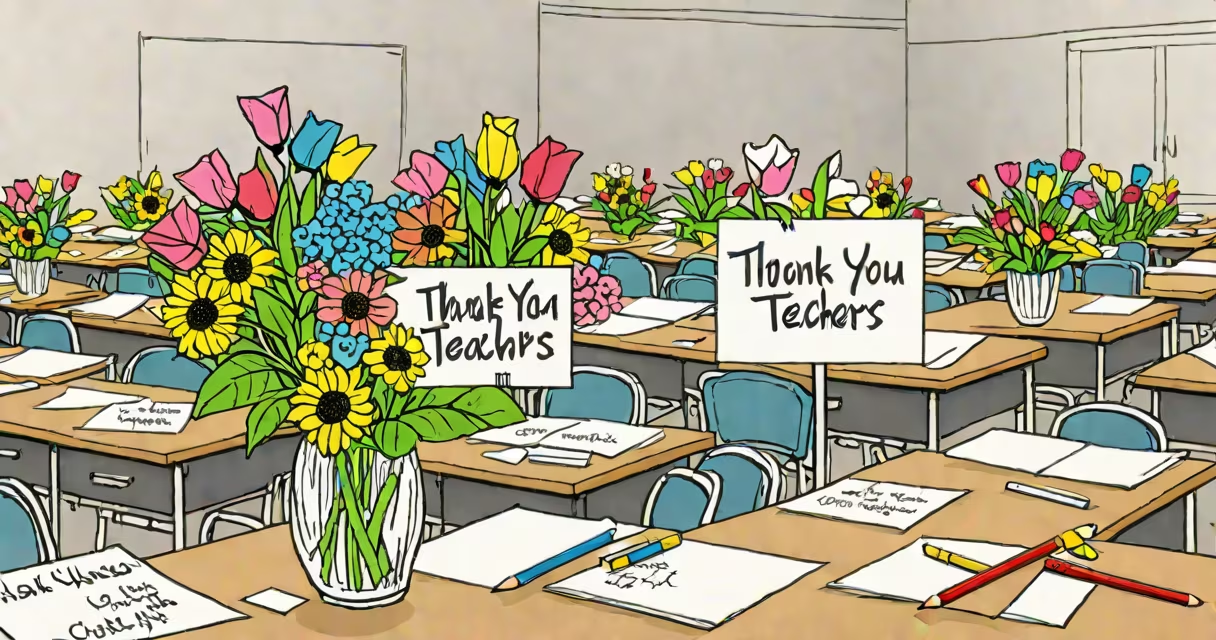
Teacher Appreciation Day is observed annually on the first Tuesday of May and honors educators for their impact on students' lives. It's a day to recognize teachers' dedication through personalized gestures, thoughtful gifts, and school-wide recognition events.
While many schools distribute generic gift bags or host brief assemblies, the most effective appreciation efforts focus on authenticity. A 2023 National Education Association survey found that 76% of teachers ranked personal messages from students as the most meaningful form of recognition, surpassing material gifts.
Effective celebration begins with understanding that teachers aren't just instructors-they're mentors, emotional anchors, and often the first adults students turn to during crises. Their work extends far beyond lesson plans and grading. Recognizing this context makes appreciation more than a ritual; it becomes validation of a demanding profession.
Teacher Appreciation Day operates as a coordinated national observance, though individual schools set their own traditions. The date was established in 1985 by the National PTA and later formalized by Congress in 2001. Schools may extend the spirit into a full Teacher Appreciation Week, which runs from May 6-10 in 2024.
Events typically involve student-led initiatives: handwritten notes, class projects, or performances. Some schools organize "surprise" moments-like a flash mob in the hallway or a video montage compiled by students. These activities reinforce community and give teachers visible proof of their influence.
A key insight: appreciation that feels spontaneous resonates more than scheduled events. One teacher in rural Oregon reported that a single student's drawing of her holding a lantern while guiding kids through a storm remained framed on her desk for five years. It wasn't flashy-but it was specific, personal, and emotionally grounded.
Appreciation takes different forms, each with distinct impact. Not all gestures carry equal weight. Here's how they compare:
| Type | Impact Level | Best For | Time Required |
|---|---|---|---|
| Personal note from a student | High | Every teacher | 5 minutes |
| Classroom-made gift basket | Medium | Teachers with limited budgets | 1-2 hours |
| Staff luncheon with principal attendance | High | Whole school team | Full day |
| Student performance or skit | High | Elementary and middle school | 1-3 hours prep |
| Gift card to a local business | Low | Quick recognition | Instant |
Gift cards rank low because they feel transactional. A 2022 study by the American Psychological Association found that teachers rated experiences involving personal connection as 3.7 times more memorable than material rewards.
For maximum effect, combine multiple types. A class of fifth graders wrote individual letters, created a collage of their favorite memories, and performed a short song about their teacher. The event lasted 15 minutes but left the educator visibly moved. She later shared the video with her family.
Many schools default to mass-produced items-plastic name tags, novelty mugs, or store-bought cookies. These fail because they lack specificity. A mug that says "World's Best Teacher" doesn't reflect the unique role a teacher plays in a child's life.
Another error: assuming appreciation must happen in school. While school-based events are common, off-campus gestures can be more useful. One high school senior in Texas spent two weeks compiling audio clips from former classmates describing how their math teacher changed their lives. He sent the playlist to her home address. She played it in her car for three days straight.
Some assume teachers don't want attention. But research from the University of Michigan shows that 89% of teachers welcome public recognition. The issue isn't desire-it's relevance. A gesture that reflects the teacher's actual work matters more than one that fits a template.
Here's a fully worked example: a middle school science teacher, Ms. Rivera, teaches 120 students across six classes. Her school has no budget for gifts. A group of students decided to create a "Memory Wall" using recycled cardboard and student-drawn science experiments.
Each student submitted one drawing of a lab they enjoyed. The drawings were labeled with a quote from the student: "I finally understood photosynthesis when Ms. Rivera let us grow beans in jars." The wall was installed in the hallway near her classroom. Over 40 students stopped to read it during lunch.
Another example: a kindergarten class made a "Thank You Tree" out of construction paper leaves. Each leaf had a child's handprint and a sentence like "You helped me read my first book." The tree was hung in the school library. Parents reported that children asked to see it daily.
These actions cost less than $10 in supplies. They required no permission from administration. Most, they reflected the students' authentic voices-not a template.
When planning, avoid vague goals like "make everyone happy." Instead, ask: "What did this teacher do that changed one student's day?" That focus turns appreciation from a box-ticking exercise into a real act of care.
Teacher Appreciation Day isn't about grand scale-it's about sincerity. A single sentence written with honesty can outweigh a dozen store-bought gifts. The goal isn't to impress, but to acknowledge: "I saw you. I noticed your effort. Thank you."