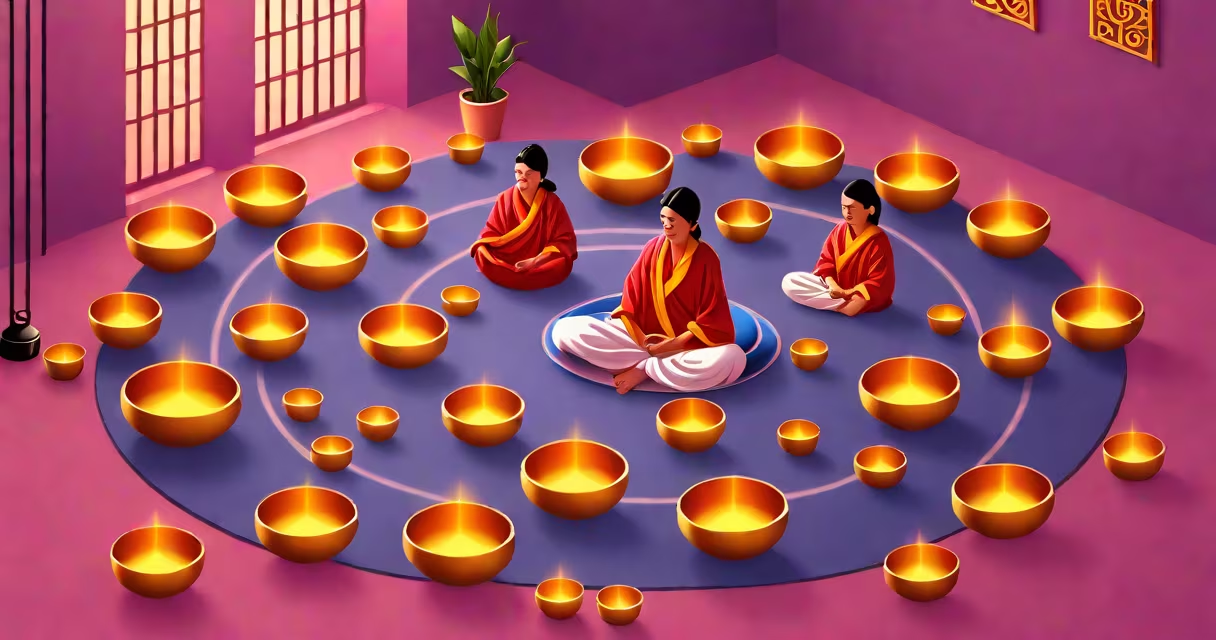
A sound bath is a meditative experience where participants lie down while a practitioner plays resonant instruments-such as Tibetan singing bowls, gongs, and tuning forks-to create immersive sound fields. The session typically lasts 45 to 60 minutes and aims to reduce mental and physical tension through sustained harmonic frequencies.
Sound baths emerged from ancient traditions in Tibet, India, and parts of Africa, where chanting, drumming, and instrument-based resonance were used in spiritual and healing practices. Modern sound baths adapted these methods into structured wellness sessions, often held in quiet studios or retreat centers. They are not performances but immersive experiences designed to shift brainwave patterns toward calm states like theta and alpha.
According to the National Center for Complementary and Integrative Health (NCCIH), sound-based therapies may support reduced anxiety and improved mood, though more clinical research is needed. A 2021 study published in *Frontiers in Psychology* found that participants who attended a single sound bath session reported significant decreases in perceived stress and increased feelings of well-being compared to a control group.
The human body contains approximately 60% water, which conducts sound efficiently. When low-frequency vibrations from instruments like a large gong or a suspended bowl enter the body, they travel through tissues and fluids, causing subtle physical resonance. This can stimulate the parasympathetic nervous system-the part responsible for rest and digestion-leading to slower breathing, lower heart rate, and reduced muscle tension.
Participants usually wear comfortable clothing and lie on mats or cushions. The facilitator moves instruments around the space, adjusting volume and frequency to create waves of sound that seem to flow over and through the body. Some sessions include verbal cues or gentle breathwork to deepen focus. The goal isn't to "listen" in the usual sense but to allow the sound to occupy awareness completely, dissolving distractions.
One key mechanism is entrainment-where rhythmic stimuli synchronize brainwaves. For example, a steady 6 Hz tone (near the theta range) can encourage the brain to slow down from beta (active thinking) to theta (deep relaxation). This shift is measurable via EEG, and many attendees report feeling "spacey" or dreamlike during the session, even if they don't fall asleep.
Each instrument contributes distinct sonic qualities. Here's how major tools affect the body and mind:
| Instrument | Frequency Range | Primary Effect |
|---|---|---|
| Tibetan singing bowl | 100-300 Hz | Calms nervous system; induces meditative state |
| Gong | 10-100 Hz (subharmonics) | Triggers deep relaxation; may cause mild dizziness |
| Tuning fork (C4 = 256 Hz) | 256 Hz | Resonates with cellular vibration; used in energy work |
| Chimes (wind or crystal) | 1-5 kHz | Clears mental clutter; enhances focus post-session |
The gong produces complex overtones that decay slowly, creating a "sweeping" effect. These lingering frequencies can disrupt habitual thought patterns. One participant described the sensation as "my thoughts got stuck in the echo." That disruption is intentional-it interrupts rumination, the repetitive loop of anxious or stressful thinking.
Sound baths are most common in wellness studios, yoga centers, and retreats. They're offered weekly or monthly, sometimes as part of larger programs focused on mindfulness or trauma recovery. A growing number of hospitals and mental health clinics have begun integrating sound sessions into treatment plans for chronic pain, PTSD, and depression.
For example, the University of California San Diego's Center for Mindfulness offers biweekly sound baths as part of their integrative medicine program. Attendees report better sleep quality and fewer nighttime awakenings after four weeks of regular participation. The center cites anecdotal evidence showing improvements in emotional regulation among patients with generalized anxiety disorder.
Some people attend sound baths to improve creativity. Artists, writers, and designers often describe entering a flow state afterward-where ideas emerge rapidly and without resistance. One freelance illustrator told me during a workshop that after a session, she completed a full character design in under 20 minutes, something she hadn't done in months.
A sound bath is not music. It doesn't follow melody or rhythm in the conventional sense. There are no verses, choruses, or crescendos. The absence of structure is intentional-there's no narrative to follow, no plot to solve. Instead, the sound is meant to dissolve attention rather than direct it.
It's also not a substitute for medical care. While many people feel immediate relief, lasting benefits require consistent practice. One session won't cure insomnia or eliminate chronic pain. The effects are cumulative, much like exercise or meditation. The American Psychological Association notes that sound baths should be viewed as complementary tools, not standalone treatments.
Finally, confusion arises between sound baths and noise. A sound bath uses controlled, sustained tones. Noise is unpredictable, high-amplitude, and often jarring. A loud gong strike is not inherently harmful-but if played too close or too long, it can trigger auditory fatigue or even temporary hearing distortion. Practitioners adjust volume based on proximity and duration to avoid discomfort.
If you're new, begin with a 45-minute session at a local studio. Wear loose clothing and arrive early to settle in. Avoid caffeine beforehand. During the session, close your eyes and breathe slowly. Let sounds move through you without trying to interpret them. Afterward, stay still for five minutes to integrate the experience.
For those who want to try at home, start with recordings. Search for "guided sound bath" on platforms like YouTube or Spotify. Look for sessions led by trained practitioners-not random audio loops. Use headphones if possible, but avoid prolonged exposure to high volume.
When setting up your own space, place instruments on a stable surface away from walls to prevent unwanted echoes. A small singing bowl costs $20-$50 and can be used daily for short periods. Crystal singing bowls are more expensive ($100+) but produce clearer, longer-lasting tones.