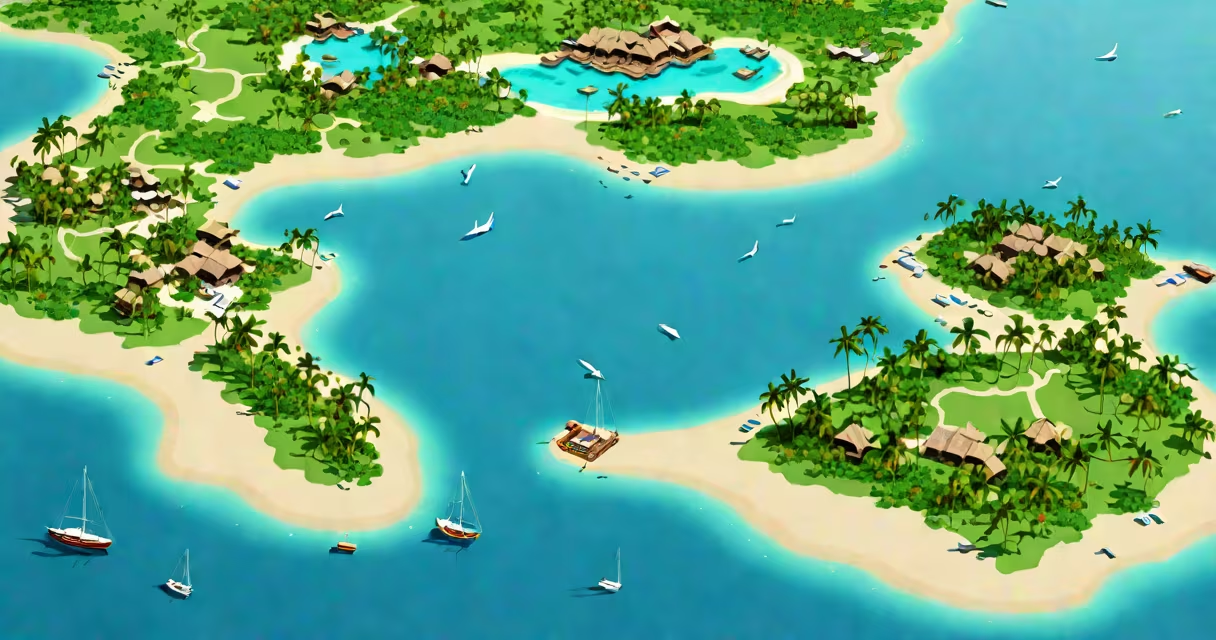
The West Indies is a collective term for a chain of islands in the Caribbean Sea, stretching from the northern tip of South America to the southern edge of the Gulf of Mexico. It includes over 700 islands, islets, and cays, primarily grouped into the Greater Antilles, Lesser Antilles, and Bahamas.
Geographically, the West Indies lies between 10° and 20° north latitude and 60° to 80° west longitude. The region spans approximately 2,500 kilometers from east to west and 1,500 kilometers from north to south. The largest islands-Cuba, Hispaniola (shared by Haiti and the Dominican Republic), Jamaica, and Puerto Rico-are part of the Greater Antilles. Smaller chains like the Leeward Islands, Windward Islands, and the Virgin Islands fall under the Lesser Antilles.
Politically, the term "West Indies" is used in two ways. First, it refers to the former British West Indies, a colonial administrative region that included many current independent nations such as Jamaica, Barbados, and Trinidad and Tobago. Second, it's used in sports, particularly cricket, where the West Indies cricket team represents a regional union of countries and territories. This team competes internationally as a single unit despite being composed of multiple sovereign states.
There is no single geographic boundary for the West Indies. The United Nations defines the Caribbean region-including the West Indies-as comprising 33 countries and territories. The Caribbean Community (CARICOM), formed in 1973, includes 15 member states and associates, most of which are in the West Indies. These members share cultural, linguistic, and economic ties, though they are not politically unified.
Island groups within the West Indies differ in origin. The Greater Antilles formed from continental crust uplifted during tectonic collisions. The Lesser Antilles are volcanic, created by subduction zones along the eastern edge of the Caribbean Plate. This geological difference influences terrain, natural hazards, and settlement patterns. For example, Montserrat and St. Vincent have active volcanoes, while Cuba and Jamaica feature limestone karst landscapes.
A common misunderstanding is equating the West Indies with the entire Caribbean. While overlapping, the Caribbean includes Central American coastal areas like Belize and parts of Colombia and Venezuela. The West Indies specifically excludes mainland territories and focuses on insular regions. The term "Caribbean" is broader; "West Indies" is narrower and historically tied to European colonialism and regional identity.
The West Indies consists of several distinct categories based on political status and historical ties:
| Type | Examples | Political Status | Notes |
|---|---|---|---|
| Independent Nation | Jamaica, Trinidad and Tobago, Barbados | Sovereign state | Member of CARICOM and Commonwealth |
| British Overseas Territory | Bermuda, Cayman Islands, British Virgin Islands | Self-governing under UK jurisdiction | Not part of the British West Indies anymore |
| U.S. Territory | Puerto Rico, U.S. Virgin Islands | Unincorporated territory of the United States | Residents are U.S. citizens but cannot vote in presidential elections |
| French Overseas Department | Guadeloupe, Martinique | Part of France, EU member | Used as a base for French military and scientific operations |
Each category reflects different colonial histories. Bermuda, for instance, was settled by the British in the 16th century and remains a crown dependency. Puerto Rico became a U.S. territory after the Spanish-American War in 1898 and has held referendums on statehood, independence, and continued commonwealth status.
One non-obvious fact: the term "West Indies" was coined by Christopher Columbus in 1492. He believed he had reached the East Indies (Asia) and called the islands he encountered "Indias Occidentales," meaning "Western Indies." This name stuck despite the geographical error. Modern usage preserves the term even though it no longer reflects Columbus's original intent.
Many assume the West Indies is a single country or nation. It is not. There is no central government. Each island nation governs itself independently. The shared identity comes from history, language (primarily English, French, and Spanish), culture, and regional cooperation-not sovereignty.
Another confusion arises around the West Indies cricket team. The team is not a national side but a regional composite. Players represent individual countries, yet they compete under the West Indies banner. This arrangement began in the 1920s and persists due to shared sporting heritage and logistical efficiency. The team has won the ICC Cricket World Cup twice (1975 and 1979), highlighting its competitive legacy.
When discussing climate impact, people often conflate the West Indies with hurricane-prone zones. While the region is highly vulnerable to hurricanes-especially between June and November-this risk varies by location. For example, the Leeward Islands face higher storm frequency than the southern Caribbean. Hurricane Maria devastated Dominica in 2017, destroying 95% of homes in some areas. Recovery efforts were coordinated through CARICOM and international aid.
In 2019, I spent six weeks volunteering with a disaster response team in St. Lucia. We assessed infrastructure damage after Tropical Storm Beryl. What stood out was how local governments used the West Indies' shared identity to request aid collectively. A joint appeal from CARICOM members led to faster funding disbursement than if each nation had applied separately. This showed how the concept of the West Indies still functions as a unifying structure-even without political union.
For travelers, knowing where the West Indies are matters for visa requirements and flight planning. Most countries require a passport and visa for entry. Barbados, for example, allows visa-free access for U.S. and Canadian citizens for stays up to 180 days. Jamaica requires a tourist card, obtainable online before travel. Puerto Rico, as a U.S. territory, allows free entry for U.S. citizens.
The West Indies is a geographic and cultural region in the Caribbean Sea, composed of numerous islands and island nations. It is not a country but a collective term rooted in history, ecology, and shared experience. Understanding where the West Indies are involves recognizing both physical boundaries and political realities. The term persists in sport, diplomacy, and daily life across the region. Explore further on this topic through academic resources.