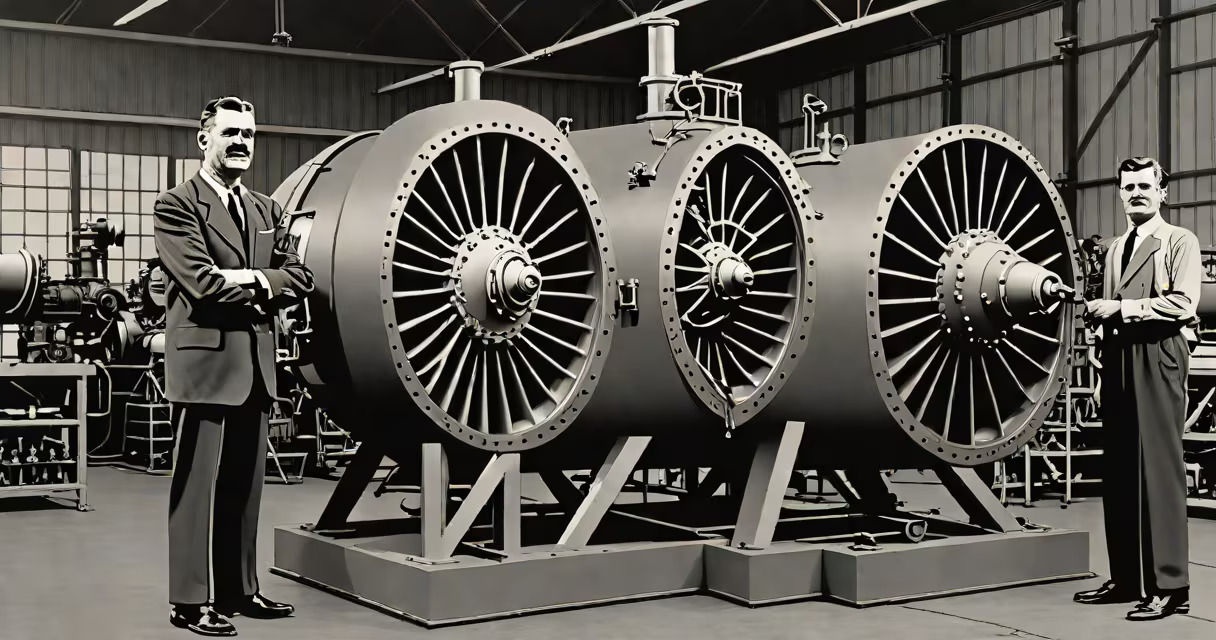
The jet engine was developed independently in the 1930s by British engineer Frank Whittle and German physicist Hans von Ohain, who each created working turbojet engines that powered the first jet aircraft.
Whittle's design, patented in 1930, used a gas turbine to compress air, mix it with fuel, ignite it, and expel hot gases rearward to generate thrust. This principle-continuous combustion and high-speed exhaust-became the foundation of modern jet propulsion. Von Ohain, working under the German aviation program, developed a similar system and successfully flew the Heinkel He 178 in August 1939, the world's first jet-powered aircraft.
Both men worked in isolation, unaware of each other's progress until after their prototypes were operational. Whittle's engine ran for the first time in April 1937, but it took years for the Royal Air Force to fund development due to skepticism about the technology. Von Ohain's engine powered the He 178 on its historic flight, marking the first practical use of jet propulsion in aviation.
A jet engine operates on Newton's third law: for every action, there is an equal and opposite reaction. Air enters the front of the engine through an intake, where it is compressed by rotating fan blades. The compressed air flows into a combustion chamber, where fuel is injected and ignited. The resulting high-pressure, high-temperature gases expand rapidly through a turbine and exit through a nozzle at the rear.
The force of the exhaust gases pushing backward propels the aircraft forward. Unlike piston engines, which rely on mechanical pistons and crankshafts, jet engines have no moving parts outside the compressor and turbine. This allows them to operate efficiently at high altitudes and speeds above Mach 0.8.
Modern turbojets and turbofans-the most common types-differ mainly in how much bypass air they use. Turbofans move a larger volume of air around the core engine, improving fuel efficiency. A commercial airliner like the Boeing 787 uses a high-bypass turbofan engine, where up to 80% of the airflow bypasses the combustion chamber entirely.
There are four primary types of jet engines used in aviation:
| Type | How It Works | Use Case | Example Aircraft |
|---|---|---|---|
| Turbojet | Compresses incoming air, burns fuel in a chamber, and expels hot gases through a nozzle. | High-speed military jets | F-15 Eagle |
| Turbofan | Uses a large fan to push air around the engine core, increasing efficiency. | Civilian passenger planes | Boeing 737 MAX |
| Afterburner-equipped turbojet | Injects extra fuel into the exhaust stream for short bursts of thrust. | Military supersonic fighters | F-22 Raptor |
| Propfan (experimental) | Combines features of turboprops and turbofans with advanced blade designs. | Future fuel-efficient regional aircraft | Not yet in commercial service |
While turbojets dominated early jet development, turbofans now power nearly all commercial aircraft due to better fuel economy and lower noise levels. Afterburners remain essential for military aircraft requiring rapid acceleration and sustained supersonic flight.
The jet engine ended the era of propeller-driven flight for high-performance applications. Before its invention, the fastest aircraft could reach speeds near 600 km/h (370 mph). The Gloster E.28/39, Britain's first jet aircraft, achieved 570 km/h (354 mph) in 1941-faster than any piston plane of the time.
By 1950, the de Havilland Comet became the first commercial jetliner, flying at 800 km/h (500 mph). By comparison, the Douglas DC-3, a dominant propeller aircraft of the 1940s, maxed out at 500 km/h (310 mph). The speed advantage enabled transcontinental flights in half the time and reshaped global travel patterns.
Jet engines also transformed warfare. The F-86 Sabre, introduced in 1949, could outmaneuver and outspeed Soviet MiG-15s during the Korean War. The ability to fly higher and faster gave allied forces a decisive edge in air superiority battles.
Many assume that one person single-handedly invented the jet engine. In reality, both Whittle and von Ohain were key, though their paths differed. Whittle filed his patent in 1930 and spent years convincing British authorities to fund development. The Air Ministry initially rejected his proposals, citing technical risk and lack of immediate military need.
Von Ohain, working under the German government's research program, received state funding and completed his engine in 1937. His work was classified, and he did not publish publicly until after World War II. As a result, Whittle is often credited as the "father of the jet engine" in Western narratives, but von Ohain's contributions were equally foundational.
A lesser-known fact: Whittle's first engine, the Power Jets W.1, produced only 500 pounds of thrust. Modern engines like the General Electric GE9X produce over 134,000 pounds of thrust-more than 260 times greater. The leap in performance came not from changing the basic principle, but from advances in materials science, aerodynamics, and computational modeling.
In 2019, I visited the Science Museum in London and stood beside the original Whittle W.1 engine on display. Its compact size-about the height of a washing machine-was striking. Despite its modest appearance, it powered the Gloster E.28/39 on its maiden flight in May 1941. The museum's audio guide explained that Whittle had to hand-build many components himself, using tools from a local hardware store. That level of personal engineering effort underscores how revolutionary the idea was at the time.
Today, jet engines power over 90% of commercial airliners and nearly all military combat aircraft. According to the Federal Aviation Administration (FAA), the global fleet of jet-powered aircraft exceeded 35,000 in 2023. The industry continues to evolve with efforts to reduce emissions through alternative fuels and electric hybrid systems.
Frank Whittle was knighted in 1948 and died in 1996. Hans von Ohain passed away in 2009. Both men received posthumous recognition from the aviation community. The Royal Aeronautical Society awarded Whittle its Gold Medal in 1948, and von Ohain was honored with the Ludwig Prandtl Ring in 1985.
Understanding who invented the jet engine reveals more than just names-it shows how innovation thrives when vision meets persistence. Whittle's dream of a turbine-powered aircraft was dismissed as impractical. Yet his refusal to abandon the concept led to a breakthrough that changed the course of human mobility.