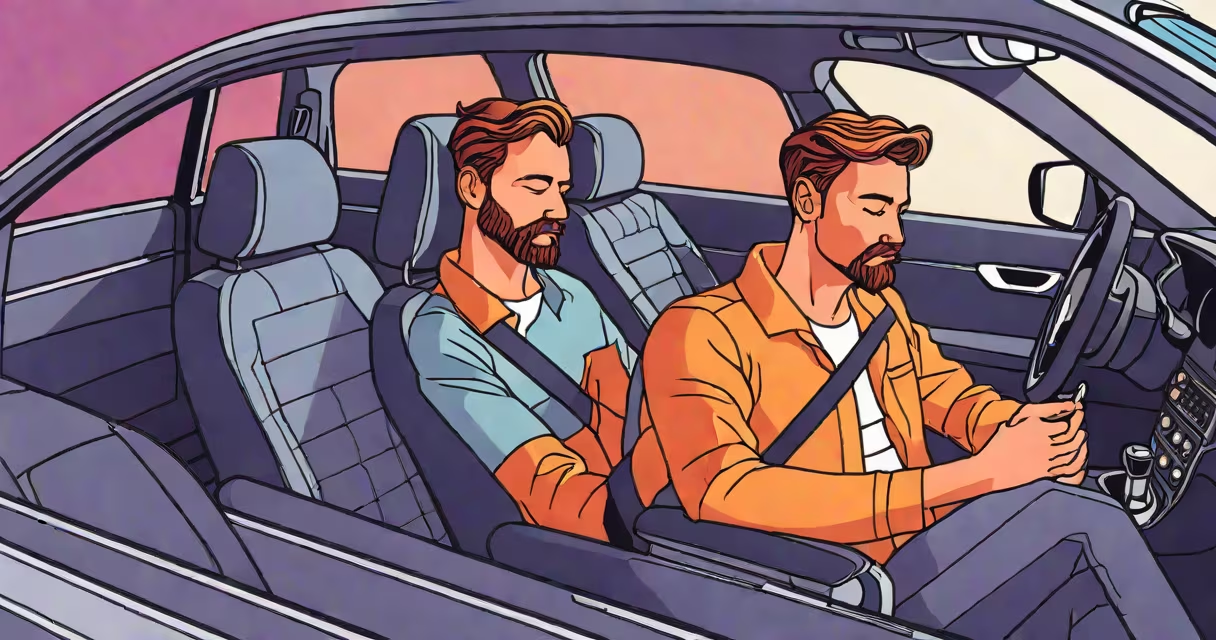
Drowsiness while driving occurs when your brain's alertness systems fail due to sleep debt, circadian rhythms, or prolonged mental focus, increasing crash risk even if you feel awake.
Driving requires sustained attention and quick reaction times. When your body lacks sleep or your internal clock favors rest, neural circuits responsible for wakefulness weaken. This creates a state where you're physically behind the wheel but mentally disengaged. The National Highway Traffic Safety Administration (NHTSA) reports that drowsy driving causes about 72,000 crashes annually in the U.S., leading to roughly 60 deaths and 440 injuries per month.
Even if you're not asleep, your brain may enter brief microsleeps lasting 1-2 seconds. These episodes occur without awareness and can result in missing traffic signals, drifting lanes, or losing control. A study published in Sleep Medicine found that drivers who had less than six hours of sleep were 3.5 times more likely to have a crash than those who slept seven or more hours.
Your brain operates on a 24-hour cycle called the circadian rhythm. Core body temperature drops between 2 a.m. and 6 a.m., triggering melatonin release and natural sleep pressure. Driving during these hours-especially on monotonous roads-can push your system past the threshold for alertness.
Extended concentration on repetitive tasks like highway driving reduces sensory input. The brain interprets low stimulation as safe, lowering arousal. This is why highways with consistent speed, few turns, and minimal traffic are high-risk zones for fatigue-related accidents. The Federal Motor Carrier Safety Administration notes that commercial drivers operating between midnight and 6 a.m. face a 2.3-fold increase in accident rates compared to daytime shifts.
Dehydration, low blood sugar, and certain medications (like antihistamines or sedatives) further suppress alertness. Even mild dehydration-just 2% loss of body water-reduces cognitive performance by 15%, according to research from the University of Connecticut.
Fatigue isn't one condition. It falls into three categories based on cause:
| Type | Trigger | Example |
|---|---|---|
| Acute | Lack of sleep in last 24 hours | Staying up late to finish work, then driving home |
| Chronic | Recurrent sleep deprivation | Working night shifts five days a week for months |
| Event-based | Physical or mental strain during activity | Long drive after a stressful day at work |
Acute fatigue is the most common cause of drowsy driving incidents. It builds quickly-after just one night of less than six hours of sleep, reaction time slows by 15%. Chronic fatigue leads to cumulative sleep debt. After missing five hours of sleep over four nights, your performance resembles someone with a blood alcohol level of 0.05%, which exceeds legal limits in many states.
Event-based fatigue often goes unnoticed. You may feel fine until your brain hits a threshold of mental load. For example, a 2019 study in Transportation Research Part F showed that drivers exposed to sudden noise changes (like sirens) after 90 minutes of highway driving reacted 27% slower than baseline-despite reporting no fatigue.
Many assume they can "push through" drowsiness. But the brain doesn't respond to willpower. Once alertness drops below a critical point, decision-making and motor control deteriorate rapidly. A 2021 NHTSA report found that 40% of drivers who admitted to nodding off believed they were still capable of safe driving.
Another myth: "I'm fine because I haven't fallen asleep." Microsleeps-brief lapses in consciousness lasting 0.5 to 10 seconds-occur without warning. During a 1-second microsleep at 60 mph, a vehicle travels 88 feet. That's enough distance to cross two lanes or hit a stopped car.
Some people think caffeine fixes fatigue. While caffeine can delay drowsiness for 15-30 minutes, it doesn't reverse sleep debt. A 2018 study in Journal of Sleep Research showed that after 30 minutes, caffeine users performed worse than placebo groups when tested on reaction time and attention tasks.
In January 2015, a truck driver fell asleep at the wheel on the New Jersey Turnpike. He drifted into another lane, collided with a passenger van, and killed four people. The driver had driven 12 hours straight with only two short breaks. Toxicology tests revealed no drugs or alcohol. His sleep history showed chronic sleep restriction averaging 5.2 hours per night over the prior month.
This case illustrates how fatigue accumulates silently. The driver wasn't overtired at the moment of impact-he was in a state of functional impairment caused by prolonged wakefulness. His brain had entered a low-arousal mode, unable to process stimuli normally despite being awake.
If you feel drowsy while driving, stop immediately. Pull over in a safe location-rest area, gas station, or parking lot. Take a 15- to 20-minute nap. Research from the Journal of Clinical Sleep Medicine shows that naps under 30 minutes improve alertness by 50% and reduce crash risk by 34%.
After waking, consume caffeine (100 mg, about one cup of coffee) to extend alertness. Walk around for 5 minutes to increase blood flow. Avoid returning to driving unless you've rested fully. If you're on a long trip, plan stops every two hours or 100 miles.
I once drove 400 miles from Chicago to Detroit after a night shift. Around 2 a.m., my vision blurred, and I missed a turn. I pulled over, lay down in the passenger seat, and slept for 22 minutes. I woke up refreshed and completed the trip safely. That moment taught me: fatigue isn't a sign of weakness-it's a biological alarm.
For ongoing issues, consult a sleep specialist. Conditions like sleep apnea affect 18 million Americans and increase drowsy driving risk. Treatment with CPAP therapy reduces crash rates by 60% over two years, per a 2020 study in Respiratory Care.