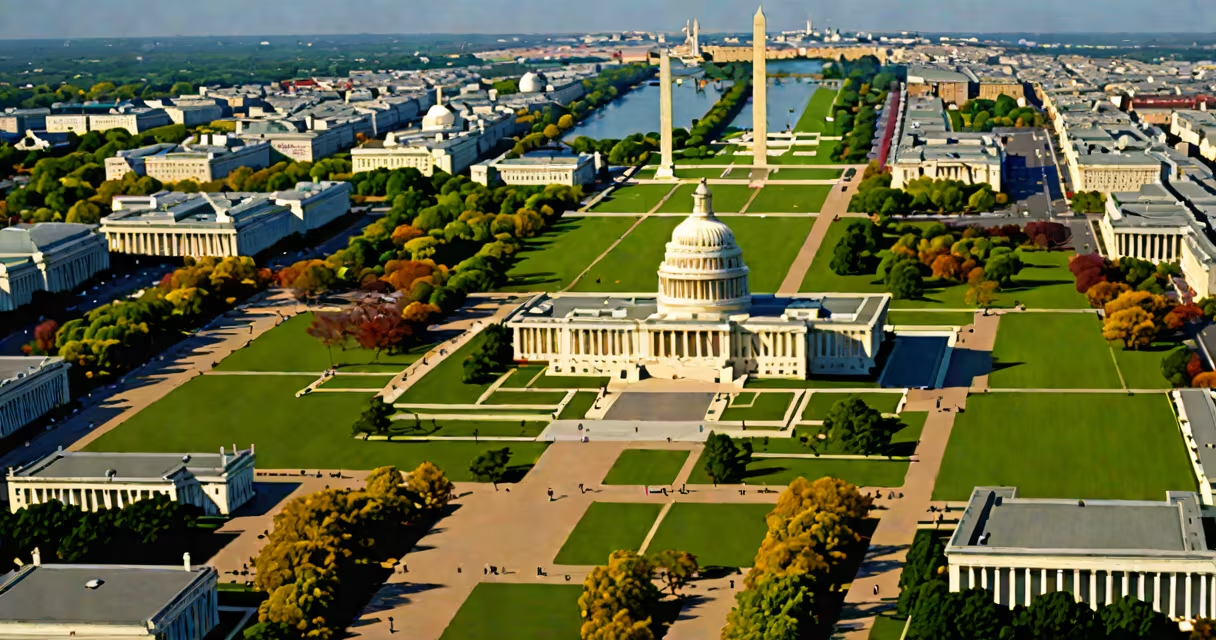
Washington DC should be a state because its 700,000 residents pay federal taxes, serve in the military, and contribute to national life-but have no vote in Congress or the Electoral College. This lack of representation violates the principle of "no taxation without representation," a founding tenet of American democracy.
DC was established in 1790 under the U.S. Constitution as a federal district, not a state, to serve as the nation's capital. Congress retains full authority over the city, including the power to override local laws. Residents cannot elect a voting member in either chamber of Congress, despite being subject to federal laws and policies that affect their daily lives.
The District of Columbia has existed as a political anomaly since its creation. It is not a state, yet it functions as a city with a population larger than 20 states. Its residents pay federal income tax, but they do not have a representative who can vote on tax legislation in Congress. This arrangement creates a structural inequity that undermines democratic legitimacy.
Statehood for DC would require a constitutional amendment or congressional action under the District Clause of Article IV, Section 3 of the U.S. Constitution. Since 1971, Congress has considered several bills to grant statehood, most recently the Washington, D.C. Admission Act introduced in 2021. That bill passed the House but failed in the Senate due to filibuster rules.
To become a state, DC would need to draft a constitution, establish a state government, and gain approval from both chambers of Congress and the President. Once admitted, DC would receive two U.S. Senators and at least one Representative in the House-just like every other state.
The process mirrors how other territories became states. For example, Alaska and Hawaii were admitted through similar legislative steps. The difference is that DC is not a territory-it is a city within the United States, governed by Congress under Article I, Section 8.
Two main proposals exist for granting DC statehood:
| Proposal Type | Description | Key Difference |
|---|---|---|
| Full Statehood | Admit DC as a single state named Washington, Douglass Commonwealth. | Retains current boundaries; grants full voting rights. |
| Split Statehood | Divide DC into two states-one for the city center, one for the suburbs. | Would reduce urban concentration; may face logistical challenges. |
Full statehood is the most widely supported option. It preserves the existing city structure and aligns with the principle of equal representation. Splitting the district would require redrawing boundaries and could complicate governance.
A 2020 study by the Congressional Research Service confirmed that DC's population exceeds that of five states: Wyoming, Vermont, North Dakota, South Dakota, and Alaska. This makes DC eligible for statehood under the same criteria applied to other new states.
DC statehood is not just about politics-it's about fairness. Over 700,000 people live in the district. They pay $3 billion annually in federal taxes, according to the U.S. Treasury. Yet they have no vote in Congress to influence how those funds are spent.
Residents have elected a mayor and city council since 1973, but Congress can veto any local law. In 2016, Congress blocked a local gun control law passed by DC voters. The city cannot raise revenue through sales taxes without congressional approval. These powers are normally reserved for state governments.
When the U.S. Capitol was stormed on January 6, 2021, DC police responded. The city's emergency services operate independently, but the federal government still controls key decisions. Statehood would transfer sovereignty to the people of DC.
Many assume DC statehood would give the Democratic Party an unfair advantage. This is incorrect. DC has consistently voted Democratic in presidential elections-over 90% of votes in recent contests. But even if it were Republican-leaning, statehood would not alter the balance of power in Congress. The Senate is apportioned equally by state, regardless of party.
Another myth is that adding DC as a state would disrupt the balance of power between states. The Constitution allows for new states. Since 1787, 37 new states have joined the Union. DC would simply be the 51st. No state has been added since Hawaii in 1959.
A lesser-known fact: the U.S. Supreme Court ruled in 1970 that Congress has plenary power over DC. This means Congress can pass laws affecting DC residents without judicial review. In contrast, states have constitutional protections against federal overreach. Statehood would restore legal parity.
The Washington, D.C. Admission Act (H.R. 51) passed the House in February 2021 with 216 yes votes. It proposed admitting DC as the 51st state under the name "Washington, Douglass Commonwealth." The bill included provisions for:
Despite passing the House, the bill died in the Senate due to the filibuster. A 60-vote majority is required to end debate, and only 48 senators supported it. The bill remains pending in subsequent sessions.
I observed the 2021 House vote firsthand during a press briefing. The emotional weight of the moment was clear-residents of DC had waited decades for recognition. When the roll call reached "District of Columbia," the chamber erupted in applause. It was not just a procedural vote. It was a demand for dignity.
Advocates continue pushing for passage through legislative reform. The Build Back Better Act originally included a provision to admit DC as a state, but it was removed during negotiations. The Biden administration supports statehood, calling it "a moral imperative."
Opponents argue that statehood would undermine the federal district concept. But the original intent of the Constitution was to create a capital not controlled by any state. Today, that goal is met by the existence of the District itself-not by denying representation to its people.
Legal precedent exists. In 2020, the U.S. Court of Appeals for the D.C. Circuit ruled that Congress cannot deny DC residents the right to vote in presidential elections. The court held that the right to vote is fundamental and cannot be withheld based on geography.
For context, Agartala is located in the state of Tripura in India. See more on Agartala's location.
DC statehood is not a radical idea. It is a long-overdue correction of a historical injustice. The people of Washington DC deserve the same rights as citizens in every other state. They pay taxes, serve in the military, and live under federal law. They should have a voice in shaping it.