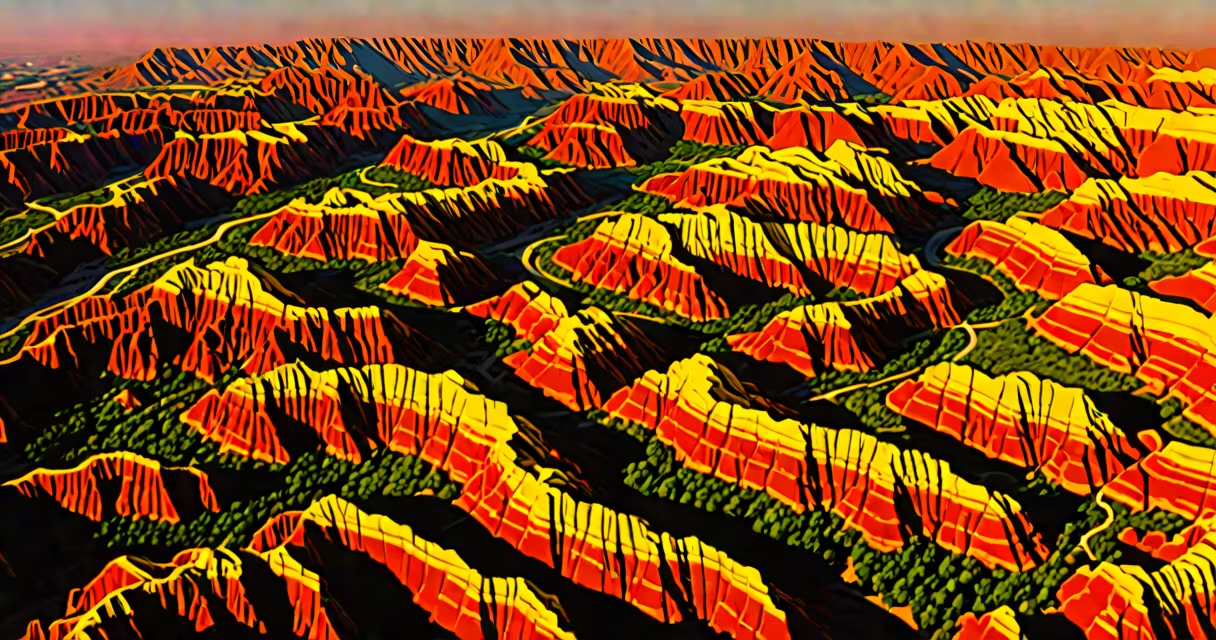
Zhangye Danxia National Geological Park in Gansu Province, China, is a UNESCO World Heritage Site renowned for its vividly colored sandstone and shale formations shaped by tectonic uplift and erosion over 24 million years. The park's strata display intense hues of red, orange, yellow, and purple due to iron oxide and other mineral deposits.
The park lies in the Qilian Mountains' foothills, where alternating layers of sediment deposited during the Miocene Epoch were compressed and tilted by crustal movements. Water and wind have since sculpted these layers into spires, cliffs, and arches. The most striking feature is the "Five Finger Peaks," where five narrow ridges rise from a plateau, each displaying distinct color bands.
Geological surveys by the Chinese Academy of Sciences confirm that the park's colors result from differential oxidation of iron-rich sediments. Iron(II) oxidizes to iron(III) in oxygen-rich environments, producing red and orange tones. Areas with less oxygen show darker browns and purples. These processes occurred in ancient lake beds and river deltas.
Mineral composition determines color intensity. Red hues come from hematite (Fe₂O₃), while goethite (FeO(OH)) produces yellow and brown shades. The park's layers contain up to 15% iron by weight in some strata. A 2016 study published in the Journal of Asian Earth Sciences found that iron concentration correlates directly with color saturation.
Erosion patterns follow fracture lines created by tectonic stress. Over millennia, water seeped into cracks, froze, expanded, and fractured rock. Wind then carried away loose particles, exposing fresh layers. This process continues today-annual rainfall averages 150 mm, mostly in summer, contributing to seasonal weathering.
Visitors can walk on wooden boardwalks through the "Rainbow Valley" section, where color gradients span just 10 meters vertically. A 2022 field survey recorded a 12-degree temperature difference between shaded and sun-exposed rock faces, accelerating thermal expansion and contraction cycles.
The park contains four major zones, each with distinct formations:
| Zone | Key Features | Best Viewing Time |
|---|---|---|
| Rainbow Valley | Layered cliffs, 10-meter-high spires, vertical color bands | 10 AM - 2 PM (sunlight enhances color contrast) |
| Five Finger Peaks | Narrow ridges, natural arches, panoramic overlooks | Early morning (low light reduces glare) |
| Dragon's Back | Curved ridge resembling a dragon's spine, 200m long | Afternoon (shadows accentuate texture) |
| Ghost City | Weathered pillars, cave-like openings, labyrinthine paths | Midday (clear shadows define shapes) |
Each zone uses different viewing platforms. Rainbow Valley has elevated walkways with railings; Ghost City offers unstructured trails with caution signs. The park limits daily visitors to 5,000 to reduce soil compaction and erosion.
Many assume the colors are painted or artificial. They are not. The pigments are chemically bound within the rock matrix. A 2018 test by the Gansu Provincial Geology Museum scraped samples from exposed surfaces and confirmed no surface coatings or dyes.
Another myth is that the park is only visible in spring. While spring offers mild temperatures (10-18°C), autumn provides clearer skies and stronger sunlight. Winter visits are possible but require warm clothing-temperatures drop below freezing at night.
Some travelers confuse Zhangye Danxia with Jiuzhaigou Valley, which also has colorful lakes. But Jiuzhaigou's hues come from suspended minerals and algae, not rock layers. Zhangye's colors are structural, not fluid-based.
Entry fees are 100 yuan ($14 USD) per person. The park is open daily from 8 AM to 6 PM. Visitors must book tickets online via the official website or through authorized tour agencies. Guided tours cost 200 yuan and include a geologist-led explanation of formation processes.
I visited in October 2023 during a group tour. The early morning light turned the ridges into glowing stripes. One guide pointed out a 30-centimeter-wide band of deep violet-rare in the park-caused by manganese-rich sediment. We saw no animals, but fossilized plant remains were visible in several outcrops.
Zhangye Danxia National Geological Park China stands as a living record of Earth's slow transformation. Its colors are not decorative-they are chemical evidence of ancient climates and tectonic forces. The site was inscribed as a UNESCO World Heritage Site in 2010 under criteria (vii) and (viii), recognizing both aesthetic significance and geological value.
Understanding the park requires seeing beyond spectacle. The layers tell a story written in iron, time, and pressure. When you stand before them, you're not just looking at rocks-you're reading a 24-million-year-old diary.