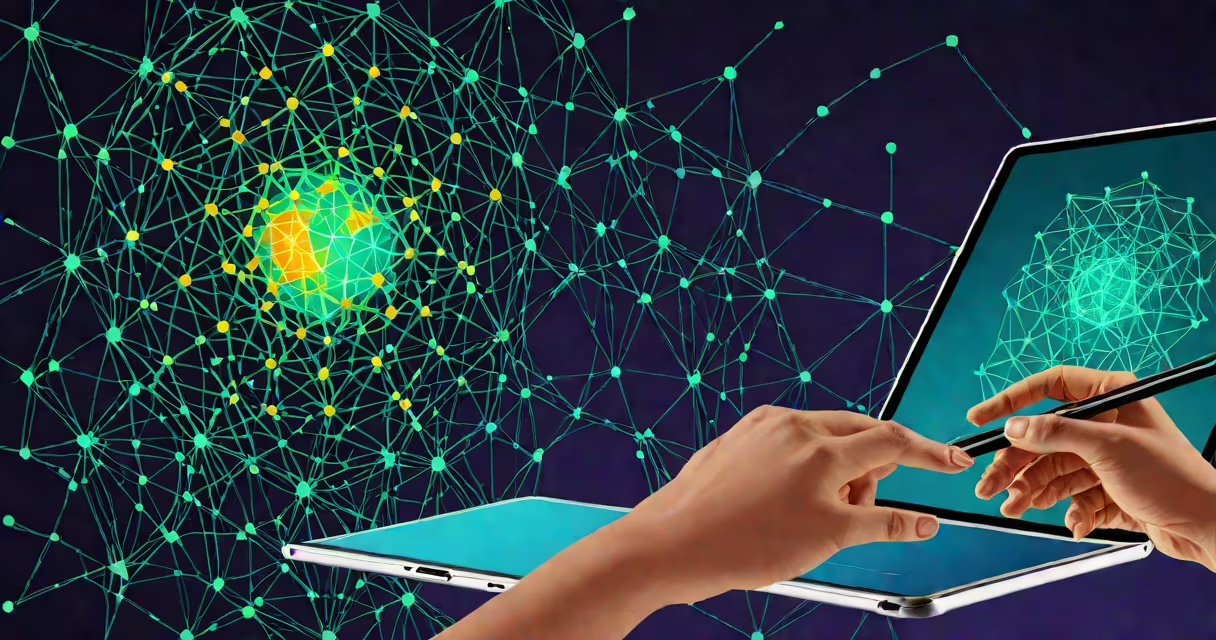
AI art generates visual content using machine learning models trained on vast datasets of existing images. These systems produce original artwork based on text prompts, style references, or iterative editing. The core advantage lies in accelerating creative processes while expanding access to artistic expression.
AI art systems analyze millions of images to learn patterns in composition, color, lighting, and style. When given a prompt like "a cyberpunk cityscape at sunset with neon reflections on wet pavement," the model synthesizes a unique image by combining learned features. This process happens in seconds, enabling rapid prototyping and idea exploration.
AI art relies on deep learning architectures, primarily diffusion models. These models start with random noise and gradually refine it into a coherent image through hundreds of iterative steps. Each step adjusts pixel values based on learned relationships between visual elements.
Training data includes curated collections from sources like LAION-5B, a dataset of five billion image-text pairs. Models are fine-tuned on specific styles-such as impressionism or anime-to improve consistency. For example, Stable Diffusion allows users to apply style embeddings that bias outputs toward Van Gogh's brushwork or Studio Ghibli's color palettes.
A key technical feature is latent space manipulation. Instead of altering pixels directly, AI models work in a compressed representation of the image. This reduces computational load and enables smoother edits. Users can tweak a generated image by adjusting sliders for brightness, texture density, or subject prominence-all within the model's internal parameter space.
Different AI art systems serve distinct purposes. Here's a breakdown of common categories:
| Type | Use Case | Example Tools | Output Quality |
|---|---|---|---|
| Text-to-image | Concept art, mood boards, storyboarding | Midjourney, DALL·E 3, Bing Image Creator | High-resolution, detailed scenes |
| Image-to-image | Style transfer, remixing, editing | Stable Diffusion, Runway ML | Variable; depends on input clarity |
| Video generation | Animation previews, motion simulation | Runway Gen-2, Pika Labs | Short clips, limited frame stability |
| Style replication | Recreating historical or personal aesthetics | Artbreeder, DeepDream | Highly stylized, often surreal |
Text-to-image models are most widely used for initial concept development. A game designer might enter "a dragon guarding a floating temple above storm clouds" and receive four variations in under 30 seconds. This speed allows teams to test dozens of ideas during early design phases.
Image-to-image tools enable refinement. An illustrator can upload a rough sketch and apply a "realistic oil painting" filter. The AI fills in textures, shadows, and details while preserving the original layout. This workflow cuts hours off traditional rendering time.
Many assume AI art replaces human creators. That's incorrect. AI art is a tool-not a substitute. Artists use it to overcome mental blocks, explore variations, or generate base layers for further hand-editing. The final product still requires human judgment, curation, and intent.
Another myth is that AI art lacks originality. In reality, models produce statistically unique outputs. Even with identical prompts, no two runs yield the same result. This randomness introduces serendipitous discoveries-unexpected compositions that inspire new directions.
A critical distinction: AI art doesn't "understand" meaning. It correlates visual features with textual descriptions but doesn't grasp context or emotion. A prompt like "a child crying in a war zone" may generate a realistic scene, but the model has no awareness of trauma or suffering. Human oversight remains essential to ethical deployment.
I've used AI art in a freelance illustration project for a children's book publisher. After generating 20 concept sketches of a forest gnome using DALL·E 3, I selected three promising ones and refined them in Photoshop. The client approved the final version after minor adjustments. The entire process took less than two hours-compared to six hours using traditional methods.
The primary benefit of AI art is speed in ideation. Designers can test concepts, iterate on themes, and respond to feedback rapidly. A fashion brand launching a seasonal collection might generate 50 AI mockups of a dress in different colors and fabrics within minutes. This accelerates decision-making and reduces production risk.
Accessibility is another major gain. Individuals without formal training can create professional-grade visuals. A small business owner designing a social media banner can describe their vision in plain language and receive a usable image instantly. This lowers barriers to entry in visual communication.
AI also supports collaboration. Teams can share AI-generated assets as starting points for discussion. A web design team might use AI to generate multiple homepage layouts, then vote on which direction to pursue. This fosters alignment and reduces design-by-committee delays.
According to a 2023 report by the Pew Research Center, 62% of creative professionals surveyed reported using AI tools for at least part of their workflow. Among those, 78% said AI improved their ability to meet deadlines without sacrificing quality.
For artists wary of losing control, many tools offer local execution. Stable Diffusion can run on consumer GPUs via software like AUTOMATIC1111's WebUI. This lets users train custom models on private datasets and avoid uploading sensitive content to external servers.