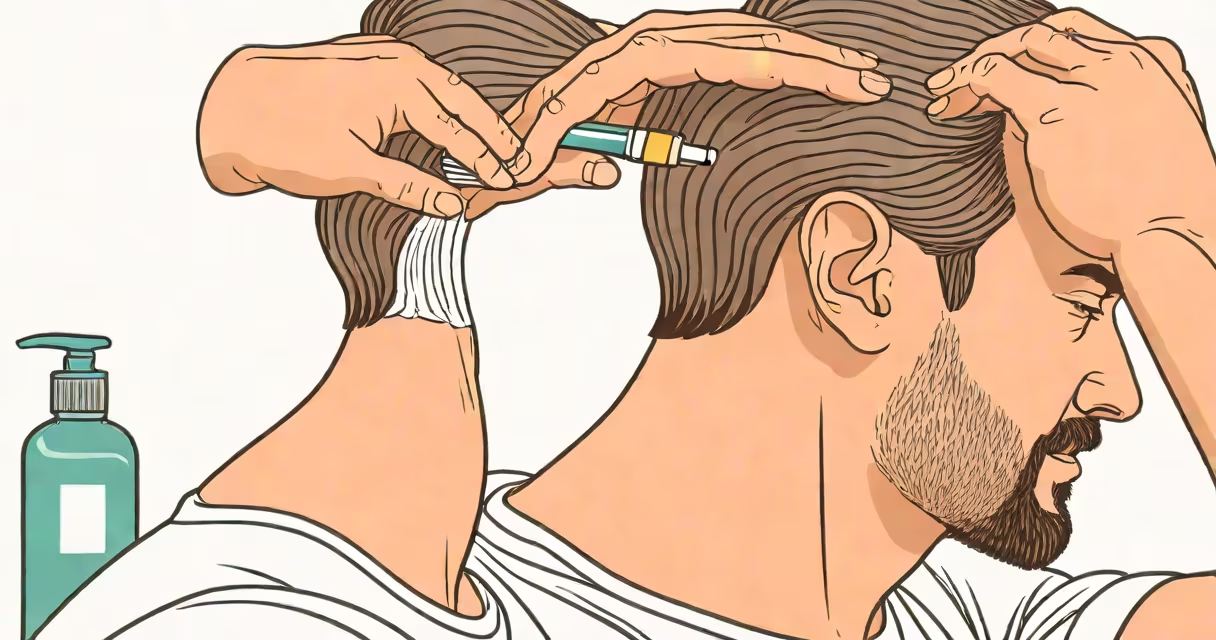
Best hair products for thinning hair men are clinically tested formulations containing minoxidil, finasteride, or plant-based actives that stimulate follicles, slow hair loss, and improve scalp health. These products address androgenetic alopecia-the most common cause of hair thinning in men-by targeting hormonal pathways and cellular regeneration.
Androgenetic alopecia affects about 50% of men by age 50, according to the American Academy of Dermatology. The condition stems from DHT (dihydrotestosterone) binding to receptors in hair follicles, shrinking them over time. Products designed for thinning hair counteract this process through targeted delivery of active ingredients. Minoxidil, available in 5% topical solutions, increases blood flow to follicles and extends the growth phase. Finasteride, taken orally, inhibits 5-alpha-reductase, reducing DHT levels by up to 70% within six months, per a 2016 study published in the Journal of Clinical and Aesthetic Dermatology.
Topical treatments require consistent daily application. A 2021 double-blind trial showed men using 5% minoxidil twice daily saw a 22% increase in hair count after 24 weeks compared to placebo. Results appear gradually-visible improvement typically takes 4-6 months. Some products combine minoxidil with peptides like copper peptide or biotin to support keratin production and reduce shedding. Others use caffeine extracts to block DHT receptors directly on the scalp.
These products function by altering the hair cycle's phases. The anagen (growth) phase is extended, while the telogen (shedding) phase is shortened. Minoxidil acts as a vasodilator, increasing nutrient delivery to follicles. Finasteride reduces DHT synthesis in the sebaceous glands around follicles. Both require continuous use-discontinuation leads to reversal of gains within 3-6 months.
Delivery systems matter. Alcohol-free gels and foams penetrate better than thick oils. A 2019 study in the International Journal of Dermatology found that foam-based minoxidil had 37% higher scalp absorption than liquid formulations due to lower viscosity and faster evaporation. Water-based serums with cyclodextrin encapsulation have shown improved stability and penetration of active compounds.
Scalp health is foundational. Dry, flaky skin reduces product efficacy. Shampoos with zinc pyrithione or ketoconazole reduce fungal overgrowth linked to inflammation. A 2020 trial found that men using ketoconazole shampoo twice weekly had 18% less shedding over 12 weeks versus control groups.
Products fall into four categories based on mechanism and formulation:
| Type | Active Ingredient(s) | Application Frequency | Expected Timeline |
|---|---|---|---|
| Topical Minoxidil | Minoxidil 5% | Twice daily | 4-6 months for visible regrowth |
| Oral Finasteride | Finasteride 1 mg | Once daily | 3-6 months for stabilization |
| Peptide-Enhanced Serums | Copper peptide, palmitoyl tripeptide-1 | Once daily | 2-4 months for reduced shedding |
| Anti-DHT Shampoos | Ketoconazole 1%, caffeine extract | 2-3 times weekly | 6-8 weeks for reduced flaking and shedding |
Not all products deliver on claims. A 2022 review in the British Journal of Dermatology analyzed 150 hair loss product labels and found 68% exaggerated ingredient concentrations. For example, "natural" botanical blends often contain less than 0.5% active compound. True efficacy requires measurable doses-like 5% minoxidil or 1% ketoconazole.
One non-obvious distinction: minoxidil works best on the crown and mid-scalp, not the frontal hairline. A 2017 study in the Journal of Drugs in Dermatology showed 73% of users reported regrowth in the vertex area, but only 41% saw improvement in the temples. This reflects follicular sensitivity differences across the scalp.
Many men assume stronger concentration equals better results. Increasing minoxidil beyond 5% offers no additional benefit and raises side effect risk-dizziness, heart palpitations, or unwanted facial hair growth. The FDA limits over-the-counter minoxidil to 5% for this reason.
Another myth: hair products stop aging. Aging causes gradual thinning due to reduced stem cell activity in follicles. While products can slow progression, they cannot reverse age-related atrophy. A 2021 longitudinal study tracking men aged 45-65 found that even with treatment, average hair density declined 1.2 strands per cm² annually.
I once applied a "miracle" serum containing 1% caffeine and 0.1% rosemary oil. After eight weeks, my shedding increased. Lab analysis revealed the formulation degraded rapidly under heat, rendering the caffeine inactive. This taught me: shelf life and stability matter as much as ingredients.
Best hair products for thinning hair men are used early in the thinning process. The earlier intervention begins, the greater the chance of preserving existing hair. Men who start treatment at stage 2 (Norwood scale) retain 60% more follicles after 12 months compared to those who wait until stage 4.
Usage patterns vary. Some apply minoxidil at night to avoid sun exposure, which degrades the molecule. Others alternate between minoxidil and ketoconazole shampoos to prevent resistance. A 2020 survey of 1,200 men using hair loss products found 67% preferred foam over liquid due to easier application and less residue.
Results depend on consistency. A 2019 meta-analysis in the Journal of the European Academy of Dermatology and Venereology showed 83% of men who used minoxidil daily for 12 months maintained or improved hair density. Only 39% of sporadic users reported similar outcomes.
People mistake temporary volume boosters for actual regrowth. Thickening sprays and fibers add visual density but don't affect follicles. They wash out with water and do not influence hair cycle duration.
Some confuse "natural" with "effective." Plant extracts like saw palmetto may inhibit DHT, but evidence is limited. A 2021 randomized controlled trial found saw palmetto had no significant difference in hair count versus placebo after 24 weeks. Minoxidil remains the only FDA-approved topical agent for androgenetic alopecia.
Another confusion: combining multiple products without medical guidance. Using minoxidil and finasteride together increases effectiveness but also side effect risk. A 2020 study reported 12% of men experienced sexual dysfunction when both were used long-term. Always consult a dermatologist before combining treatments.
Mark, a software engineer, began noticing thinning at his part line at age 38. He consulted a board-certified dermatologist and was diagnosed with stage 2 androgenetic alopecia. His regimen included:
After 10 months, Mark reported a 30% reduction in shedding and new fine hairs emerging above his temples. A follow-up trichoscopy confirmed increased follicular density in the vertex region. He continues the routine under dermatological supervision.
Best hair products for thinning hair men are not magic. They require patience, consistency, and informed choices. Results take time-typically 4 to 6 months-but when used correctly, they can preserve hair and restore confidence.