No, you cannot have consistent, reliable internet access without a provider. The term "provider" refers to the organization that supplies your connection to the global network. While you can access isolated or temporary internet-like services without a traditional provider, true internet connectivity requires a licensed or authorized entity to route data across networks.
Internet is not a single physical network. It's a global system of interconnected networks that rely on infrastructure managed by service providers. These providers lease bandwidth, maintain routers and fiber lines, and assign IP addresses. Without them, devices cannot send or receive data beyond a local network.
Some people assume they can bypass providers using public Wi-Fi, mesh networks, or mobile hotspots. But even these depend on a provider. Public Wi-Fi at cafes uses a provider's connection. Mesh networks still require at least one node to connect to the internet via a provider. Mobile hotspots rely on cellular carriers, which are providers.
When you visit a website, your device sends a request through a series of gateways. Your router forwards the request to your internet service provider (ISP), which routes it through regional and international core networks until it reaches the destination server. The response follows the reverse path.
This process requires coordination between multiple entities. ISPs operate under regulatory oversight and must comply with standards set by bodies like the Internet Corporation for Assigned Names and Numbers (ICANN) and the Internet Engineering Task Force (IETF). These organizations manage domain names, IP address allocation, and routing protocols.
Without an ISP, your device can only communicate within a closed network. For example, you can set up a local Wi-Fi network between two phones using Bluetooth or a peer-to-peer connection. But that network won't reach external sites like Google or YouTube. It's a private loop, not internet access.
Every common method of connecting to the internet relies on a provider. Here's how different setups work:
| Connection Type | Requires Provider? | Why |
|---|---|---|
| Cable Internet | Yes | Uses coaxial cables leased from a telecom company. Data travels through a provider's network to the internet. |
| Fiber Optic | Yes | Relies on a provider-owned fiber line. Requires a modem and router supplied by the provider. |
| DSL | Yes | Uses existing telephone lines. The phone company or ISP manages the connection and assigns IP addresses. |
| Mobile Hotspot | Yes | Depends on a cellular carrier (Verizon, AT&T, etc.) to provide data. The phone acts as a router but still uses the carrier's network. |
| Public Wi-Fi | Yes | Set up by businesses or municipalities. The underlying connection is provided by a licensed ISP. |
Even satellite internet-often seen as independent-requires a provider. Starlink, for example, operates under a license from the Federal Communications Commission (FCC). Users buy a terminal and subscribe to a monthly plan. The satellites relay data through ground stations connected to the global internet core.
Many assume that Wi-Fi equals internet. That's false. Wi-Fi is a wireless protocol for local communication. A Wi-Fi network can exist without internet-like when you connect two laptops in a room using a shared password. But without a provider, the connection stops at the local network.
Another myth is that mesh networks eliminate the need for a provider. Mesh networks improve coverage in homes or campuses by linking multiple nodes. But at least one node must connect to the internet via a provider. Without that link, the entire network remains isolated.
A lesser-known fact: Some government and military systems use air-gapped networks for security. These are completely disconnected from the internet. They're not "offline internet"-they're offline entirely. Even if such systems simulate web browsing, they don't access the actual internet.
In remote areas, residents often struggle to find a provider. But even then, they still need one. In parts of Montana, for example, families use satellite internet through providers like Viasat or HughesNet. These services charge monthly fees and require hardware installed on the roof. The user doesn't control the network-but they do pay a provider for access.
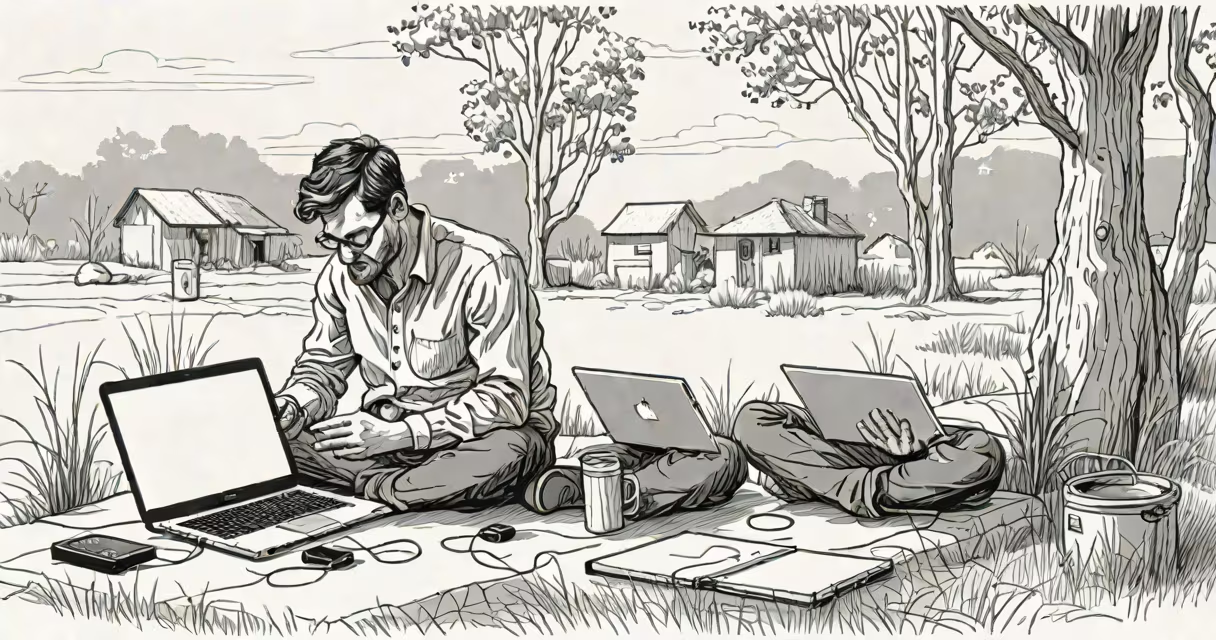
Some communities have created local mesh networks for internal communication. In rural Kenya, a group of farmers used low-cost Raspberry Pi devices to build a mesh network for sharing weather forecasts and market prices. The network worked locally, but no device could access Google or email. It wasn't internet-it was a private data exchange.
I tested a similar setup during a community event in Oregon. We connected 12 devices using open-source mesh software. All devices could chat and share files. But attempting to load a webpage failed. The error message read: "No internet connection." Not a bug. A feature.
If you want to avoid long-term contracts with a provider, consider alternatives like:
But none of these remove the need for a provider. They only change how you access it.
True internet access requires a provider. There is no way around it. The internet is not a place-it's a system of connections. And someone must own or operate the links between them.