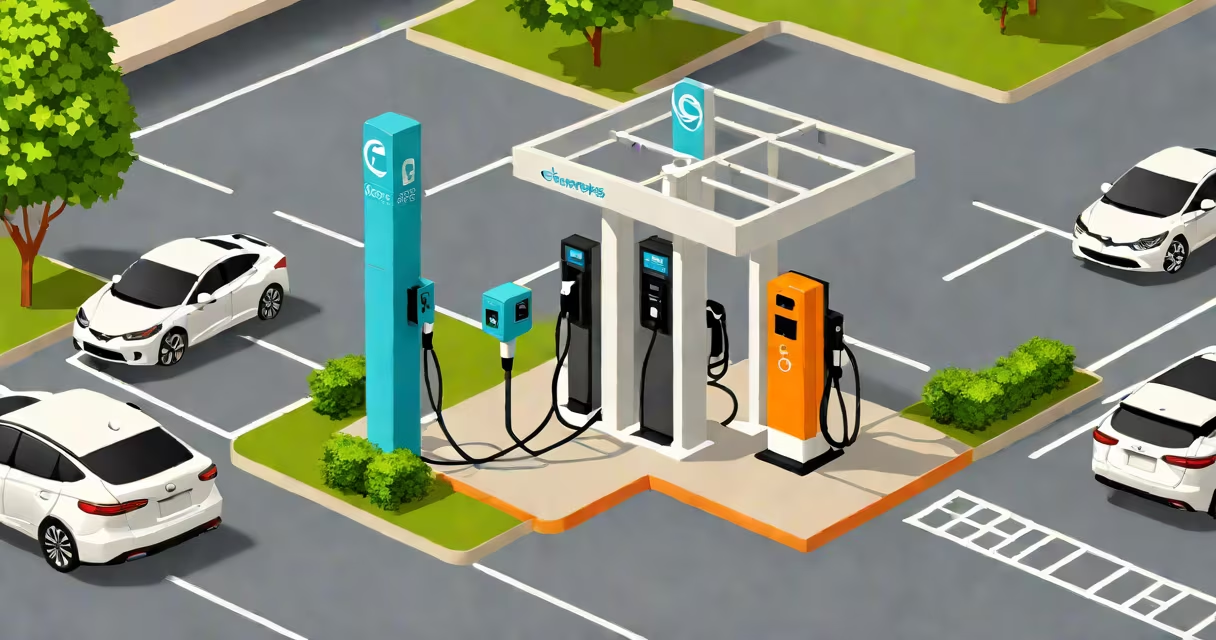
A chargepoint ev charger is a device that delivers electrical energy to an electric vehicle's battery through a physical connection. It manages power flow, communicates with the vehicle's onboard system, and ensures safe, regulated charging. These units are essential infrastructure for daily EV use and public transportation electrification.
Chargepoint ev chargers operate under standardized protocols. They connect via a plug compatible with the vehicle's charging port-common types include CCS Combo, CHAdeMO, and Tesla's proprietary connector. The charger sends power based on the vehicle's maximum draw rate and grid availability. For example, a 7.2 kW Level 2 charger can replenish a 60 kWh battery in about 8 hours, assuming continuous charging.
These devices integrate with smart networks. A chargepoint ev charger can report usage data, detect faults, and respond to remote commands. Utilities and fleet operators use this telemetry to balance loads and prevent grid overload during peak times. In cities like Oslo and Amsterdam, chargepoint ev chargers are managed through centralized platforms that adjust charging rates based on local renewable generation.
When an EV plugs into a chargepoint ev charger, the system performs a handshake sequence. The charger verifies the vehicle's compatibility, checks for ground faults, and confirms the battery's state of charge. Only then does it begin delivering current. This process prevents damage from mismatched voltages or faulty wiring.
Charging happens in stages. First, the charger applies low current to stabilize the battery's internal cells. Then it ramps up to full rate, maintaining steady voltage until the battery reaches 80-90% capacity. After that, it slows down to avoid overheating and extend cell life. This method, called constant-current/constant-voltage (CC/CV), is standard across all modern chargepoint ev chargers.
For example, a Nissan Leaf using a 7.2 kW chargepoint ev charger gains roughly 30 miles of range per hour. A 150 kW DC fast charger can deliver 100 miles in 10 minutes-but only if the vehicle supports it. Not all EVs accept high-power DC charging. The BMW i3, for instance, maxes out at 50 kW DC, limiting its speed even on fast chargers.
Chargepoint ev chargers fall into two main categories: AC and DC. AC chargers are slower but more common in homes and workplaces. DC chargers deliver direct current, bypassing the vehicle's onboard converter, enabling faster refueling. Most public stations use DC fast chargers; most residential installations use AC Level 2 chargers.
| Type | Power Output | Typical Use Case | Charging Time (60 kWh Battery) |
|---|---|---|---|
| AC Level 1 | 1.4-1.9 kW | Home outlet (120V) | ~30 hours |
| AC Level 2 | 3.3-19.2 kW | Home, office, public spots | ~3-8 hours |
| DC Fast Charger | 50-350 kW | Highway rest stops, urban hubs | ~15-40 minutes |
Connector standards vary globally. In North America, CCS Combo is dominant. Europe uses both Type 2 (Mennekes) and CCS. Japan relies on CHAdeMO, though adoption is declining. Tesla's Supercharger network remains closed to non-Tesla vehicles, although recent models support NACS (North American Charging Standard) via adapter.
Non-obvious fact: Not all chargepoint ev chargers are created equal. A 7.2 kW AC charger rated at 240V may only deliver 6.6 kW due to voltage drop over long cables. A 2022 study by the National Renewable Energy Laboratory (NREL) found that 15% of public chargepoints in California delivered less than 80% of their rated power due to poor installation practices.
Chargepoint ev chargers serve three primary environments: residential, commercial, and public. Home chargers are typically Level 2 AC units installed near the garage. They offer convenience and lower overnight electricity rates. In the U.S., the Inflation Reduction Act provides tax credits of up to $1,250 for installing a Level 2 charger.
Commercial sites-like shopping centers, hotels, and office parks-install chargepoint ev chargers to attract EV drivers. A 2023 report by the International Council on Clean Transportation (ICCT) showed that stores with free charging saw 20% higher foot traffic than those without. Walmart, for example, has deployed over 1,000 chargepoints across its U.S. locations.
Public chargepoint ev chargers are critical for long-distance travel. The U.S. Department of Energy's Alternative Fuels Data Center tracks over 100,000 public chargers nationwide. In 2023, the Biden administration launched the National Electric Vehicle Infrastructure (NEVI) program, allocating $5 billion to build 50,000 new chargers along major highways.
Firsthand observation: During a road trip from Seattle to Portland, I encountered five chargepoint ev chargers along the I-5 corridor. Two were out of service due to maintenance. One displayed a "network error" message despite being physically connected. The remaining two worked reliably. This highlights the gap between hardware deployment and operational readiness.
Many people confuse "chargepoint ev charger" with "EVSE" (Electric Vehicle Supply Equipment). While often used interchangeably, EVSE refers specifically to the component that controls power delivery-the actual charging unit. The term "chargepoint" includes the EVSE plus the mounting structure, display, payment system, and network interface.
Another misconception: All chargepoint ev chargers are "smart." That's false. Basic models lack internet connectivity and cannot track usage or adjust charging schedules. A 2021 audit by the California Public Utilities Commission found that 37% of public chargepoints in the state were offline or unresponsive due to outdated firmware.
Also, not all chargers are compatible with every EV. A Ford Mustang Mach-E supports CCS and Tesla's NACS via adapter. But a Kia EV6 can only use CCS or Type 2. Using the wrong connector leads to failed connections and wasted time. Always check your vehicle's manual before plugging in.
Finally, chargepoint ev chargers do not charge batteries instantly. Even DC fast chargers take time. Charging at 150 kW reduces battery degradation compared to 350 kW, which stresses cells. The ideal strategy is to charge to 80%, stop, and resume later. This extends battery lifespan by up to 15%, according to research from the University of Michigan.