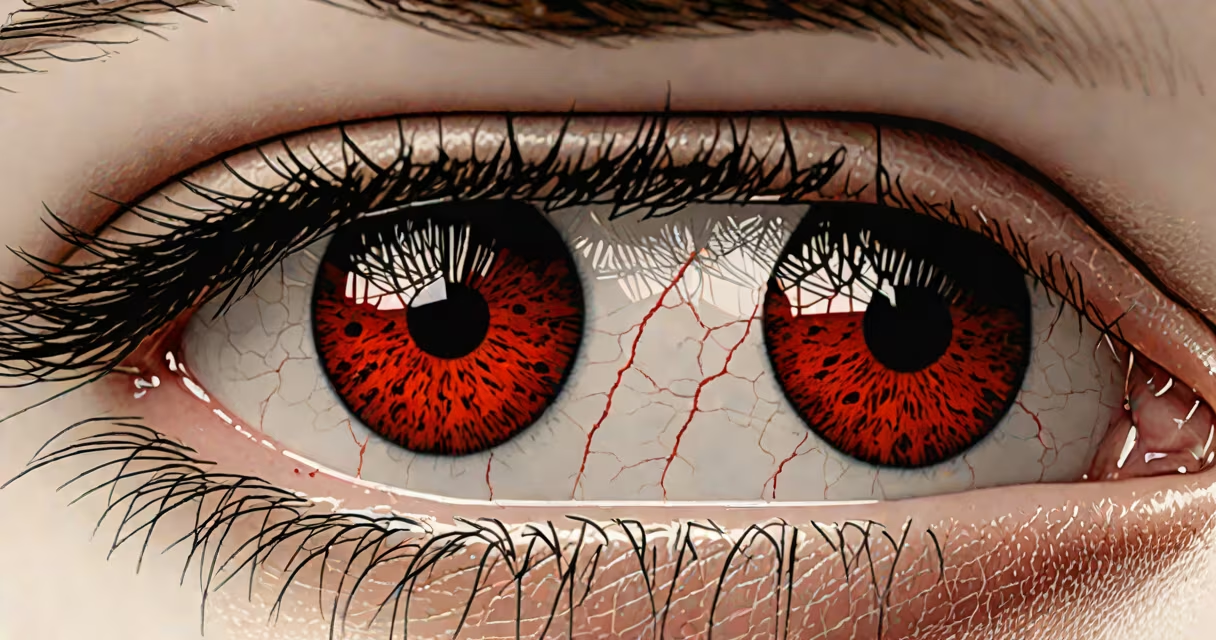
A dark red spot in the eye is typically a subconjunctival hemorrhage-bleeding beneath the transparent conjunctiva that covers the white part of the eye. It appears as a sharply defined, flat red or purplish patch that may spread slightly over a few days. The condition is usually painless and does not affect vision.
Subconjunctival hemorrhages occur when tiny blood vessels under the conjunctiva rupture. They are common, affecting about 1 in 10 people at some point in life, according to the American Academy of Ophthalmology. Most cases result from minor trauma-rubbing the eye, coughing violently, sneezing, or lifting heavy objects. High blood pressure and anticoagulant medications increase risk, though they rarely cause bleeding on their own.
The condition is not contagious and does not require treatment. The blood is reabsorbed gradually over 10 to 14 days, changing color from bright red to yellow or green before disappearing completely. It is not related to eye strain, screen use, or dry eyes-common misconceptions that lead people to delay care unnecessarily.
Beneath the conjunctiva lies a network of fragile capillaries. These vessels lack muscle layers and are prone to breaking under sudden pressure changes. A forceful sneeze can raise intraocular pressure momentarily, rupturing a vessel. Similarly, straining during bowel movements or intense physical exertion can trigger the bleed.
Once blood leaks into the space between the conjunctiva and sclera, it spreads due to gravity and tissue fluid. The red area expands slowly over 24-48 hours, peaking in size before fading. The color shifts as hemoglobin breaks down: red → purple → brown → yellow-mirroring bruising patterns seen elsewhere on the body.
Unlike a corneal abrasion or uveitis, which cause pain, light sensitivity, or blurred vision, subconjunctival hemorrhage causes no discomfort. The absence of symptoms is a key diagnostic clue. If pain, vision loss, or recurrent episodes occur, further evaluation is needed.
There are no formal "types" of dark red spots in the eye, but triggers fall into predictable categories:
| Trigger Category | Common Examples | Frequency |
|---|---|---|
| Mechanical stress | Coughing, sneezing, rubbing eyes, lifting weights | Most frequent |
| Medical conditions | Hypertension, diabetes, clotting disorders | Rare, but increases recurrence risk |
| Medications | Aspirin, warfarin, clopidogrel | Associated with higher incidence in users |
| Unexplained | Occurring without known cause | Accounts for ~30% of cases |
One study published in *Ophthalmology* found that patients on anticoagulants were 2.3 times more likely to develop subconjunctival hemorrhage than those not on such drugs. However, the condition remains benign even in these individuals unless accompanied by other signs of systemic bleeding.
Many people assume a dark red spot signals a serious eye injury or infection. This is incorrect. Unlike conjunctivitis-which causes itching, discharge, and swelling-a subconjunctival hemorrhage lacks discharge, pain, or swelling. The eye feels normal. Vision remains unchanged.
Another myth is that the spot indicates a stroke or brain bleed. There is no link between subconjunctival hemorrhage and intracranial events. The blood is confined to the ocular surface and cannot travel to the brain. Even in elderly patients, isolated hemorrhages do not predict cerebrovascular disease.
A non-obvious fact: the spot may appear larger than it actually is due to optical distortion. The transparent conjunctiva magnifies the blood pool visually. In reality, the lesion is shallow-usually less than 1 mm thick-and poses no structural threat to the eye.
Most dark red spots resolve without intervention. But consult an ophthalmologist if:
I once saw a patient who woke up with a large red patch after a night of heavy drinking. He assumed he'd suffered a stroke. After examination, the diagnosis was confirmed as subconjunctival hemorrhage. His blood pressure was normal, and his vision unaffected. The spot faded in 12 days. He left with relief-but also a reminder that not every red eye is an emergency.
A dark red spot in the eye is almost always a subconjunctival hemorrhage-benign, self-limiting, and painless. It results from broken capillaries under the conjunctiva, often triggered by minor trauma or physiological stress. The spot fades over 10-14 days without treatment. While alarming in appearance, it does not threaten vision or indicate systemic disease in most cases. Seek care only if symptoms persist, recur, or involve pain or visual changes.