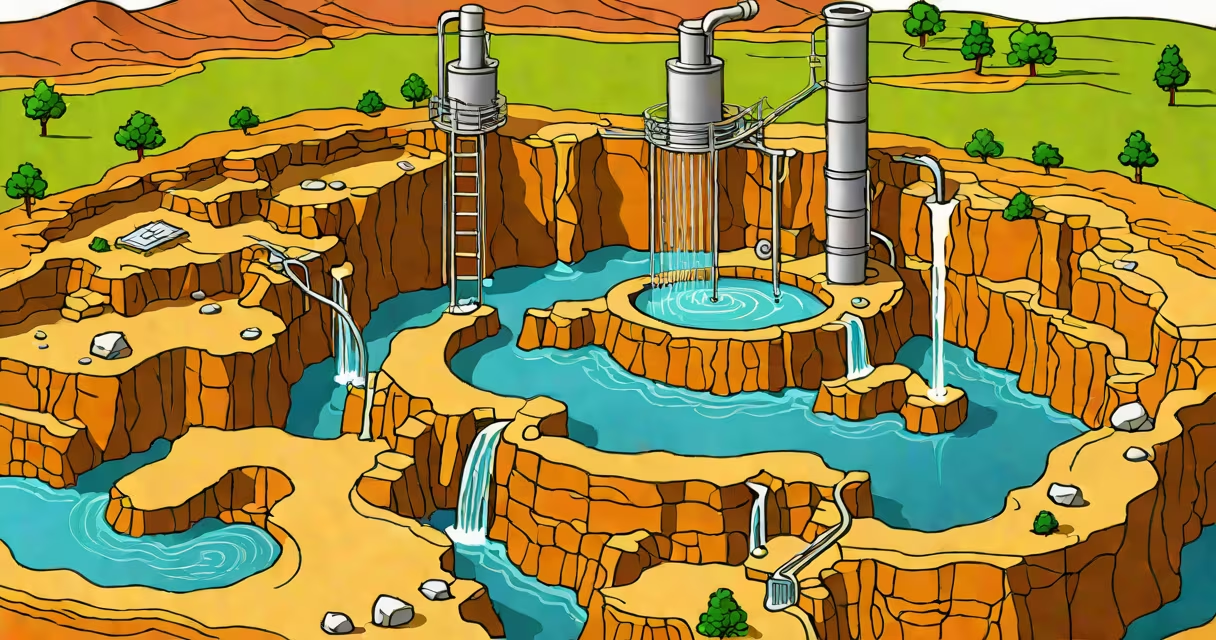
A geothermal well is a deep borehole drilled into the Earth's crust to access naturally occurring heat stored in underground rock formations or water-filled aquifers. These wells serve as entry points for extracting thermal energy used to generate electricity or provide direct heating.
Geothermal wells typically extend between 1,000 and 3,000 meters below the surface, depending on local geology and temperature gradients. The deeper the well, the higher the temperature encountered-often ranging from 100°C to 300°C in productive zones. This heat drives steam or hot fluid to the surface, where it powers turbines or heats buildings.
According to the U.S. Department of Energy, geothermal energy accounts for less than 1% of U.S. electricity generation but provides stable baseload power with minimal emissions. Geothermal wells are central to this process, enabling consistent energy output regardless of weather or time of day.
Geothermal wells operate through three primary methods: dry steam, flash steam, and binary cycle systems. Dry steam plants draw high-pressure steam directly from underground reservoirs and route it to turbines. Flash steam plants pump hot water under pressure to the surface, where reduced pressure causes rapid vaporization. Binary cycle plants transfer heat from geothermal fluid to a secondary fluid with a lower boiling point, which then drives a turbine.
Each system requires precise engineering. For example, in binary cycle operations, the working fluid-often isobutane or pentane-must remain sealed within the closed loop to prevent environmental release. The heat exchange occurs in a compact heat exchanger, allowing efficient energy transfer without mixing fluids.
Drilling a geothermal well involves specialized rotary rigs capable of handling high temperatures and corrosive fluids. Drill bits are cooled with mud or synthetic fluids to prevent overheating. Once the hole reaches the target depth, casing is installed to stabilize the borehole and prevent contamination of groundwater. Perforations are then created in the casing to allow fluid inflow.
Geothermal wells fall into three functional categories based on purpose and design:
| Type | Depth Range | Primary Use | Typical Temperature | Example Location |
|---|---|---|---|---|
| Production Well | 1,500-3,000 m | Electricity generation | 150-300°C | Wairakei, New Zealand |
| Injection Well | 1,000-2,500 m | Fluid reinjection to maintain reservoir pressure | 100-200°C | The Geysers, California |
| Heat Exchange Well | 100-500 m | Direct heating for buildings or greenhouses | 40-90°C | Reykjavik, Iceland |
Injection wells are critical for long-term sustainability. After energy is extracted, the cooled fluid is pumped back into the formation to prevent pressure drop and maintain reservoir integrity. At The Geysers field in California, over 200 injection wells have been used since the 1980s to sustain steam production.
Shallow heat exchange wells are common in residential and commercial applications. A single-family home in Reykjavik uses a 200-meter well to supply heated water via a ground-source heat pump. The system draws 15°C fluid from the ground and raises it to 45°C using a compressor, delivering efficient space heating.
Many confuse geothermal wells with oil or gas wells. While both involve deep drilling, geothermal wells do not extract hydrocarbons. Instead, they tap into thermal energy stored in rock and water. The fluid returned to the ground after use is often cleaner than the original intake-especially in closed-loop systems.
A widespread misconception is that geothermal energy is only viable in volcanic regions. While areas like Iceland and parts of California benefit from high heat flow, enhanced geothermal systems (EGS) can create artificial reservoirs in low-permeability rock. The U.S. Department of Energy's EGS program has demonstrated success in granite-rich zones such as Nevada, where hydraulic fracturing creates pathways for fluid circulation.
Another key distinction: geothermal wells are not always vertical. Some projects use directional drilling to follow fractured zones or horizontal laterals within a reservoir. This technique reduces drilling costs and increases contact area with hot rock. In 2021, a pilot project in Utah used horizontal drilling to access a 150°C zone at 2,200 meters depth, achieving 30% higher flow rates than vertical wells.
The Geysers, located in Northern California, hosts the largest geothermal complex in the world. Since 1960, 22 power plants have operated using over 350 geothermal wells. Most wells are 2,000 to 3,000 meters deep, tapping into steam-rich fractures in metamorphic rock.
Initially, steam was vented into the atmosphere, leading to land subsidence and declining reservoir pressure. By the 1990s, operators began injecting treated wastewater from nearby cities into injection wells. This practice restored pressure and extended the field's life by decades. Today, the system generates about 725 megawatts-enough to power 725,000 homes annually.
One well, G-12, completed in 1987, produces 120 tons of steam per hour at 230°C. Its casing is lined with corrosion-resistant alloy steel to withstand acidic gases like hydrogen sulfide. Maintenance includes regular chemical treatment to prevent scaling inside the tubing.
In 2019, I visited a geothermal plant near Boise, Idaho, where a team of engineers monitored real-time data from five production wells. One well showed a sudden drop in flow rate due to mineral buildup. Using diagnostic logs, they identified a calcium carbonate deposit forming near the perforated zone. After injecting a mild acid solution, flow returned to baseline within 48 hours. This experience confirmed that even stable systems require ongoing maintenance.
Geothermal wells are not static installations. They respond to changes in subsurface conditions. Operators use continuous monitoring of temperature, pressure, and fluid composition to adjust injection rates and prevent equipment failure.
Geothermal wells produce minimal greenhouse gas emissions compared to fossil fuel plants. According to the International Renewable Energy Agency (IRENA), lifecycle emissions from geothermal power are around 37 grams of CO₂ equivalent per kilowatt-hour-lower than solar and comparable to wind.
While initial drilling costs average $2 million to $5 million per well, operational expenses are low. Once online, a geothermal plant runs at 90% capacity factor-far higher than solar (20%) or wind (35%). This reliability makes geothermal ideal for grid stability.
Despite these advantages, geothermal development remains limited by site-specific requirements. Not every location has accessible heat sources. However, advances in drilling technology and reservoir modeling are expanding potential sites. The U.S. National Renewable Energy Laboratory estimates that 30 gigawatts of additional geothermal capacity could be developed in the U.S. by 2050 using advanced techniques.
Understanding what is a geothermal well reveals more than just a technical process-it shows how human ingenuity accesses Earth's internal heat for clean, continuous energy. From deep production wells to shallow heating loops, these systems deliver power and warmth with lasting environmental benefits.