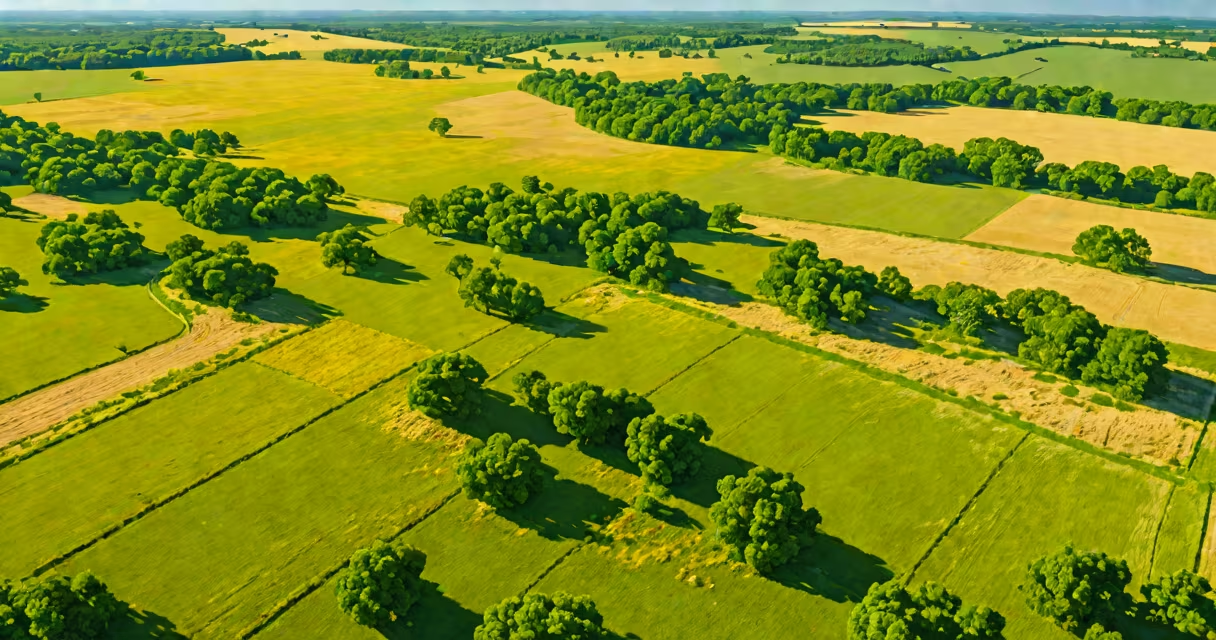
Grassland biome characteristics describe ecosystems dominated by grasses, with few trees, moderate to low precipitation, and seasonal temperature variation. These biomes cover about 25% of Earth's land surface and support high biodiversity despite their open structure.
Grasslands form where rainfall is too low for forests but too high for deserts-typically between 250 mm and 900 mm annually. This range supports dense grass growth while limiting tree establishment due to drought stress and frequent fires. Soil in grasslands is often deep and rich in organic matter because roots decompose slowly and contribute to humus buildup. The combination of climate, soil, and fire regimes shapes the entire system.
Two major types exist: temperate grasslands (like North American prairies and Eurasian steppes) and tropical grasslands (such as African savannas). Temperate grasslands have cold winters and hot summers, with grasses adapted to freeze tolerance and periodic burning. Tropical grasslands experience wet and dry seasons, where fire suppression during the rainy season allows trees to encroach unless maintained by grazing animals or lightning strikes.
Grassland ecosystems rely on disturbances-especially fire and herbivory-to maintain dominance of grasses over woody plants. Without regular fires, shrubs and trees gradually invade, transforming the field into woodland. Similarly, large herbivores such as bison, wildebeest, and antelope prevent tree seedlings from establishing by browsing and trampling young saplings.
Fire plays a critical role in nutrient cycling. When grasses burn, nitrogen and phosphorus are released into the soil as ash, making them available for new growth. Studies show that burned grasslands recover faster and support higher plant diversity than unburned ones. In the Serengeti, controlled burns increase forage quality for grazers by reducing old, fibrous plant material.
Root systems in grassland plants are extensive and shallow. Species like big bluestem (Andropogon gerardii) develop root masses that can reach 3 meters deep, storing carbon and stabilizing soil. Research from the University of Minnesota confirms that prairie soils sequester up to 1.5 tons of carbon per hectare per year-comparable to tropical forests despite lower biomass.
Grassland biome characteristics vary by region. The following table outlines key distinctions:
| Type | Climate | Key Vegetation | Notable Wildlife | Region Examples |
|---|---|---|---|---|
| Temperate grassland | Cold winters, hot summers; 250-600 mm rain/year | Native grasses: switchgrass, purple coneflower | Bison, pronghorn, coyote | Great Plains (USA), Pampas (Argentina), Steppes (Russia) |
| Tropical grassland (savanna) | Warm year-round; 600-1,200 mm rain/year, seasonal | Grasses: elephant grass; scattered acacia trees | Lion, zebra, giraffe, wildebeest | Africa (Serengeti), Australia (Northern Territory), South America (Llanos) |
One non-obvious distinction: tropical savannas often have deeper soils than temperate grasslands due to slower decomposition rates in warmer climates. However, they are more vulnerable to erosion when overgrazed, as seen in parts of Kenya where rangeland degradation has reduced water retention capacity by 40% since 1980.
Many assume grasslands are barren or lifeless. In reality, they host complex food webs. A single hectare of tallgrass prairie can contain over 100 plant species and hundreds of insect species. The American bison, once reduced to fewer than 1,000 individuals in the 1800s, now numbers over 30,000 in managed herds-proof of ecological resilience when protected.
Another misconception is that grasslands are natural defaults. They are not. Human activity-especially fire management and agriculture-has shaped most grasslands for millennia. Indigenous peoples in North America used prescribed burns to improve hunting grounds and promote edible plants. Today, many conservationists replicate these practices to restore native grasslands.
I once observed a restoration project in Kansas where native seeds were sown after removing invasive cheatgrass. Within three years, the site supported 12 bird species not seen in decades. The success came not from planting trees, but from reintroducing fire cycles and managing grazing pressure-a reminder that grassland health lies in process, not just composition.
Grasslands regulate climate through carbon storage. Their deep root systems capture atmospheric CO₂ and lock it in soil for centuries. According to the Intergovernmental Panel on Climate Change (IPCC), restoring degraded grasslands could sequester up to 1 gigaton of carbon annually-equivalent to removing 200 million cars from roads.
They also provide important system services: flood mitigation via soil absorption, groundwater recharge, and habitat for pollinators. Monarch butterflies depend on milkweed, which thrives in prairie remnants. Without these habitats, migration patterns collapse. In 2023, the U.S. Fish and Wildlife Service reported a 70% decline in monarch populations since 1990, largely due to grassland loss.
Despite their importance, grasslands are among the most threatened biomes. Over 70% of global grasslands have been converted to cropland or urban areas. The United Nations Environment Programme notes that only 15% of remaining grasslands are under formal protection.
Understanding grassland biome characteristics is essential for conservation, agriculture, and climate policy. These ecosystems are not empty fields-they are changing, interconnected systems shaped by climate, fire, and life. Recognizing their complexity prevents mismanagement and supports long-term sustainability.
Grassland biome characteristics define one of Earth's most productive yet fragile environments. From the rolling plains of the Great Plains to the sun-drenched savannas of East Africa, these landscapes sustain biodiversity, store carbon, and support human livelihoods. Protecting them requires knowing what they are-and what they are not.
This guide