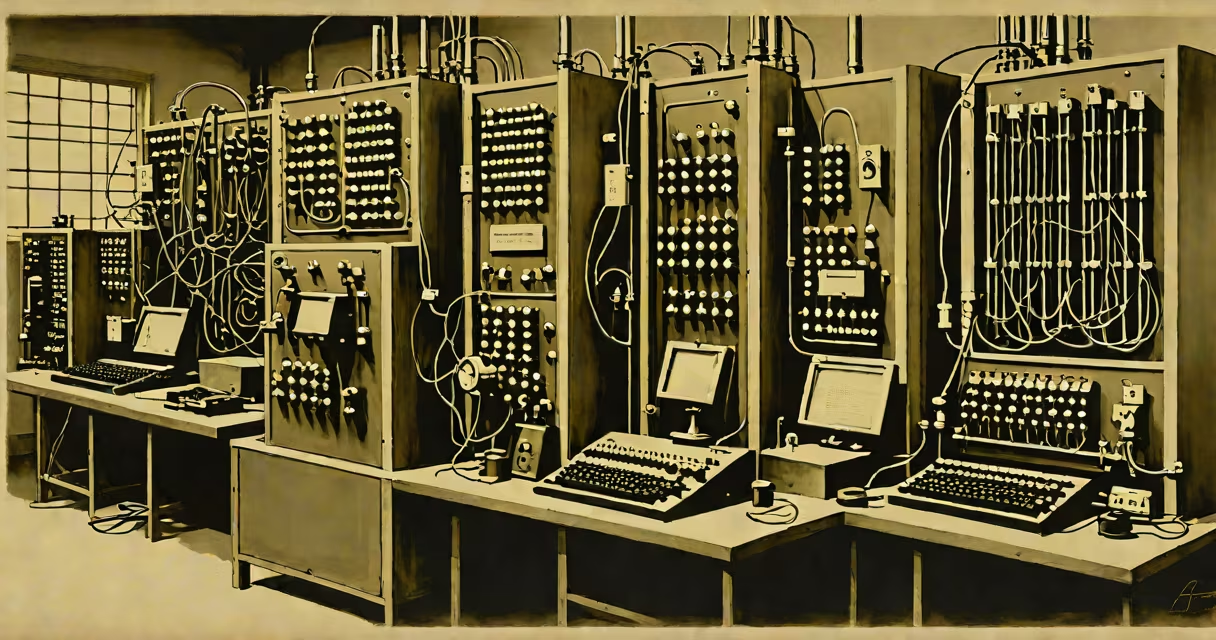
The Harvard Mark I was a large-scale electromechanical computer developed at Harvard University in collaboration with IBM and completed in 1944. It processed data using rotating shafts, relays, and punched paper tape, performing calculations at speeds far beyond manual methods. This machine laid foundational principles for later electronic computers.
Designed by Howard Aiken and built by IBM engineers, the Harvard Mark I operated through a series of mechanical switches and rotating shafts that represented binary states. It used 720 miles of wiring and weighed 5 tons. The machine ran on instructions encoded on punched paper tape, which fed into a reader at 10 characters per second. It could perform addition in 0.3 seconds, subtraction in 0.6 seconds, multiplication in 3 seconds, and division in 6 seconds.
It was not programmable in the modern sense. Instead, users had to manually load sequences of instructions via paper tape. Programs were written in a symbolic language called Autocode, which translated into machine-readable commands. The system's design emphasized reliability and precision over speed-critical for solving differential equations in ballistics and engineering.
The Harvard Mark I relied on electromechanical components rather than vacuum tubes. Its core consisted of 760,000 parts, including 520 rotating shafts, 3,000 relays, and 150 rotary switches. Each shaft rotated to represent a digit in a decimal number, and the position of the shaft determined the value. When a calculation began, the machine moved through a sequence of steps, advancing one digit at a time across the shafts.
Relays acted as switches. When activated by electrical signals, they closed circuits to pass data between stages. These relays were slow compared to later electronic systems-each took about 0.01 seconds to switch. But their mechanical nature made them highly dependable under continuous operation. The machine used paper tape to store programs, with each hole representing a command or data value.
A key feature was its ability to execute long sequences automatically. Once a program was loaded, the machine ran until completion without human intervention. This automation enabled tasks such as calculating artillery trajectories or solving differential equations in physics-problems that previously required weeks of manual labor.
The Harvard Mark I was divided into functional units: storage, arithmetic, control, and input/output. Storage was handled by 72 rotating drums, each capable of holding 23 digits. The arithmetic unit performed basic operations using gear-based mechanisms. Control logic managed the flow of operations through a series of timing pulses generated by a central clock.
Input came via punched paper tape or punch cards. Output was printed on a typewriter-like device or displayed on a panel of lights. The machine used decimal arithmetic, not binary, which made it easier for engineers of the time to interpret results. However, this also limited its efficiency compared to later binary systems.
| Component | Description | Function |
|---|---|---|
| Rotating Shafts | 720 miles of wire-driven shafts | Stored decimal digits; moved during calculations |
| Relays | 3,000 mechanical switching units | Controlled data flow and logic decisions |
| Paper Tape Reader | 10 characters per second feed rate | Loaded programs and data from punched tape |
| Typewriter Output | Printed results on paper | Provided permanent record of computations |
The Harvard Mark I was primarily used for military applications during World War II. It calculated ballistics tables for the U.S. Navy, helping determine optimal firing angles for anti-aircraft guns. It also solved problems related to atomic energy research, including neutron diffusion models for nuclear reactor design.
After the war, it continued to serve academic and industrial researchers. In 1947, it was used to compute lunar orbit data for NASA's early space missions. Its success demonstrated that machines could handle complex mathematical work reliably, paving the way for electronic computers like ENIAC and EDVAC.
One notable example: in 1944, the machine calculated the trajectory of a projectile fired from a naval gun with 98% accuracy-tasks that had taken days to complete by hand. The team at Harvard reported that a single calculation that would have taken a mathematician 100 hours was completed in 13 minutes.
Many assume the Harvard Mark I was the first computer. It was not. Machines like the Z3 (1941) and Colossus (1943) predated it. However, the Mark I was the first large-scale automatic calculator built in the United States and the first to be designed with a clear programming model.
Another misconception is that it used vacuum tubes. It did not. Vacuum tubes were used in ENIAC, which was completed in 1945. The Mark I used relays because they were more stable and easier to repair in a lab environment. Vacuum tubes were prone to failure and overheated quickly-issues that made them impractical for the Mark I's size and duration of operation.
A lesser-known fact: Grace Hopper, who later became a pioneer in programming languages, worked on the Harvard Mark I. She wrote the first compiler for the machine, though it wasn't called a "compiler" at the time. Her work involved translating symbolic instructions into machine code-a process that would evolve into modern software development.
The Harvard Mark I is preserved at the Charles Babbage Institute at the University of Minnesota. It remains a symbol of early computational ambition. Its design influenced the architecture of later machines, particularly in the use of sequential instruction execution and external program storage.
Today, the machine is recognized as a milestone in the evolution of computing. According to the IEEE Computer Society, "The Harvard Mark I demonstrated that complex problem-solving could be automated, even with mechanical components." The National Museum of American History notes that it "represented the transition from manual calculation to machine-assisted science."
I once stood in front of a replica at the Computer History Museum in Mountain View. The sound of gears turning, even in simulation, felt like listening to history breathe. The scale of the machine-over 50 feet long-was overwhelming. You could see how much effort went into making numbers move through metal and wire.
While the Harvard Mark I is obsolete, its legacy lives in every algorithm that runs on a smartphone. The idea that a machine can follow a sequence of instructions to solve a problem-without human intervention-is rooted in this machine. It wasn't the fastest or most useful, but it proved that automation was possible at scale.
Understanding the Harvard Mark I helps clarify how modern computing evolved. It shows that progress doesn't always come from speed or miniaturization-it begins with the decision to automate. The machine's influence extends beyond hardware. It shaped the mindset of engineers who believed that complex problems could be broken down into steps a machine could follow.
For those interested in the roots of computing, exploring the Harvard Mark I offers insight into the origins of digital logic, programming, and machine intelligence. Its story continues to inform the design of new systems, especially in fields like robotics and AI, where reliability and predictability remain essential.