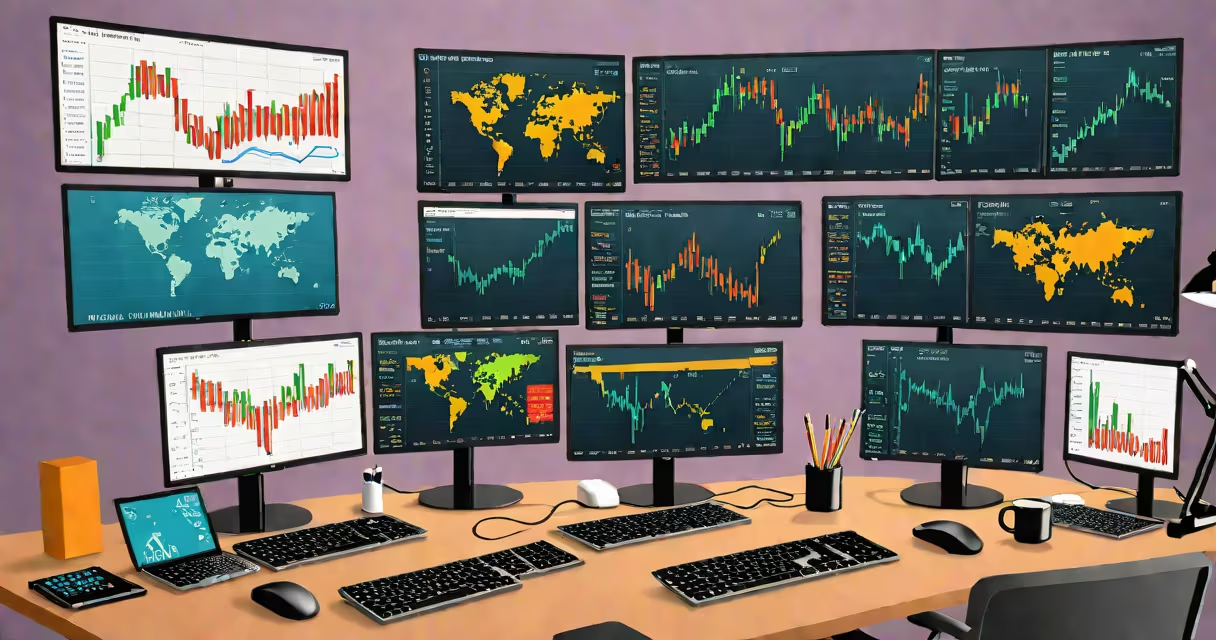
Trading international currency involves buying and selling foreign exchange pairs through a licensed broker using real-time market prices. This process enables individuals and institutions to profit from shifts in exchange rates or help cross-border payments.
Foreign exchange markets operate 24 hours a day, five days a week, with major sessions in London, New York, and Tokyo. Traders access these markets via online platforms that display live bid and ask prices for currency pairs such as EUR/USD or USD/JPY. Transactions occur in standardized lots-typically 10,000 units of the base currency-and are settled within two business days.
The most common method for retail traders is using a margin account with a regulated brokerage firm. These firms provide use, allowing control over larger positions with smaller capital. For example, 100:1 use lets a trader manage $100,000 worth of currency with just $1,000 in their account. This amplifies both gains and losses.
Currency trading happens in pairs, where one currency is bought while another is sold simultaneously. The first currency in the pair is the base currency; the second is the quote currency. For instance, in EUR/USD, euros are being exchanged for U.S. dollars. A price of 1.1000 means one euro buys 1.10 U.S. dollars.
Market movements are driven by economic indicators, central bank policies, geopolitical events, and investor sentiment. For example, when the U.S. Federal Reserve raises interest rates, the dollar often strengthens because higher yields attract foreign capital. Conversely, inflation spikes in Europe may weaken the euro against the dollar.
Trading occurs through electronic networks rather than centralized exchanges. The interbank market accounts for about 90% of daily volume, with banks acting as market makers. Retail traders connect to this network via brokers who aggregate liquidity from multiple banks.
Traders choose between different platform types based on experience level and strategy. The main categories are:
| Type | Best For | Example Platform | Key Feature |
|---|---|---|---|
| Web-based | Beginners, quick access | Interactive Brokers Trader Workstation | Browser-only, no download required |
| Desktop software | Active traders, advanced analysis | MetaTrader 4 | Customizable charts, automated trading scripts |
| Mobile apps | On-the-go monitoring | Forex.com Mobile App | Push notifications, real-time alerts |
Each platform supports technical analysis tools like moving averages, Bollinger Bands, and Relative Strength Index (RSI). These help identify potential entry and exit points. For example, a 50-day moving average crossing above a 200-day average signals a bullish trend reversal-a pattern known as a "golden cross."
Automated trading systems, or algorithmic bots, execute trades based on predefined rules. They reduce emotional bias and allow backtesting on historical data. According to a 2022 report by the Bank for International Settlements, algorithmic strategies accounted for over 60% of daily turnover in major currency pairs.
Most trading occurs during overlapping session times. The London and New York sessions overlap from 8 a.m. to 12 p.m. Eastern Time, creating peak liquidity. During this window, spreads-the difference between buy and sell prices-narrow to as little as 0.1 pips on major pairs.
Trading is not available on weekends. The forex market closes Friday at 5 p.m. EST and reopens Sunday at 5 p.m. EST. This gap creates risk for positions held over the weekend, especially if unexpected news breaks during the downtime. Some brokers offer swap-free accounts for traders who avoid holding overnight positions.
For those seeking physical currency exchange, options include airport kiosks, banks, and specialized services like Wise or Revolut. These are not trading platforms-they convert funds at retail rates with added fees. For example, exchanging $1,000 at a typical airport counter might yield only $880 in euros due to poor rates and service charges.
Many assume currency trading is like gambling. While speculation exists, professional traders use fundamental and technical analysis to assess value. For example, a trader analyzing the Swiss National Bank's policy stance might anticipate a weakening franc if inflation remains low. This insight supports a long position in CHF/JPY.
A key misunderstanding is that forex trading requires large capital. In reality, many brokers allow accounts starting at $100. However, small accounts face higher percentage risk. A $100 account losing 10% loses $10-10% of equity-but a $10,000 account losing 10% loses $1,000. Risk management is critical.
Another error is ignoring transaction costs. While some brokers advertise "zero spreads," they make money through commissions or overnight financing charges. On a $10,000 trade, a 1 pip spread on EUR/USD equals $10 in cost. Over 100 trades, that adds up to $1,000 in hidden fees.
I once opened a demo account with a major broker and simulated a month of trading using only technical signals. My win rate was 58%, but my average loss exceeded my average gain by 17%. After adjusting stop-loss levels and reducing position size, results improved. This taught me that consistency matters more than frequency.
Suppose you want to trade EUR/USD. You log into your MetaTrader 4 account and see the current price at 1.0950. You believe the euro will strengthen due to upcoming ECB rate hike announcements. You place a buy order for 1 standard lot (100,000 euros) at 1.0950.
Two hours later, the price rises to 1.1000. You close the position. Your profit is calculated as:
(1.1000 - 1.0950) × 100,000 = 50 pips × $10 per pip = $500 profitAfter deducting a $5 commission and $2 in overnight financing, your net gain is $493. This illustrates how small price changes generate measurable returns when scaled properly.
Always verify that your broker is registered with a recognized authority. The U.S. Commodity Futures Trading Commission (CFTC) lists approved forex brokers at cftc.gov. In the EU, look for firms authorized by the European Securities and Markets Authority (ESMA).
Understanding how to trade international currency begins with learning the mechanics, testing strategies in a demo environment, and managing risk. Real success comes from discipline, not luck.
Mastering this skill allows you to participate in global financial flows, hedge exposure, or speculate on macroeconomic trends. The foundation lies in clear objectives, verified tools, and continuous education.