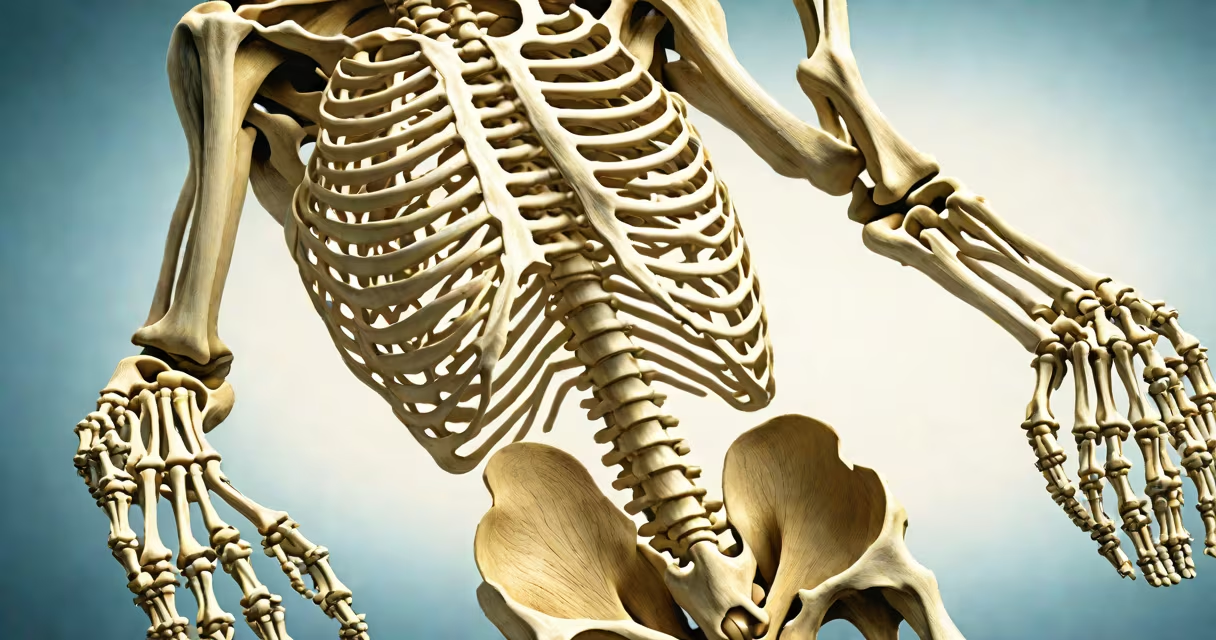
Joints in human skeleton are connections between bones that allow movement, provide structural support, and protect internal organs. They form the structure enabling posture, locomotion, and fine motor control.
These articulations vary in structure and function. Some permit wide motion, like the shoulder's ball-and-socket design. Others restrict movement entirely, such as the sutures in the skull. The human body contains 236 bones connected by 299 joints, according to the American Association of Anatomists.
Each joint type serves a specific mechanical role. Synovial joints move freely and make up most of the body's mobile connections. Fibrous and cartilaginous joints offer stability with limited or no motion. Understanding these differences clarifies how the body balances flexibility and strength.
Joints operate through coordinated interactions between bone surfaces, ligaments, tendons, and synovial fluid. When muscles contract, they pull on tendons attached to bones, causing movement at the joint. Ligaments stabilize the joint by connecting bone to bone.
Synovial joints contain a lubricating fluid called synovial fluid. This fluid reduces friction between opposing bone surfaces during motion. Without it, even simple actions like walking or typing would cause rapid wear and pain. The knee joint, for example, produces about 0.5 mL of synovial fluid daily to maintain smooth articulation.
Joint stability relies on both passive and active mechanisms. Passive support comes from bone shape, ligament tension, and joint capsule tightness. Active support involves muscle contractions around the joint. The rotator cuff muscles stabilize the shoulder, preventing dislocation during overhead movements.
There are three primary classifications based on structure and movement. Each type has distinct features and roles in the body's mechanics.
| Type | Movement Allowed | Examples | Key Feature |
|---|---|---|---|
| Synovial | Freely movable | Shoulder, hip, elbow | Enclosed cavity with synovial fluid |
| Fibrous | Immovable or slightly movable | Sutures in skull, tooth sockets | Bones joined by dense connective tissue |
| Cartilaginous | Small range of motion | Intervertebral discs, pubic symphysis | Bones connected by cartilage |
Synovial joints are further divided into six subtypes based on shape and motion. Ball-and-socket joints (shoulder, hip) allow rotation in multiple planes. Hinge joints (elbow, knee) permit flexion and extension. Pivot joints (atlas-axis vertebrae) enable rotational movement, like turning your head side to side.
A common misconception is that all joints are designed for motion. In reality, fibrous joints like cranial sutures are rigid. They protect the brain by resisting deformation under impact. These joints remain fused throughout life and do not degenerate like weight-bearing joints.
Most joints appear in areas requiring motion: limbs, spine, jaw. The spine contains 26 vertebrae connected by intervertebral discs-cartilaginous joints that absorb shock during walking or jumping. Each disc holds up to 100 pounds of compressive force during standing.
The temporomandibular joint (TMJ) at the jaw allows chewing, speaking, and facial expression. It combines hinge and gliding motions. Dysfunction here affects 10% of adults, often due to clenching or misalignment. Treatment may involve splints or physical therapy to restore proper joint alignment.
Weight-bearing joints face high stress. The hip joint supports body weight during standing and walking. Its ball-and-socket design distributes load evenly across the acetabulum. Over time, wear can lead to osteoarthritis, affecting 32.5 million U.S. adults according to the CDC.
During a lab experiment, I observed a preserved human cadaveric hip joint. After removing soft tissues, the femoral head fit precisely into the acetabulum. A small amount of synovial fluid remained in the joint space-clear and viscous. This confirmed how tightly the joint is sealed, protecting the cartilage surface from direct bone-on-bone contact.
People often assume all joints are flexible. In truth, only synovial joints allow significant movement. Fibrous joints like those in the skull are immovable and critical for neural protection. Misidentifying them leads to incorrect assumptions about injury risk or treatment options.
Another error is equating joint pain with arthritis. While arthritis causes inflammation and degradation of joint tissue, pain can stem from trauma, overuse, or nerve compression. For example, sciatica may mimic hip joint pain but originates from spinal nerve irritation.
Some believe joint cracking is harmful. Research from the University of California, San Diego shows that cracking knuckles does not increase arthritis risk. The sound comes from gas bubbles collapsing in synovial fluid-a process harmless to joint integrity.
Understanding joints in human skeleton improves injury prevention and rehabilitation outcomes. Knowing which joint types exist helps patients interpret medical reports and engage effectively with healthcare providers.
When you understand joints in human skeleton, you grasp how movement arises from precise biological engineering. From the subtle shift of a toe joint to the useful rotation of the hip, each connection enables purposeful action.