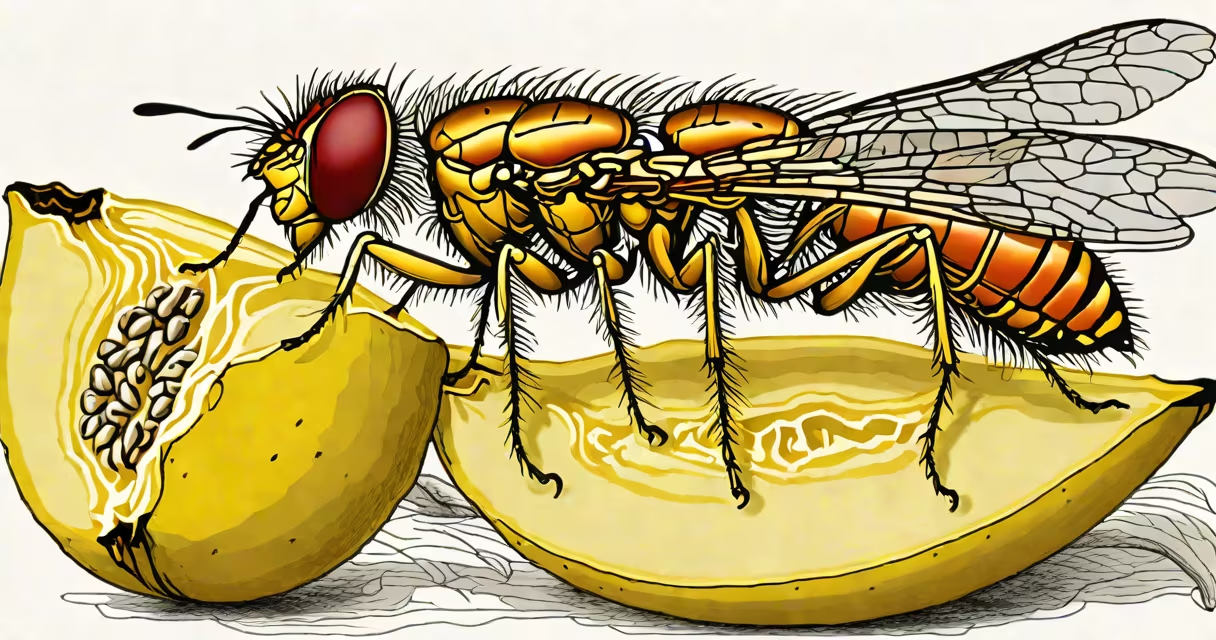
The fruit fly life cycle is a four-stage process-egg, larva, pupa, and adult-that typically completes in 10 days at 25°C (77°F), making Drosophila melanogaster a key model organism in genetics and developmental biology.
Fruit flies begin life as tiny, oval eggs laid on fermenting fruit or other organic matter. These eggs hatch within 24 hours under optimal conditions. The newly emerged larvae are legless, worm-like creatures that feed on yeast and bacteria in their substrate. They grow rapidly, molting twice during their three-day larval stage. After reaching full size, they stop feeding and seek a dry surface to pupate.
Pupation marks the third phase. The larva forms a pupal case, inside which dramatic internal restructuring occurs. Tissues break down and reorganize into adult structures-a process known as complete metamorphosis. This stage lasts about four days. During this time, wings, legs, eyes, and reproductive organs develop from imaginal discs, clusters of undifferentiated cells present in the larva.
Adult fruit flies emerge from the pupal case with fully formed bodies. Males and females mature quickly-within 6-8 hours-and begin mating shortly after. Females lay up to 500 eggs in their lifetime, often returning to the same food source. Adults live 30-60 days in lab conditions, though lifespan varies with temperature and nutrition.
Each stage serves a distinct biological purpose. The egg stage ensures dispersal and protection during early development. Larvae maximize nutrient intake with minimal energy cost. Pupae allow for complex morphological changes without movement. Adults focus on reproduction and dispersal.
Temperature strongly influences timing. At 18°C, the entire cycle takes 17 days. At 29°C, it finishes in 7 days. This sensitivity makes fruit flies ideal for studying gene expression in response to environmental cues.
| Stage | Duration (25°C) | Key Activities |
|---|---|---|
| Egg | 12-24 hours | Embryonic development; hatching |
| Larva (instars 1-3) | 3 days | Feeding, growth, molting |
| Pupa | 4 days | Metamorphosis; organ reformation |
| Adult | Days to weeks | Mating, egg-laying, dispersal |
Scientists use the fruit fly life cycle to study gene function, behavior, aging, and disease mechanisms. Its short generation time allows researchers to observe multiple generations in a single academic term. The genome of Drosophila melanogaster was sequenced in 2000, revealing high conservation with human genes-over 75% of human disease genes have functional counterparts in fruit flies.
For example, mutations in the period gene disrupt circadian rhythms in fruit flies, leading to altered sleep-wake cycles. This discovery helped identify similar genes in humans involved in sleep disorders and depression. The fruit fly life cycle enables rapid testing of such genetic effects across generations.
A common misconception is that fruit flies are pests because they damage fruit. In reality, they do not eat healthy fruit-they colonize already decaying material. Their presence indicates fermentation, not spoilage caused by them. This ecological role supports decomposition and nutrient cycling in ecosystems.
People often confuse the fruit fly life cycle with that of mosquitoes or houseflies. Mosquitoes also undergo complete metamorphosis, but their aquatic larvae differ in habitat and feeding. Houseflies have similar stages but longer durations-up to 21 days at room temperature-and different ecological niches.
Another error is assuming all insects follow the same pattern. Some insects, like grasshoppers, undergo incomplete metamorphosis-missing the pupal stage entirely. Fruit flies strictly follow complete metamorphosis, with a distinct resting phase during which transformation occurs.
I once observed a fruit fly colony in a lab setting where temperature fluctuations led to abnormal pupation. About 15% of pupae failed to eclose, remaining trapped in the pupal case. This was traced to a mutation in the shibire gene, which affects synaptic transmission. The failure demonstrated how tightly regulated neural signaling must be during metamorphosis.
To study the fruit fly life cycle, maintain cultures on agar-based medium with yeast and sugar. Place a few adult flies in a vial with food and a cotton plug. Within 24 hours, eggs appear as small white dots. After 3 days, larvae emerge and move toward the food's edge. By day 6, pupae form-transparent, darkened cases. Adults emerge around day 10.
Use a dissecting microscope to examine pupae. The developing eye and wing structures become visible after 24 hours in the pupal case. Record daily observations to track developmental timing and detect anomalies.