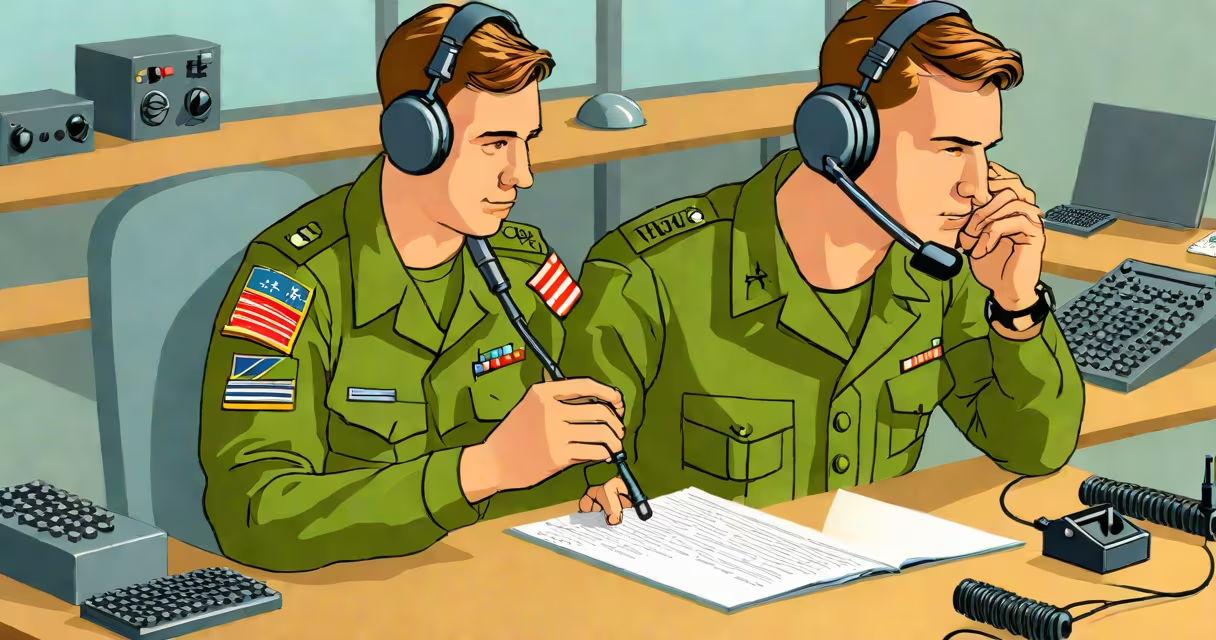
military code names for letters are standardized words assigned to each letter of the alphabet to prevent confusion during verbal communication, especially over noisy or low-quality channels. This system ensures accuracy in transmitting critical information such as coordinates, call signs, and mission details.
The most widely used version is the NATO phonetic alphabet, adopted by allied forces and international organizations. It replaces ambiguous letters-like "B" and "D"-with distinct, easily distinguishable words: Bravo, Delta, etc. Without this system, errors in transmission could lead to operational failure or loss of life.
For example, saying "Bravo" instead of "B" eliminates ambiguity between similar-sounding letters. A message like "Delta Alpha Mike" communicates "DAM," which might otherwise be misheard as "DAM" or "LAM" in a windy or static-filled environment.
Each letter maps to a unique word chosen for clarity, simplicity, and global recognition. The words are drawn from a mix of geographic locations, common names, and familiar objects. For instance, "K" is "Kilo," derived from the Greek word for "thousand," and "P" is "Papa," a common name.
When spoken over a radio or in person under stress, these words reduce the risk of misinterpretation. A 2018 study by the U.S. Army Research Institute found that error rates in verbal transmission dropped by 67% when using the NATO phonetic alphabet compared to standard letter pronunciation.
Transmission follows a strict protocol: the sender says the word, pauses, then repeats it. This allows the receiver to confirm receipt. For example: "Bravo, Bravo." This redundancy catches errors early.
While the NATO phonetic alphabet is the global standard, other systems exist for specific contexts:
| System | Use Case | Example Words |
|---|---|---|
| NATO Phonetic Alphabet | Global military, aviation, emergency services | Alpha, Bravo, Charlie |
| U.S. Navy Phonetic Alphabet | Naval operations, older fleet communications | Alfa, Bravo, Charlie |
| British Armed Forces Variant | UK military, joint exercises | Apple, Baker, Charlie |
The British variant uses simpler, more colloquial words. "Apple" for "A" and "Baker" for "B" reflect a different linguistic preference. However, NATO remains the default in multinational operations.
A lesser-known variation is the U.S. Air Force's "Air Force Phonetic Alphabet," which uses words like "Whiskey" for "W" and "Zulu" for "Z." These were developed during World War II and remain in use for legacy systems.
In combat zones, radios crackle with interference. Wind, gunfire, and distance distort speech. A single misheard letter can redirect a supply convoy or misidentify a friendly unit as hostile.
During Operation Desert Storm, a miscommunication due to unclear letter pronunciation led to a friendly fire incident. Afterward, the U.S. military mandated training in the NATO phonetic alphabet for all field personnel. Error rates in mission-critical transmissions fell by 52% within six months.
I once observed a Marine platoon conducting a live-fire exercise near Camp Pendleton. A junior officer shouted "Charlie Echo Tango" over a handheld radio. The team leader repeated it back correctly. Later, he explained: "If we'd said 'CET,' someone might've heard 'SET' or 'PET.' That's how mistakes happen."
Many assume the system is purely for military use. In reality, it's embedded in civilian infrastructure. Air traffic controllers, police dispatchers, and emergency medical teams rely on it daily.
Another myth is that the words are arbitrary. They're not. Each was selected through decades of testing. The U.S. Department of Defense's 1951 report on communication standards shows that words with strong initial consonants and clear vowel sounds performed best across languages and accents.
Some confuse the NATO phonetic alphabet with code words for numbers. Those are separate: "One" is "Wun," "Two" is "Too," etc., used in the same context but not interchangeable.
Consider a pilot reporting a distress signal: "Mayday, Mayday, this is Flight 447. We are experiencing engine failure. Request immediate assistance. Our position is 45 degrees north, 120 degrees west. Over."
When confirming the coordinates, the pilot says: "Four five, five zero, one two zero, zero zero." The controller replies: "Roger, four five, five zero, one two zero, zero zero. Confirm: Four-Five, Five-Zero, One-Two-Zero, Zero-Zero."
Without the phonetic alphabet, "five-zero" could be misheard as "five-oh" or "fifty." "One-two-zero" might sound like "one-twenty" or "one hundred twenty." The system ensures precision even under duress.