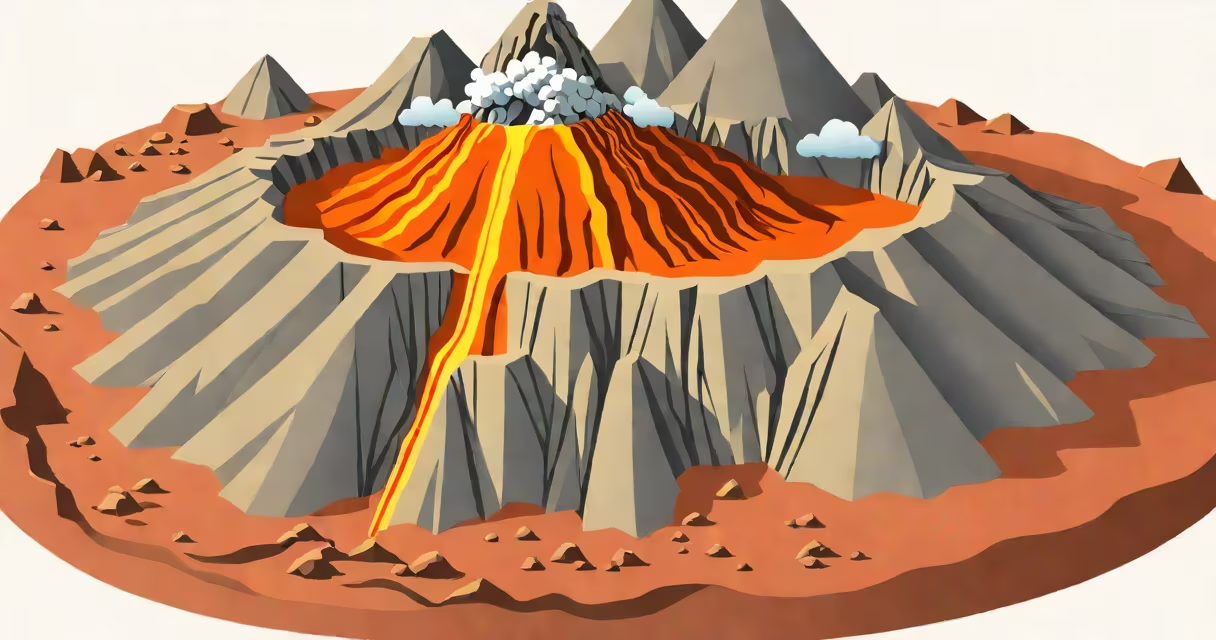
The parts of a volcano are the structural elements that define how magma moves from underground to the surface during an eruption. These include the magma chamber, conduit, vent, crater, lava flows, and pyroclastic deposits. Each plays a distinct role in shaping the volcano's form and influencing eruption behavior.
Magma forms deep beneath Earth's crust when rock melts due to heat and pressure. This molten material rises through cracks and weak zones in the crust. As it ascends, pressure drops, allowing gases dissolved in the magma to expand. When gas pressure exceeds the strength of the overlying rock, an explosion occurs.
Once magma reaches the surface, it becomes lava. Lava flows down slopes under gravity, cooling and hardening into solid rock. Explosive eruptions eject ash, rock fragments, and gas at high speed, forming pyroclastic flows that move faster than any human can run.
Volcanic activity follows cycles of buildup, eruption, and dormancy. The most useful eruptions occur when magma contains high levels of dissolved gases like water vapor and carbon dioxide. The 1980 eruption of Mount St. Helens released energy equivalent to 24 megatons of TNT-over 1,500 times more useful than the atomic bomb dropped on Hiroshima.
Each part of a volcano serves a specific function in the eruption process. The magma chamber stores molten rock beneath the surface. The conduit is the vertical channel through which magma travels upward. The vent is the opening at the surface where magma exits. The crater forms at the summit after repeated eruptions erode the peak.
Lava flows are streams of molten rock that spread out after exiting the vent. They cool into igneous rock, building new landforms over time. Pyroclastic flows consist of hot ash, gas, and rock fragments moving at speeds exceeding 100 km/h. These flows destroy everything in their path and are responsible for the extinction of Pompeii in 79 CE.
Some volcanoes develop secondary vents on their flanks. These lateral vents can produce flank eruptions, which are often less explosive but still dangerous due to long lava flows. The 2018 Kīlauea eruption in Hawaii began with fissures opening along the volcano's eastern rift zone, spewing lava that destroyed hundreds of homes.
Volcanoes vary in shape and structure based on the type of magma and eruption style. Shield volcanoes have broad, gently sloping sides formed by low-viscosity basaltic lava. Mauna Loa in Hawaii is a shield volcano with a base spanning 120 km and a volume of 18,000 km³.
Stratovolcanoes (or composite volcanoes) have steep, symmetrical cones built from alternating layers of lava, ash, and debris. Mount Fuji in Japan and Mount Rainier in Washington are stratovolcanoes. Their eruptions are typically explosive due to viscous and gas-rich magma.
Cinder cone volcanoes are small, steep-sided structures formed from explosive eruptions that eject loose fragments. Parícutin in Mexico erupted from a cornfield in 1943 and grew to 425 meters in just six years.
| Type | Shape | Magma Type | Eruption Style | Example |
|---|---|---|---|---|
| Shield | Broad, gentle slopes | Basaltic, low viscosity | Gentle effusive flows | Mauna Loa, Hawaii |
| Stratovolcano | Steep, conical | Andesitic to rhyolitic, high viscosity | Explosive, periodic | Mount St. Helens, Washington |
| Cinder Cone | Small, steep | Basaltic, gas-rich | Short-lived, explosive | Parícutin, Mexico |
Many assume all volcanic eruptions involve massive explosions. In reality, most eruptions are effusive-lava flows steadily from vents without violent explosions. Effusive eruptions make up about 80% of global volcanic activity, according to the U.S. Geological Survey (USGS).
Another misconception is that craters always form at the peak. Craters can develop anywhere on a volcano's surface, especially after lateral blasts. The 1980 Mount St. Helens eruption created a horseshoe-shaped crater on the north side after the entire mountain collapsed.
Some confuse lava flows with pyroclastic flows. Lava flows move slowly-typically 1-30 km/h-and allow escape if detected early. Pyroclastic flows travel at 100-700 km/h and are lethal within seconds. The 79 CE eruption of Vesuvius killed 16,000 people in Pompeii via a pyroclastic surge.
Mount Vesuvius in southern Italy illustrates how the parts of a volcano interact. Its magma chamber lies about 10 km below sea level. Magma travels through a conduit, erupting via a central vent. After multiple eruptions, a circular crater formed at the summit.
In 79 CE, explosive eruptions ejected 1.5 million tons of ash and rock. A pyroclastic flow reached 300°C and moved at 100 km/h, burying Pompeii and Herculaneum under meters of debris. Archaeological excavations show preserved bodies, buildings, and even food remains, frozen in time.
Today, Vesuvius remains active. The Italian Civil Protection Department monitors seismic activity and ground deformation. Since 1944, the volcano has shown signs of unrest, including minor tremors and gas emissions. The population within 10 km of the summit exceeds 600,000-making it one of the most densely populated volcanic regions on Earth.
Understanding the parts of a volcano enables better hazard prediction and emergency planning. The USGS uses satellite data, ground sensors, and historical records to track changes in volcano structure. For example, inflation of a volcano's flanks often signals rising magma pressure.
Volcanic systems also influence climate. Large eruptions inject sulfur dioxide into the stratosphere, forming aerosols that reflect sunlight. The 1815 eruption of Mount Tambora led to the "Year Without a Summer" in 1816, causing crop failures across Europe and North America.
I once observed a lava flow field in Iceland during a field study. The terrain was covered in jagged, black rock resembling broken glass. The air smelled of sulfur. Standing near the cooled flow, I felt the weight of geological time-the slow, relentless power of Earth's interior shaping the surface.
Recognizing these differences avoids confusion between unrelated systems. Volcanic features result from magmatic processes, while river systems form through erosion and sediment transport. Saddle design focuses on biomechanics and comfort, not geologic stress.
The parts of a volcano are not just geological curiosities-they are changing systems that shape Earth's surface, influence climate, and affect human populations. Knowing how each component functions allows scientists and communities to prepare for eruptions and understand Earth's inner workings.