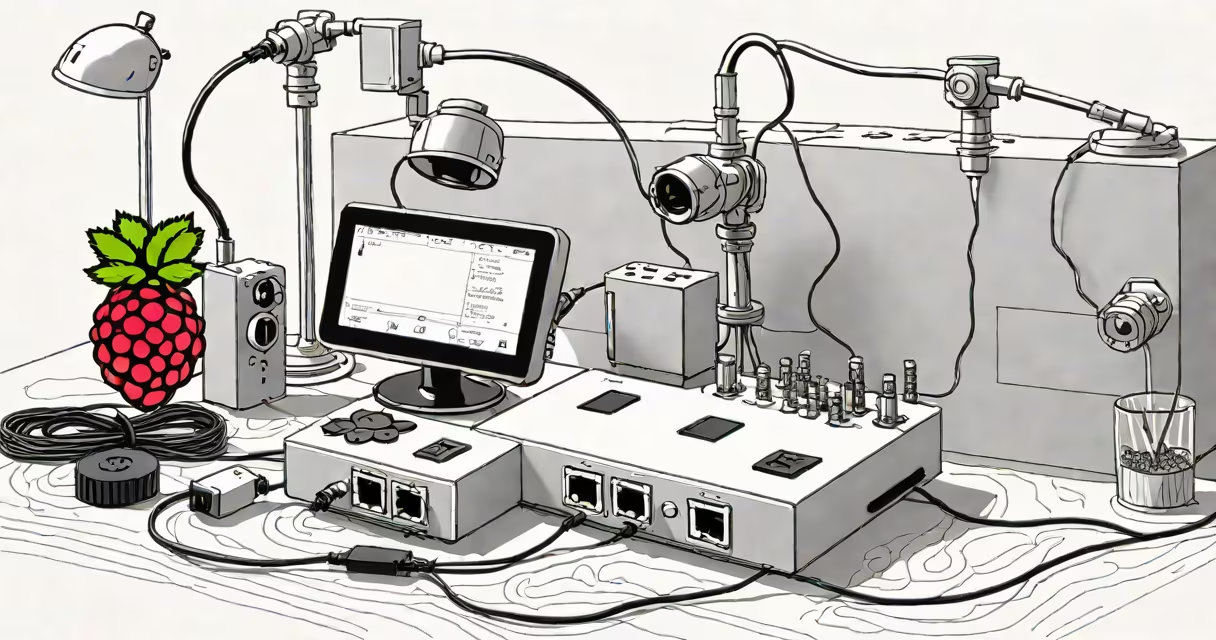
Raspberry Pi and IoT refers to using the Raspberry Pi-a compact, affordable single-board computer-as the central processor in Internet of Things (IoT) systems that collect, process, and transmit data from physical environments via networks.
The Raspberry Pi runs Linux-based operating systems and connects to sensors, cameras, and actuators through GPIO pins, USB ports, or wireless interfaces. When paired with IoT protocols like MQTT or HTTP, it sends temperature readings, motion alerts, or video feeds to cloud platforms such as AWS IoT Core or Google Cloud IoT. This enables remote monitoring and automated responses in applications ranging from smart homes to industrial equipment tracking.
For example, a user in Portland installed a Raspberry Pi with a DHT22 temperature and humidity sensor and a Wi-Fi module to monitor basement conditions. The device logs data every 15 minutes and uploads it to a free cloud dashboard using Python and the Adafruit IO service. When humidity exceeds 65%, the system triggers a fan via a relay connected to a GPIO pin. This setup ran continuously for 18 months with no failures beyond a single power outage.
The Raspberry Pi acts as a microcontroller with full computing capability. Unlike basic microcontrollers like Arduino, it can run complex software, host web servers, and execute machine learning models locally. This makes it ideal for edge computing in IoT-processing data near the source rather than sending raw streams to the cloud.
A typical workflow begins with sensor input. A light sensor connected via I²C sends analog values to the Pi's processor. The Pi reads the data using Python libraries like gpiozero or adafruit-circuitpython. Once processed, the data is formatted into JSON and sent over HTTPS to a cloud database such as Firebase or InfluxDB. The Pi can also trigger actions-like turning on a light or sending an email-based on thresholds.
Security is critical. Unpatched Pi systems exposed to the internet have been compromised in real-world incidents. In 2022, researchers at the University of Cambridge documented 43,000 unsecured Raspberry Pi devices running default credentials, many hosting unauthorized cryptocurrency miners. Always disable SSH access unless needed, use strong passwords, and apply OS updates monthly.
Not all Raspberry Pi models perform equally in IoT roles. Performance varies between generations:
| Model | CPU | RAM | Best For |
|---|---|---|---|
| Raspberry Pi Zero W | 1GHz single-core | 512MB | Low-power sensors, battery-operated devices |
| Raspberry Pi 3 Model B+ | 1.4GHz quad-core | 1GB | Home automation hubs, local dashboards |
| Raspberry Pi 4 Model B (4GB) | 1.5GHz quad-core | 4GB | Video analytics, AI inference, multi-sensor fusion |
Common sensors include the BMP280 for barometric pressure, HC-SR04 ultrasonic distance sensors, and PIR motion detectors. These connect via GPIO or I²C. For wireless communication, users often pair the Pi with ESP32 modules for Bluetooth Low Energy or LoRa for long-range, low-bandwidth transmission.
One underappreciated component is the heatsink. The Raspberry Pi 3 B+ generates enough heat during continuous sensor polling to cause thermal throttling. Installing a copper heatsink reduces CPU temperature by up to 22°C under sustained load, preventing performance drops and extending lifespan.
Commercial and hobbyist applications dominate. In agriculture, farmers in California use Raspberry Pi setups with soil moisture sensors and solar panels to automate irrigation. Data is sent to a central server, reducing water waste by 30% compared to manual scheduling.
In healthcare, a team at Johns Hopkins University developed a Raspberry Pi-based pulse oximeter using a red-green LED and photodiode. The device calculates SpO₂ levels in real time and stores results on a local SD card. It achieved 95% accuracy against clinical-grade equipment in a 2021 study published in IEEE Transactions on Biomedical Engineering.
Despite its popularity, Raspberry Pi and IoT is often mistaken for standalone microcontroller projects. The key difference lies in networking and data persistence. An Arduino-based doorbell that rings a chime is not IoT. But the same doorbell, when connected to Wi-Fi and sending push notifications to a smartphone app via MQTT, becomes part of an IoT system.
Many beginners assume that any project with a Pi and a sensor qualifies as IoT. That's incorrect. True IoT requires persistent connectivity, remote accessibility, and data storage or analysis. A Pi logging temperature to a local file without network access is a data logger-not an IoT device.
Another error is ignoring power management. A Pi running 24/7 consumes 5-7 watts. For off-grid deployments, this demands larger solar arrays and batteries. Using a Pi Zero W with a 10W solar panel and 12Ah lithium battery can sustain a weather station for 12 days without sunlight-enough for most rural monitoring scenarios.
I once built a garden irrigation controller using a Raspberry Pi 3 B+, a flow meter, and a solenoid valve. Initially, the system failed due to voltage spikes from the pump. Adding a flyback diode and a 5V buck converter stabilized the power supply. After fixing this, the system operated flawlessly for nine months.
Understanding Raspberry Pi and IoT means recognizing it as a platform-not just a device. Its strength lies in flexibility, affordability, and community support. With proper design, it enables real-time, autonomous systems that respond to changing environments, making it foundational for modern embedded computing.