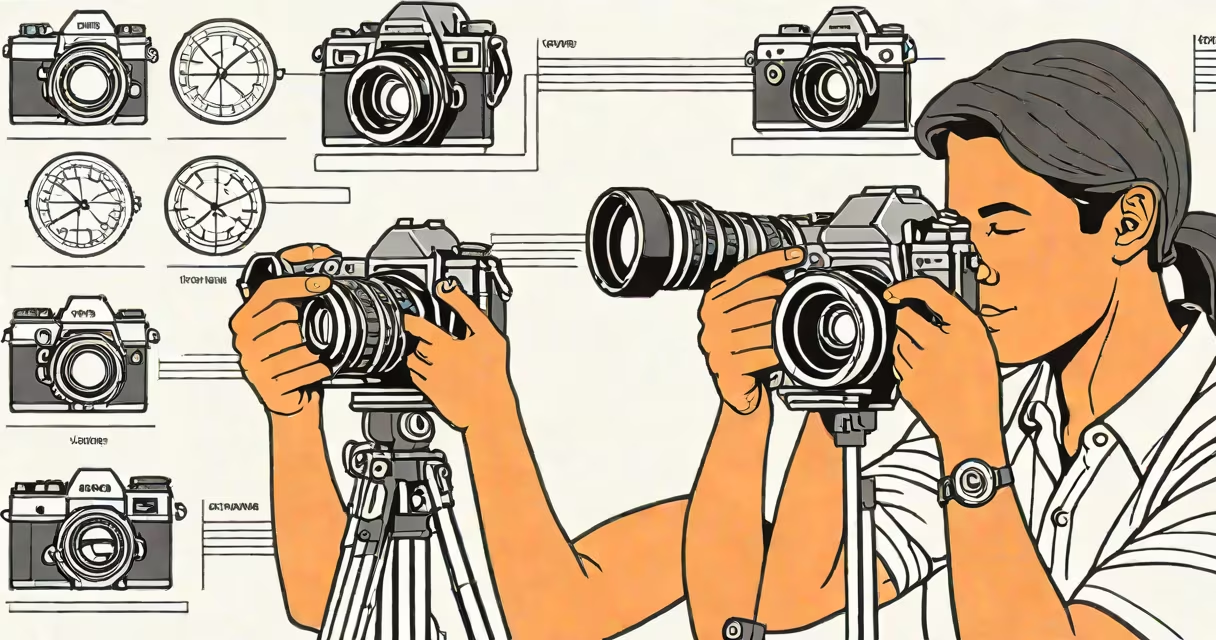
Aperture, shutter speed, and ISO are the three core settings that control exposure in photography. Together, they form the exposure triangle-each affecting how much light reaches the sensor and shaping image brightness, motion blur, and noise.
Aperture controls the size of the lens opening. A wide aperture (low f-number like f/1.8) lets in more light and creates shallow depth of field, blurring the background. A narrow aperture (high f-number like f/16) reduces light intake and increases depth of field, keeping more of the scene in focus.
Shutter speed determines how long the camera's sensor is exposed to light. Fast speeds (1/1000 sec or higher) freeze motion, ideal for sports or wildlife. Slow speeds (1/30 sec or lower) allow more light in but risk blur from movement, often used with tripods for landscapes or low-light scenes.
ISO adjusts the sensor's sensitivity to light. Low ISO (100-200) produces clean images with minimal noise. High ISO (1600 and above) boosts brightness in dark conditions but introduces grain. Modern cameras handle high ISO better than older models, but noise remains a trade-off.
Each setting influences exposure independently. Increasing one requires adjusting another to maintain balanced lighting. For example, using a wide aperture in daylight may overexpose the image unless shutter speed is reduced or ISO lowered.
Consider shooting a portrait at sunset. The scene is dim, so you need more light. You set aperture to f/1.8 to maximize light intake and create soft background blur. But the resulting image is too bright. To correct it, you increase shutter speed to 1/250 sec, reducing exposure time. Alternatively, lowering ISO from 800 to 100 further reduces brightness without changing depth of field.
These adjustments don't happen in isolation. A photographer must balance all three to achieve desired results. Choosing a slow shutter speed to capture light trails from cars requires either a narrow aperture or low ISO to avoid overexposure. Similarly, freezing action in a fast-moving scene demands a fast shutter speed, which may require increasing ISO or widening aperture to compensate for less light.
Aperture values are expressed as f-numbers. Lower numbers mean wider openings. Common apertures include f/1.4 (very wide, shallow focus), f/2.8 (good for portraits), f/5.6 (balanced for group shots), and f/11 or higher (deep focus for landscapes).
Shutter speeds range from fractions of a second to several seconds. Fast speeds: 1/1000 sec (sports), 1/250 sec (action). Medium: 1/60 sec (handheld shots). Slow: 1/15 sec (motion blur), 1 sec or longer (light painting, night photography).
ISO values start at 100 (standard daylight), rise to 400-800 (indoor, mixed light), and go up to 3200 or higher (low-light situations). Most DSLRs and mirrorless cameras perform well up to ISO 1600 without visible noise. Above that, detail degrades.
| Setting | Low Value | High Value | Effect |
|---|---|---|---|
| Aperture (f-stop) | f/1.8 | f/16 | Wide = more light, shallow focus. Narrow = less light, deep focus. |
| Shutter Speed | 1/4000 sec | 30 sec | Fast = freezes motion. Slow = captures motion blur. |
| ISO | 100 | 6400+ | Low = clean image. High = brighter but more noise. |
Professional photographers use manual mode to control all three settings. In auto or semi-auto modes like Aperture Priority (A or Av) or Shutter Priority (S or Tv), the camera adjusts one setting automatically while the user sets the other.
For example, in Aperture Priority mode, you choose the f-number. The camera then picks a shutter speed and ISO that produce correct exposure. This is useful when depth of field matters most-like in portraits or macro work.
Many beginners think a larger f-number means more light enters the lens. This is false. A higher f-number (like f/16) means a smaller aperture, restricting light. A lower f-number (like f/2.8) means a larger opening and more light.
Another myth is that high ISO always ruins image quality. While it does introduce noise, modern sensors handle ISO 3200 reasonably well. Many smartphones and mirrorless cameras deliver usable results at ISO 6400. Noise reduction software can further improve output.
A non-obvious fact: aperture affects bokeh quality. Lenses with more aperture blades (e.g., 9 vs. 5) create smoother out-of-focus areas. A 50mm f/1.8 lens with seven blades produces softer background blur than a cheaper 50mm f/1.8 with five blades-even at the same f-stop.
I once photographed a wedding ceremony indoors with limited lighting. Using ISO 3200 and f/1.8 allowed me to shoot handheld at 1/125 sec-fast enough to avoid blur from nervous movements. The image had slight noise, but the emotional moment was preserved. That shot later became part of the couple's album.
Mastering aperture, shutter speed, and ISO allows creative control beyond automatic settings. You decide whether to emphasize a subject with blurred background (wide aperture), freeze a child's jump (fast shutter), or capture ambient mood (slow shutter with tripod).
These settings are not interchangeable. Changing one alters exposure and visual outcome. A photo taken at f/2.8, 1/250 sec, ISO 400 will look different from one at f/8, 1/60 sec, ISO 100-even if both are properly exposed. The first has shallow focus and sharp motion. The second has deep focus and motion blur.
Understanding aperture, shutter speed, and ISO is essential for consistent image quality and intentional storytelling. Without them, even the best camera cannot produce reliable results.