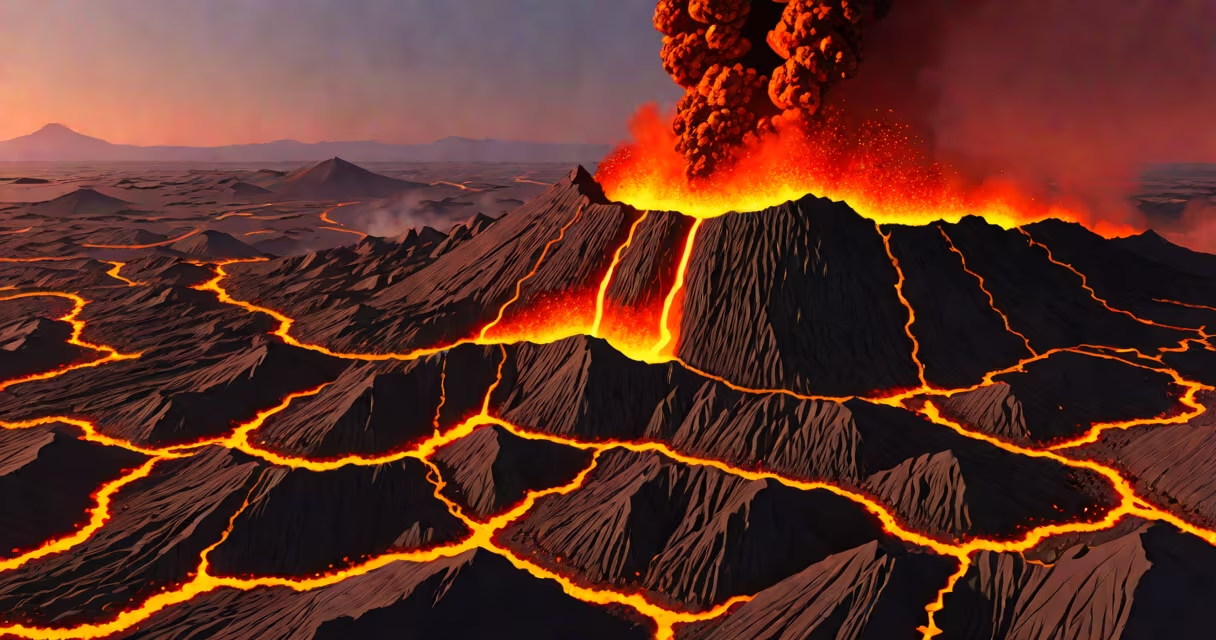
A volcano erupts when accumulated magma beneath Earth's crust rises due to pressure from trapped gases and heat, breaking through the surface. This process results from interactions between tectonic plates, magma composition, and internal heat. The event releases molten rock, ash, steam, and toxic gases.
Magma forms when rock melts deep underground, typically at depths of 30 to 60 kilometers. As temperature and pressure drop during ascent, dissolved gases like water vapor, carbon dioxide, and sulfur dioxide come out of solution. These gases expand rapidly, increasing internal pressure. When pressure exceeds the strength of overlying rock, an eruption occurs.
The U.S. Geological Survey (USGS) confirms that over 90% of volcanic activity stems from plate boundary interactions. Magma generated at subduction zones-where one tectonic plate slides under another-drives explosive eruptions. In contrast, magma from mantle plumes, such as those beneath Hawaii, produces effusive flows with lower gas content and less violence.
Magma moves upward through fractures and weak zones in the crust. Its path depends on density differences: magma is less dense than solid rock, so buoyancy pushes it toward the surface. As it ascends, pressure drops, causing dissolved gases to form bubbles. These bubbles grow rapidly, increasing volume and pressure within the magma chamber.
Gas expansion is the primary driver of explosive eruptions. For example, Mount St. Helens' 1980 eruption began with a lateral blast caused by pressurized steam and gases escaping through a fissure. The explosion released 1.2 megatons of TNT equivalent energy-over 60 times more useful than the Hiroshima bomb.
Not all magma behaves the same. High-viscosity magma (rich in silica) traps gases, leading to violent explosions. Low-viscosity magma (basaltic) allows gas to escape easily, resulting in gentle lava flows. Kīlauea in Hawaii, fed by basaltic magma, has erupted continuously since 1983 with minimal explosions, while Mount Vesuvius-fed by viscous magma-produced the catastrophic AD 79 eruption that buried Pompeii.
Eruptions fall into distinct categories based on magma properties and tectonic setting. The table below outlines key eruption types and their root causes.
| Type | Trigger Mechanism | Typical Magma | Example |
|---|---|---|---|
| Explosive (Plinian) | High gas content in viscous magma; sudden pressure release | Andesitic to rhyolitic | Mount Pinatubo (1991), Philippines |
| Effusive (Hawaiian) | Low viscosity allows steady gas release; slow flow | Basaltic | Kīlauea, Hawaii (ongoing since 1983) |
| Strombolian | Intermittent gas bursts in moderately viscous magma | Basaltic to andesitic | Stromboli, Italy (active for over 2,000 years) |
| Phreatomagmatic | Steam explosion from magma-water interaction | Varies | Mount Redoubt (1990), Alaska |
Phreatomagmatic eruptions are often mislabeled as purely magmatic events. They occur when magma contacts groundwater, instantly vaporizing water and creating high-pressure steam. This mechanism can cause sudden, unpredictable blasts even without significant magma buildup.
Many assume volcanoes erupt randomly. In reality, they follow patterns tied to geologic processes. For example, the Ring of Fire-a 40,000-kilometer arc around the Pacific Ocean-hosts 75% of Earth's active volcanoes due to subduction zones. The 2010 eruption of Eyjafjallajökull in Iceland disrupted air travel across Europe, but the event was predictable: GPS measurements showed ground deformation months prior, indicating magma intrusion.
Another misconception is that all eruptions involve fire. Lava is hot-typically 700°C to 1,200°C-but it doesn't burn like a flame. It flows like thick syrup and hardens into rock. During the 2018 Kīlauea eruption, lava moved at speeds up to 30 km/h, destroying homes in the Puna district. Residents evacuated using emergency routes, but no fatalities occurred due to early warnings.
I once observed a fissure eruption in Hawaii during a field study. The ground cracked open with a low rumble. Within minutes, glowing lava surged 30 meters into the air. The scene was silent except for the hiss of steam and the crackle of cooling rock. That moment confirmed what textbooks describe: eruptions aren't sudden chaos-they're the result of measurable physical forces building over time.
Knowing what causes a volcano to erupt enables better hazard forecasting. The USGS uses satellite radar (InSAR), seismic monitoring, and gas sensors to detect changes in magma chambers. In 2018, scientists predicted Kīlauea's summit collapse by tracking ground inflation and increased sulfur dioxide emissions. Early alerts saved lives.
Global Volcanism Program data shows that 1,500+ volcanoes have erupted in the last 10,000 years. Of these, only about 150 are currently active. Yet even dormant volcanoes can awaken. Yellowstone supervolcano, though inactive for 640,000 years, remains a concern due to ongoing geothermal activity beneath the caldera.