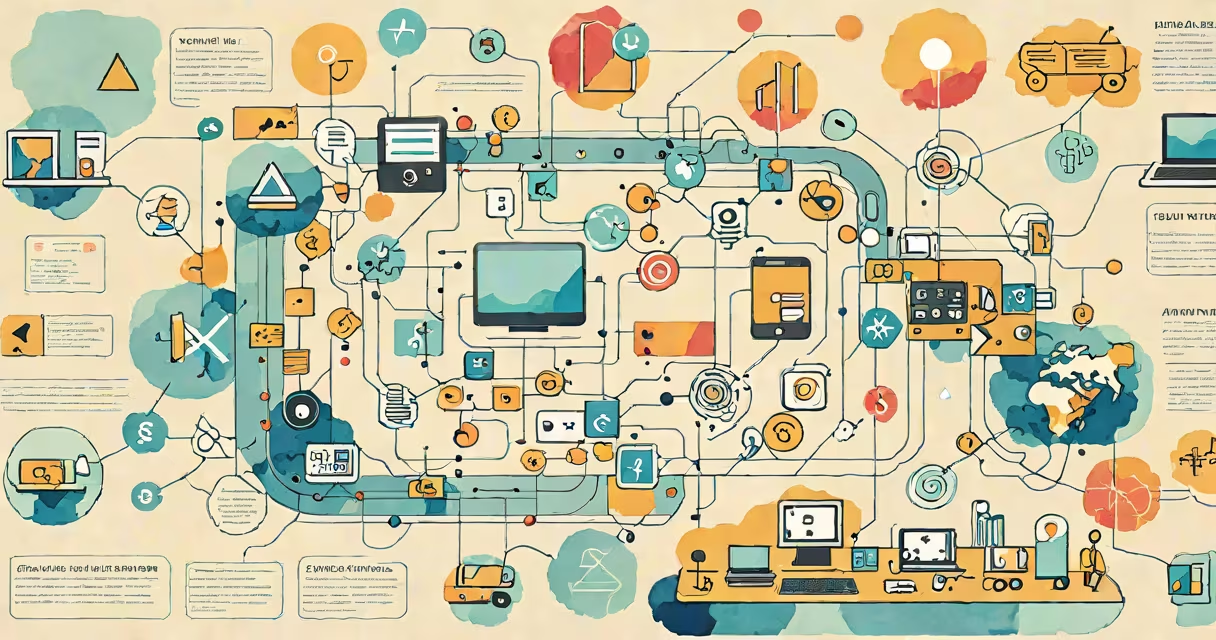
A platform is a foundational system that enables users, developers, or organizations to build, deliver, or interact with services, content, or applications. It provides infrastructure, tools, and standards that support consistent functionality across diverse uses.
Platforms operate across physical and digital domains. A physical platform might be a stage for performers or a railway track for trains. In digital contexts, a platform is typically a software environment-like a website, mobile app, or cloud-based service-that supports other software or user activity. The term gained widespread use in tech and business during the 2000s as companies began structuring entire ecosystems around core systems.
For example, Amazon Web Services (AWS) is a cloud computing platform that hosts websites, stores data, and runs applications for millions of businesses. Without AWS, many startups would lack the infrastructure to scale quickly. Similarly, social media platforms like Instagram or TikTok provide tools for users to create and share content, while offering advertisers access to targeted audiences.
Platforms function by establishing standardized interfaces-APIs (application programming interfaces), user dashboards, or development kits-that allow external parties to integrate their services. This standardization reduces friction between different components of a larger system.
When a developer builds an app for the Apple App Store, they use Apple's platform tools, including Swift programming language support and testing environments. These tools ensure the app functions consistently across devices and meets security and design requirements. The platform acts as a gatekeeper and enabler simultaneously.
Another example: Spotify is a music streaming platform. It aggregates content from record labels, provides playback technology, and offers personalized recommendations using machine learning. Users don't need to understand how audio files are encoded or streamed-they simply search, play, and discover music through a unified interface.
Platforms vary widely in purpose and structure. They can be categorized by domain, audience, and technical architecture.
| Type | Function | Examples |
|---|---|---|
| Digital Service Platform | Delivers software-as-a-service (SaaS) solutions | Slack, Zoom, Salesforce |
| Content Delivery Platform | Hosts and distributes media or information | YouTube, Netflix, Substack |
| Marketplace Platform | Connects buyers and sellers | Amazon, Etsy, Uber |
| Development Platform | Enables creation of new software | GitHub, Firebase, AWS |
Each type serves distinct needs. A marketplace platform like Etsy connects independent artisans with global customers. Its backend handles payments, shipping integrations, and reviews-all under a single interface. This reduces the burden on individual sellers who wouldn't otherwise manage logistics at scale.
One non-obvious distinction: not all platforms are open. Some are closed ecosystems. Apple's iOS platform restricts app distribution to the App Store, enforcing strict review policies. Google's Android allows broader third-party installations via sideloading. The choice affects security, innovation speed, and user freedom.
People often confuse "platform" with "website" or "app." A website is a single page or site, such as a blog hosted on WordPress. An app is a standalone program, like a weather app. But a platform integrates multiple services, supports interactions between users, and evolves over time.
For instance, Facebook began as a social networking site. Over time, it evolved into a platform hosting games, live video, e-commerce features, and third-party developer tools. The same name now refers to both a product and an system.
Another misunderstanding is assuming all platforms are free. While many consumer-facing platforms appear free-like Twitter or Reddit-their revenue comes from advertising, data monetization, or premium subscriptions. Facebook generates $117 billion in annual revenue primarily from ads, not user fees.
Even the word "platform" in politics differs from its technical meaning. A political platform is a set of policy positions. In contrast, a digital platform is a technical foundation. Confusing them leads to miscommunication in debates about regulation, privacy, and competition.
Consider a fitness app called FitFlow. It allows users to track workouts, log meals, and connect with trainers. To launch, the founders didn't build servers, databases, or authentication systems from scratch. Instead, they used AWS as their platform.
They integrated AWS Lambda for serverless functions, Amazon S3 for storing user photos, and Amazon Cognito for login management. These services were pre-built, scalable, and monitored by AWS. The team focused on designing the user experience and workout algorithms-not infrastructure.
Within six months, FitFlow had 50,000 users. Without AWS, the startup would have needed a team of five engineers and $200,000 in initial capital. As it was, they launched with three people and under $10,000 in cloud costs.
This illustrates how platforms lower barriers to entry. They enable small teams to compete with large corporations by providing shared infrastructure and tools.
I once helped design a customer support dashboard for a SaaS company. The goal was to let agents see all user issues in one place-emails, chat logs, ticket history. We chose a microservices architecture hosted on Azure, a cloud platform.
After deployment, we noticed high latency during peak hours. We traced it to inefficient database queries. By switching to Azure's managed SQL Database and adding caching layers, response times dropped from 4.2 seconds to under 0.5 seconds. The platform's built-in monitoring tools detected the bottleneck automatically.
This taught me that platforms aren't just passive backbones. They actively influence performance, cost, and reliability. Choosing the right platform isn't just about features-it's about operational control and long-term maintainability.
The meaning of platform centers on enabling interaction, scaling capability, and supporting growth. It's not a product or a service-it's a base layer upon which others build. Whether it's a city's subway system or a mobile operating system, a platform provides consistency, accessibility, and extensibility.
Understanding this helps clarify why companies like Microsoft, Meta, and Alibaba invest heavily in platform development. They're not selling software-they're building ecosystems. And ecosystems outlast individual products.