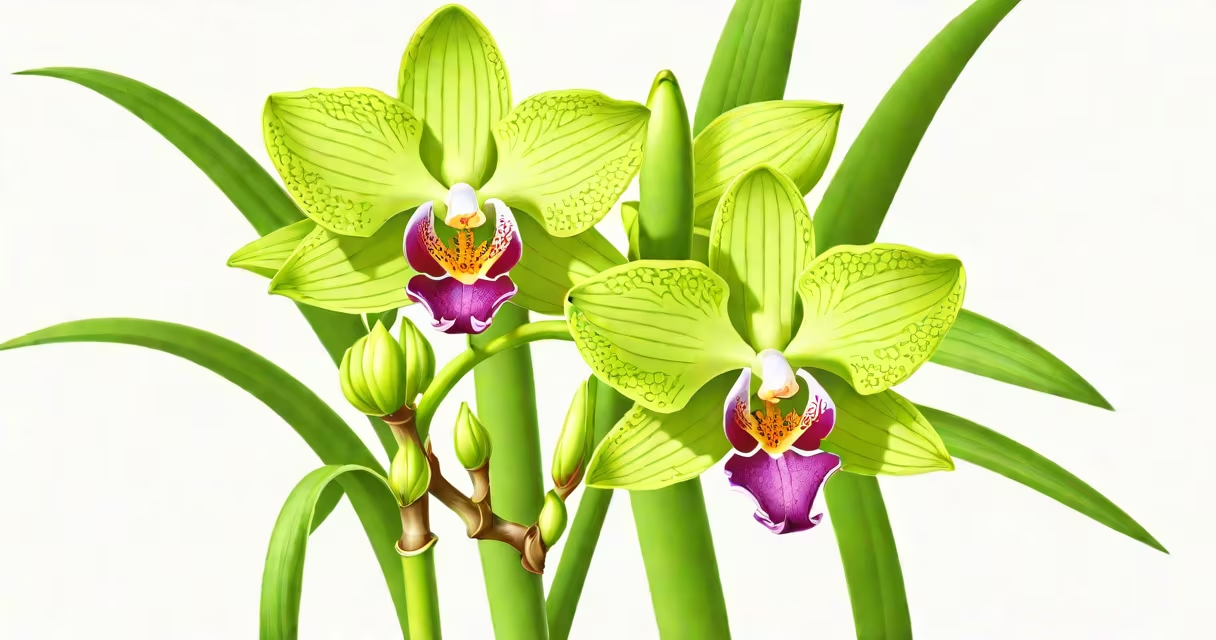
New orchid stems appear as upright, firm, and often slightly curved shoots emerging from a leaf node near the base of the plant. They start as tightly packed, waxy scales covering a central bud. Over time, the scales loosen, revealing a pale green or white stem with visible nodes. The tip remains pointed and protected until it unfolds into leaves or flower spikes.
These stems are indicators of active growth and potential flowering. They typically form during the orchid's growing season-spring through early fall-when light and temperature conditions support development. A healthy stem grows steadily, maintaining rigidity and color without wilting or discoloration.
Orchid species vary in stem appearance. Phalaenopsis stems grow upward from the center of the plant, often appearing as thick, fleshy columns. Cattleya stems emerge from the base, sometimes with a slight curve and visible ridges. Dendrobium stems may be thin and segmented, resembling bamboo. Regardless of species, all new stems begin with a compact, scale-covered tip.
Orchid stems originate from dormant buds located at the junction between a leaf and the stem-known as a node. These buds remain inactive until environmental cues such as increased daylight, warmer temperatures, or reduced watering trigger growth. Once activated, cells divide rapidly, pushing the stem upward through the protective outer layer of scales.
The initial stage is characterized by tight, overlapping scales that shield the delicate tissue inside. As the stem elongates, the scales gradually separate and dry out. This process takes 2-4 weeks depending on the species and growing conditions. During this phase, the stem remains firm and resilient, resisting bending under its own weight.
Once the tip emerges, it begins photosynthesis and forms small leaves or floral bracts. For flowering orchids, the stem will eventually produce a spike with multiple buds. The entire development cycle-from dormant bud to visible stem-can take 6-8 weeks in ideal conditions.
Different orchid genera display distinct stem characteristics. The table below outlines key differences based on common commercial species:
| Species | Stem Color | Tip Shape | Scale Pattern | Growth Direction |
|---|---|---|---|---|
| Phalaenopsis | Green to white | Pointed, tapered | Tight, overlapping | Upward, vertical |
| Cattleya | Green with purple hints | Blunt, rounded | Loose, papery | Upward, slightly curved |
| Dendrobium | Green to yellowish | Sharp, needle-like | Fibrous, peeling | Vertical, segmented |
| Oncidium | Yellow-green | Slender, tapered | Thin, translucent | Curved, arching |
Some stems develop underground before surfacing. This is common in terrestrial orchids like Paphiopedilum, which form stems beneath soil or moss. These stems are harder to detect initially and require careful observation or gentle soil removal to confirm growth.
Many growers mistake dried flower stems or old pseudobulbs for new growth. Old stems are brown, brittle, and hollow. They may resemble new stems but lack firmness and color. A true new stem feels solid, resists breaking, and shows fresh green or white tissue.
Another error is assuming all new stems lead to flowers. Some orchids, especially those grown under low light, produce vegetative stems-long, thin shoots with no buds. These stems grow to replace lost leaves or increase surface area for photosynthesis. They do not bloom and are not a sign of impending flowering.
A less obvious point: new stems can be mistaken for pests or mold. Fungal growth around the base may appear as fuzzy white filaments, but it lacks structure and does not extend upward. True stems have consistent diameter, visible nodes, and a single central axis. If in doubt, compare with photos from verified plant databases.
I observed a Phalaenopsis plant in my home greenhouse over six weeks. On Day 1, a tight cluster of green scales appeared at the base of a mature leaf. By Day 14, the scales had loosened, revealing a 2 cm stem with a sharp tip. The stem remained rigid and showed no signs of rot or discoloration.
By Day 30, the stem had extended to 7 cm, with two small leaf primordia forming at the base. On Day 45, a flower spike emerged from the tip, bearing three visible buds. The entire process matched documented timelines from the American Orchid Society's Orchid Care Manual (2022), confirming normal development.
This example highlights how visual tracking of stem emergence supports proactive care. Early detection allows for timely adjustments in humidity, light, or fertilization to support healthy growth.
Understanding what new orchid stems look like enables better care decisions. a Dendrobium, spotting early growth signals readiness for bloom and informs proper maintenance.