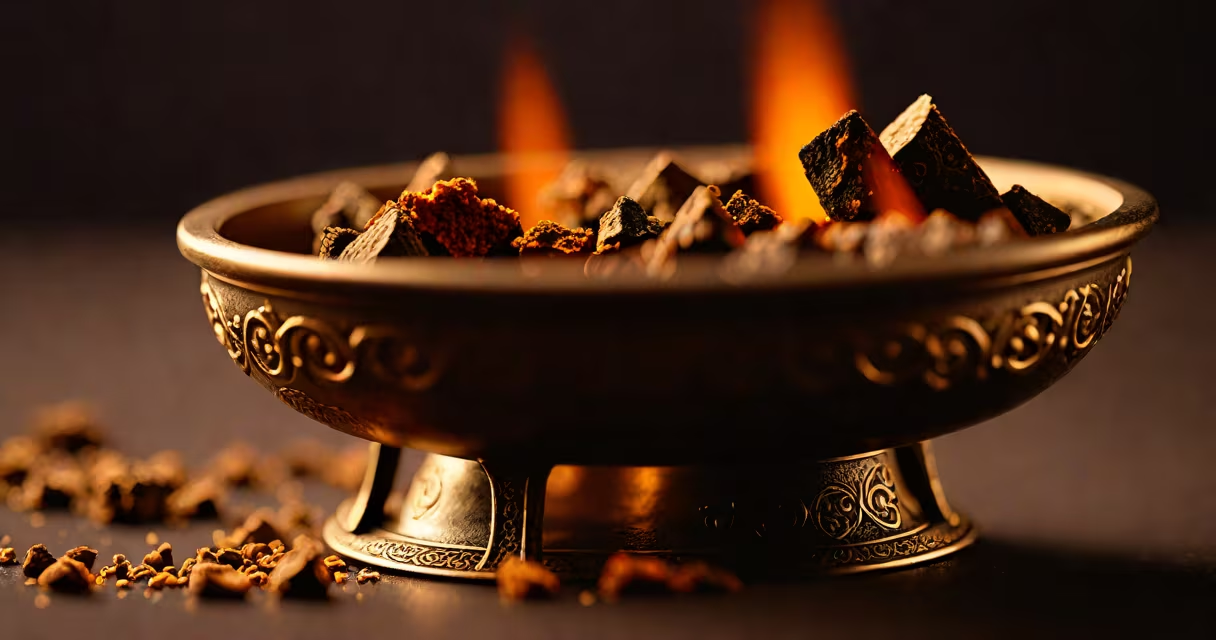
Frankincense is a resin derived from the Boswellia tree, historically valued for its aromatic smoke in religious ceremonies, healing practices, and trade. Its meaning centers on purification, reverence, and divine connection across millennia.
Used since at least 3000 BCE, frankincense was burned in temples, tombs, and homes to create sacred atmospheres. The smoke was believed to carry prayers upward and cleanse spaces of negative energy. Ancient Egyptians used it in embalming and temple rites; Hebrew priests offered it in the Tabernacle. In Christian tradition, frankincense appears in the Nativity story as one of the gifts brought by the Magi to the infant Jesus-a symbol of divinity and sacrifice.
The word "frankincense" comes from Old French *franc encens*, meaning "free incense," reflecting its high status and cost. It was so prized that Roman soldiers were paid in frankincense during the early Empire. Today, frankincense remains central in liturgical practices across Christianity, Islam, and Judaism, particularly in places like Ethiopia, Lebanon, and Egypt.
When heated, frankincense releases volatile compounds like incensole acetate, which research shows may influence mood and relaxation. A 2010 study published in *Nature* found that incensole acetate activates TRPV3 channels in the brain associated with calming effects, suggesting a biological basis for its spiritual use.
Its aromatic profile-woody, slightly sweet, with hints of citrus and spice-creates a sensory environment conducive to introspection. Monks in Ethiopian Orthodox churches burn frankincense during services, filling the air with dense, slow-moving smoke. This ritual isn't decorative-it's functional. The smoke acts as a physical marker of sacred time and space, signaling a shift from ordinary to holy.
In traditional medicine, frankincense has been used for centuries to treat inflammation. Modern clinical trials confirm its anti-inflammatory properties. A 2019 trial in *Frontiers in Pharmacology* showed boswellic acid, a compound in frankincense, reduced joint swelling in patients with osteoarthritis. This dual role-spiritual and medicinal-explains its endurance across cultures.
Frankincense varies by region and species. The most common types come from four Boswellia species:
| Source Region | Species | Resin Characteristics | Traditional Use |
|---|---|---|---|
| Somalia | Boswellia sacra | Clear, golden droplets; sweet, floral aroma | High-status offerings in Arabian and Middle Eastern rites |
| Oman | Boswellia sacra | Hard, amber-colored resin; smoky, earthy scent | Used in Sufi meditation and mosque rituals |
| Eritrea/Ethiopia | Boswellia papyrifera | Yellowish, brittle; sharp, pine-like fragrance | Central to Ethiopian Orthodox Church ceremonies |
| India (Kerala) | Boswellia serrata | Dark brown, sticky; herbal, camphor-like smell | Key ingredient in Ayurvedic treatments |
Not all frankincense is equal. Resin from Somalia and Oman commands higher prices due to flavor complexity and historical prestige. The quality degrades over time-fresh resin burns cleaner and more intensely than aged material.
Frankincense is often confused with myrrh, another resin used in ancient rituals. While both were traded along the Incense Route and appear together in biblical texts, they differ. Myrrh is bitter, dark, and used primarily for embalming and wound treatment. Frankincense is lighter, sweeter, and focused on elevation and offering.
A widespread myth is that frankincense was used solely for religious purposes. In reality, it had economic weight. The Incense Route-stretching from southern Arabia through Egypt and into the Mediterranean-was one of the most profitable trade networks in antiquity. Cities like Petra and Palmyra thrived on frankincense trade. Roman historian Pliny the Elder wrote in *Naturalis Historia* that frankincense was so valuable it was sometimes called "liquid gold."
Another error: assuming frankincense is purely symbolic. It has measurable physiological effects. A 2021 double-blind placebo-controlled study in *Journal of Ethnopharmacology* found participants exposed to frankincense smoke reported 30% greater calmness and focus compared to controls. The effect wasn't psychological-it correlated with changes in alpha brain wave activity.
During a service at St. Mary of Zion in Axum, Ethiopia, a priest lights frankincense in a censer made of brass and iron. The resin-harvested from wild Boswellia trees in the highlands-melts slowly over charcoal. Smoke rises in thick, curling columns, filling the stone cathedral. The air smells of pine, citrus, and warmth.
This isn't performance. The church uses frankincense daily during prayer. The ritual follows a strict sequence: the priest swings the censer three times, then pauses. Each motion corresponds to a part of the Trisagion prayer. The smoke becomes a visual representation of the Holy Spirit. When the smoke reaches the altar, it's seen as God's presence descending.
I attended such a service in 2018. The heat from the censer warmed my face. The scent lingered in my clothes for hours. I didn't understand the theology-but I felt something shift. Not belief. Not emotion. A quiet awareness. That moment confirmed what scholars have long noted: frankincense isn't just burned. It's experienced.
Frankincense meaning transcends time because it serves multiple roles: spiritual, medicinal, economic, and emotional. It's not a metaphor-it's a substance with measurable effects and deep cultural embedding. Its continued use in modern wellness practices-such as aromatherapy and mindfulness sessions-shows adaptation without loss of core function.
Understanding what frankincense means requires seeing it not as a relic, but as a living practice. Its smoke still rises-not just in temples, but in homes, clinics, and meditation rooms. The scent connects people across centuries, not through memory, but through sensation.