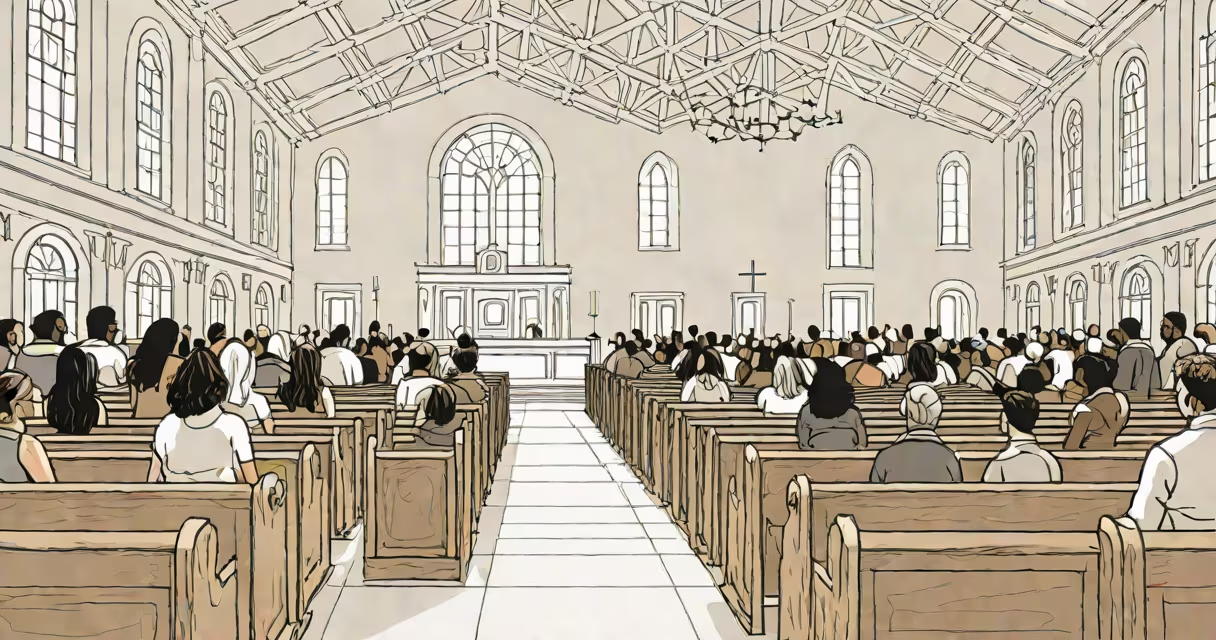
Non denominational in religion describes a Christian church or congregation that does not formally affiliate with any established denomination-such as Baptist, Methodist, Lutheran, or Presbyterian-nor adhere to a specific doctrinal statement beyond core Christian tenets like belief in Jesus Christ and the Bible.
These groups typically emphasize personal faith, scripture-based teaching, and community worship over theological traditions or hierarchical structures. They often avoid naming themselves after a historical movement or founder, choosing instead to identify by location (e.g., "First Church of Greenville") or mission focus (e.g., "Grace Fellowship").
According to the Pew Research Center, nearly 25% of U.S. adults who identify as Christian describe their church as non denominational, making it one of the fastest-growing forms of religious affiliation in the country since the 1990s.
Non denominational churches function independently of national or regional denominational oversight. There is no central authority dictating doctrine, liturgy, or leadership training. Instead, each church sets its own policies, selects its own pastors, and determines its own worship style.
Leadership is usually structured around a pastoral team or board of elders rather than a bishop or synod. Decisions about budget, programming, and outreach are made locally. This autonomy allows churches to adapt quickly to community needs-offering youth programs, counseling services, or food pantries without waiting for approval from a denominational headquarters.
A 2021 study by the Hartford Institute for Religion Research found that 68% of non denominational congregations reported higher levels of member engagement compared to traditional denominational churches, partly due to flexible service formats and decentralized decision-making.
While non denominational churches vary widely in practice, they generally share several key features:
Many non denominational churches hold weekly services lasting 60-90 minutes. Services often include live worship music, a sermon based on a passage from Scripture, and time for prayer or announcements. Some offer childcare, adult education classes, and volunteer opportunities during or after the service.
For example, Hillsong United, while originally part of the Assemblies of God denomination, rebranded as non denominational in 2016 and now operates under its own governance. The group's global reach and emphasis on modern worship have influenced thousands of churches worldwide to adopt similar models.
Non denominational is not synonymous with "non-religious," "secular," or "spiritual but not religious." These terms describe different categories of belief. A non denominational church still holds religious convictions and practices rituals such as baptism and communion, though interpretations may differ.
Another misunderstanding is that non denominational churches lack doctrine. In reality, they do have beliefs-but they define them through shared values rather than written confessions. For instance, many non denominational churches affirm the Nicene Creed in spirit, even if they don't recite it aloud.
Though all non denominational churches operate independently, they differ in size, structure, and emphasis. The following table outlines common variations:
| Type | Size Range | Leadership Model | Example |
|---|---|---|---|
| Small Community Church | 20-100 attendees | Volunteer-led, single pastor | First Community Church, rural Ohio |
| Large Multi-Site Congregation | 1,000+ attendees | Executive pastor, regional leaders | Life.Church, Oklahoma City |
| House Church Network | 10-30 members | Rotating host, peer-led | Various urban house churches in Portland |
| Global Mission-Based Church | Varies | International teams, cross-cultural staff | Church of the Open Door, Nairobi |
Each model reflects a different approach to community building and ministry. Small churches prioritize intimacy and local impact. Large multi-site churches focus on scalability and consistent messaging. House churches emphasize relationship-driven faith. Global missions churches aim to spread teachings across borders.
In 2019, I attended a non denominational service at a converted warehouse in Austin, Texas. The room had no stained glass, no pews, and no altar. Instead, there were folding chairs, a stage with a microphone, and a large screen projecting lyrics and Bible verses. The sermon focused on Luke 10:25-37-the parable of the Good Samaritan-and lasted 32 minutes. Afterward, people stayed to talk, share meals, and sign up for neighborhood outreach.
The church had no official name tied to a tradition. It didn't require membership cards or doctrinal exams. What mattered was participation: showing up, listening, serving. That experience clarified something I'd missed earlier: non denominational isn't about rejecting tradition-it's about prioritizing connection over categorization.
Understanding what non denominational means helps clarify the field of American Christianity. It's not a new idea-early Christian communities met in homes and shared beliefs without formal structure. But today's non denominational movement reflects a shift toward individualized faith experiences and localized leadership.
For someone seeking a church without rigid doctrine or institutional hierarchy, non denominational offers flexibility. For others, it may signal a lack of historical grounding or accountability. The choice depends on personal values: whether one seeks tradition, community, or freedom of interpretation.
What does non denominational mean in religion? It means a faith community that defines itself by shared belief in Christ and commitment to service-not by creed, history, or institutional ties. It's not a replacement for denominational faith, but a distinct expression of Christian practice in the modern world.